The true story of Henry Moser & Cie watches

The true story of Henry Moser & Cie watches

Henry Moser

A legendary figure in 19th-century Swiss watchmaking, Henry Moser established a watch factory bearing his name in Le Locle. Several generations of his family took over the business in the 20th century, ensuring its continuity, and it was relaunched in the 21st century.
Description

Joël Pynson

July 2025

1. Heinrich Moser

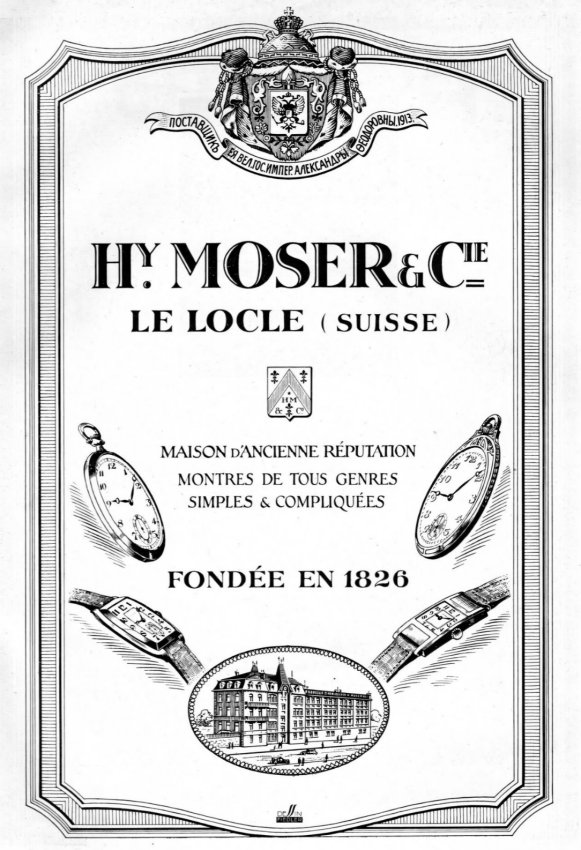
Heinrich (Henry or Henri) Moser, originally from Schaffhausen, went to Le Locle in 1824 to perfect his training as a watchmaker [1]. In 1826, he set up a workshop in the town to produce watches for the Russian market. This date is considered to be the founding date of the company that would become Henry Moser & Cie.

An extraordinary character, Heinrich Moser conquered the Russian market and established trading posts in Saint Petersburg, Moscow, Nizhny Novgorod, and Kiev. His watches were renowned throughout Russia.

In 1848, he returned to Schaffhausen, where he set up a watch case factory around 1854 [2]. In 1865, he had a dam built on the Rhine to harness its power and supply the city's factories. It was this source of energy that enabled the American Florentine Jones to found the International Watch Co. in Schaffhausen in 1868 [3].

Moser dam 1870

Credit http://www.schaffhausen-foto-archiv.ch/

Heinrich Moser died in 1874. His widow Fanny, née Sulzer-Wart, became the owner of the various factories. According to some sources [1], she sold the factories to their respective directors, but as far as the Le Locle branch, Henri Moser & Cie, was concerned, she was still the owner in 1883, even though she was living in Germany [4]. However, management of the factory was entrusted to Louis Ferdinand Dubois, who was replaced in 1885 by Adolphe Winterhalter.

In 1889, Henri Moser & Cie was transferred to St. Petersburg under the name H. Moser et Cie, and the Le Locle factory became a branch [5]. In 1897, H. Moser et Cie in St. Petersburg became the property of Ottilie Winterhalter, Adolphe's widow, and her two sons, Jean and Cornelius, the latter residing in Le Locle [6].

2. The Winterhalter family

Most pocket watches, and even the first wristwatches designed by Hy Moser that have survived to this day, actually date back to the Winterhalter period. The early 20th century was a troubled period in Russia, with numerous obstacles to the importation of watches [1]. This probably explains the intervention of a financier in the capital of the St. Petersburg company in 1913: Dr. Henri Richard [7].

The Russian Revolution of 1917 proved fatal for the St. Petersburg company, which was nationalized. In 1918, the Le Locle branch became an independent company under the name H. Moser & Cie SA [8], with Cornelius Winterhalter and Henri Richard on the board of directors.

1920

The exhibition at the Swiss Watch Fair in Geneva in 1920 gives an idea of Moser's production at that time. These were mainly superb jewelry watches and ultra-thin watches, intended for a wealthy clientele. However, there may be a bias due to the fact that the Geneva fair focused on this type of watch, compared to the Basel Fair, which was more generalist.

1927

During the crisis years of the late 1920s, the factory was in difficulty. Several industrialists were called to join the board of directors. In 1934, it was finally the Pfister family who took over the management of H. Moser & Cie [9].

3. The Pfister family

Henri and Paul Pfister took over the management of the company in 1934. They were already working with Moser in their own factory, La Terrasse Watch Co. [1].

Alfred Pfister joined Henri and Paul in 1942, and it was from this date that H. Moser & Cie gained new momentum.

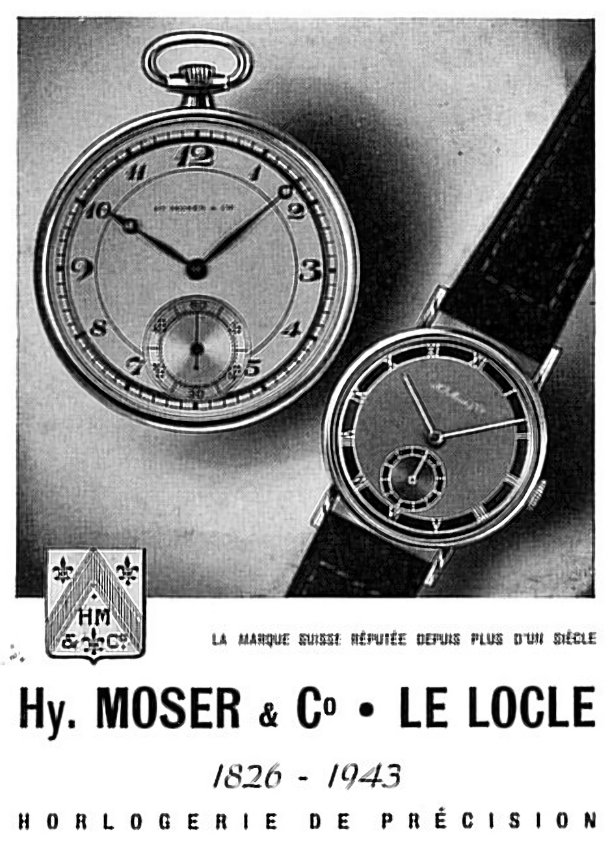
A range of simple and elegant watches was launched, and the factory benefited from the economic boom that followed World War II.

1943

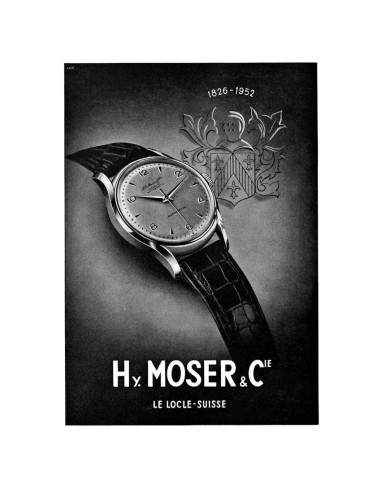
1952

1955

In 1952, Alfred and Paul Pfister passed away and were replaced by Jean-Eric and Frédéric-Emile Pfister [10].

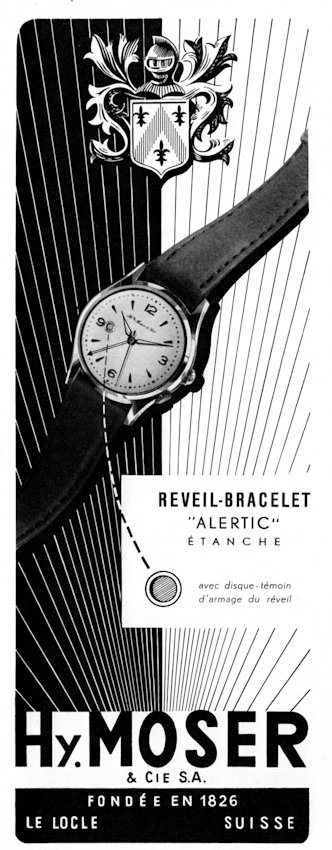
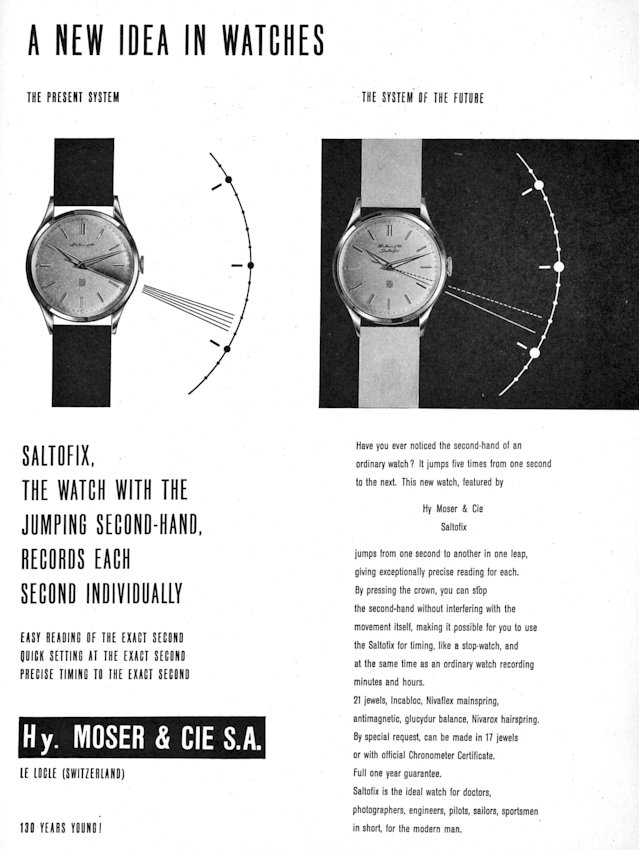
New models followed, including chronometer watches and alarm watches in 1955, but most notably, in the same year, an iconic Moser model: the Saltofix.

This model was described as follows:

"While the second hand of a standard watch moves in five small jumps from one minute marker to the next, the large second hand of Hy Moser & Cie Saltofix chronometers and watches "beats" every second, giving them a very special precision and exceptional clarity of reading.

Pulling out the crown stops the movement, allowing the time to be set quickly and accurately "to the second."

By pressing the crown, it is possible to stop the large second hand without blocking the movement, allowing a Saltofix watch to be used for timekeeping, like a chronograph without pushers, while still keeping the time with the hour and minute hands."

1955

1956

1957

This watch existed in several versions, including one in which the hour hand was replaced by a disc with a sun and moon to represent daytime and nighttime hours.

The movement came from Chézard, one of the movement manufacturers belonging to Ébauches SA. Several other manufacturers used it, including Doxa, Lanco, and Zila [11].

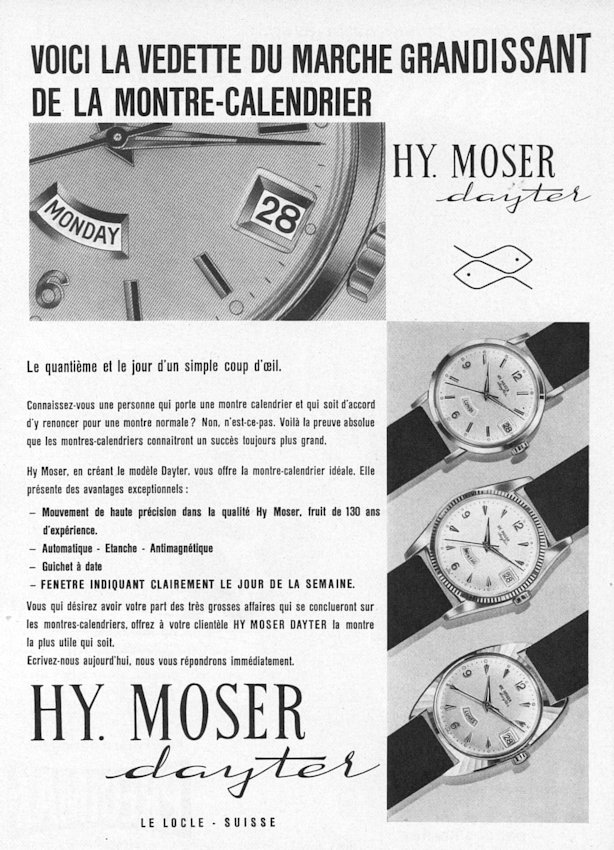
In 1960, Moser launched its dayter model, a watch with a day and date calendar, which was very popular at the time.

1960

1966

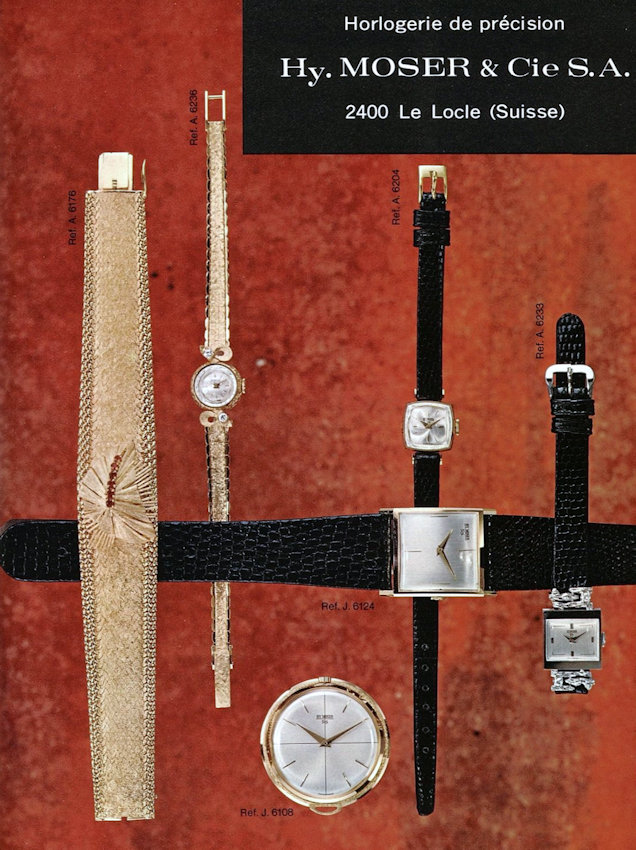
In the 1960s, Moser turned its attention to jewelry watches made from precious metals. This sector, which was highly competitive and difficult to break into without the prestige of the city of Geneva behind it, proved unsuccessful for the company, which found itself in difficulty in the early 1970s. It was Paul Castella, the dynamic boss of Dixi, who came to its rescue.

4. Paul Castella and Zénith

Paul Castella took over H. Moser & Cie and Terrasse Watch Co. in 1974. He already owned Paul Buhré and Robert Cart. He then took over Jean Perret in 1976, Luxor in 1977, and most notably Zenith in 1978 [12].

The Moser brand was put on hold. In 1987, all of Dixi's watchmaking companies merged under the name Zenith International [13]. The Moser brand disappeared.

5. Moser in the 21st century

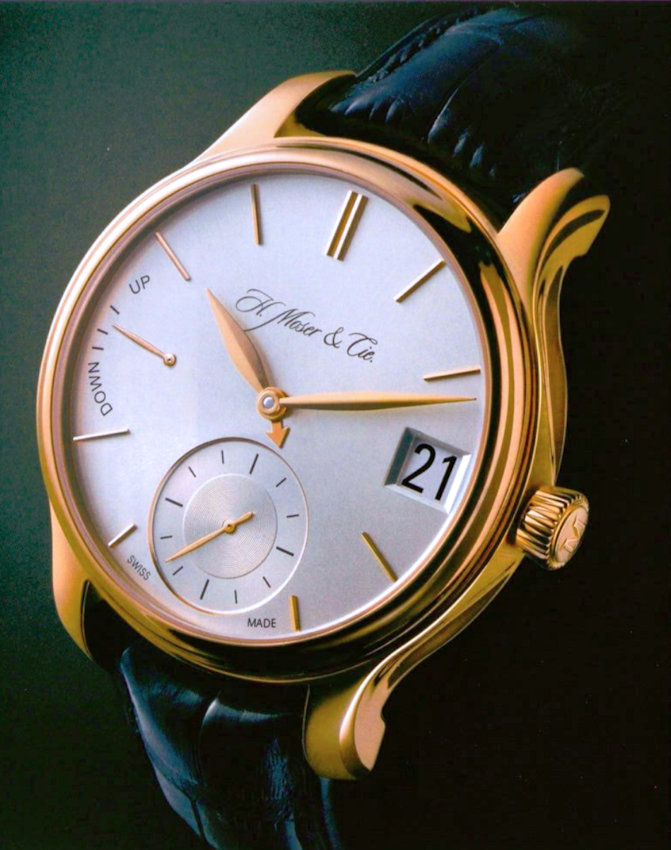
In 2005, the H. Moser & Cie brand was relaunched in Schaffhausen by Jürgen Lange and Roger Balsiger to produce watches that are exceptional in terms of their design and technical qualities.

2007

Finally, in 2013, the manufacturer was taken over by Georges-Henri Meylan's MELB Holding, which still owns it today.

Current website of H. Moser & Cie: https://h-moser.com/


[1] Chronométrophilia, 2010, 67, pp. 91-107

[2] Journal Suisse d’Horlogerie, 1879, 10, pp. 169-171

[3] La Fédération Horlogère, 1942, 25, p. 259

[4] FOSC 1883

[5] FOSC 1889

|6] FOSC 1897

|7] FOSC 1913

[8] FOSC 1918

[9] FOSC 1934

[10] FOSC 1952

[11] Joël Pynson, La montre-bracelet Suisse, 2024, éditions Time To Tell, pp. 244-245

[12] Joël Pynson, La montre-bracelet Suisse, 2024, éditions Time To Tell, pp. 374-375

The FOSC (Swiss Official Gazette of Commerce) is available at E-periodica

Notes:

About Time To Tell: Time To Tell has one of the largest private digitized databases on the history of Swiss watchmaking, with over 2.5 TB of data on more than 1,000 Swiss watch manufacturers. This database has been built up over a period of around 30 years and continues to be updated with around 50 to 100 GB of data each year. The database consists of historical documents, mainly Swiss trade journals, dating from the late 19th century to the late 20th century. Most of these documents are not available on the Internet. The historical articles published on the time2tell.com website always cite the sources used.

Time To Tell is a private company, independent of any watch manufacturer.

©Time To Tell, 2026

Reproduction without permission is prohibited.

Any use of this article by artificial intelligence is strictly prohibited and will be considered a violation of copyright.

Product Details

Product added to wishlist

Nous utilisons des cookies afin de fournir une expérience utilisateur conviviale. En naviguant sur ce site, vous acceptez la politique d'utilisation des cookies.