The True Story of Choisi Watches

The True Story of Choisi Watches

Choisi

Founded in Geneva in 1929, Choisi has had an eventful history and has moved several times. The company has weathered several crises and still exists today.

Description

Joël Pynson

October 2025

1. From Geneva to Locarno

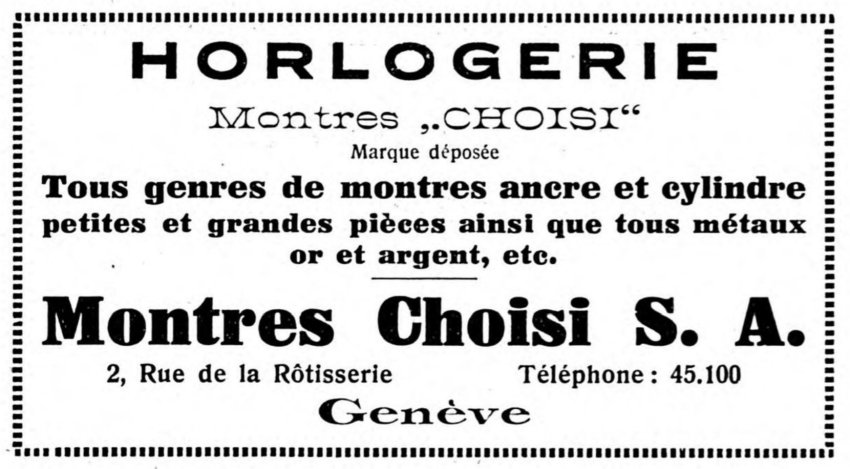
Constant Darbre founded Montres Choisi SA in Geneva in 1929 [1]. It is a general manufacturer that produces all kinds of watches for men and women.

1930

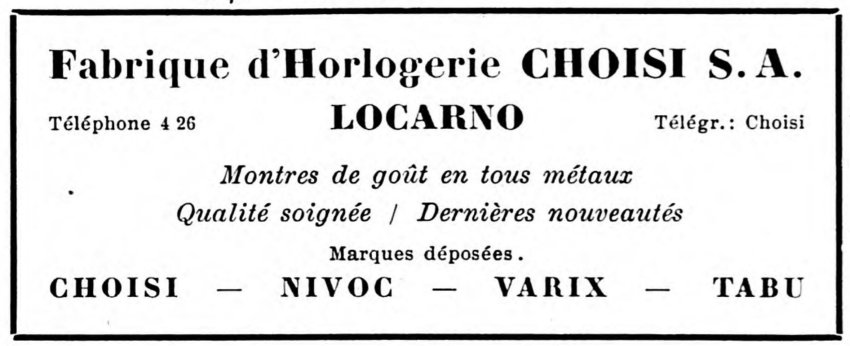
In 1941, the company was taken over by Giorgio Varini, who moved it to Locarno. The following year, Montres Choisi absorbed the Nivoc SA factory, which Giorgio Varini had founded in 1940.

1944

2. From Locarno to Biel

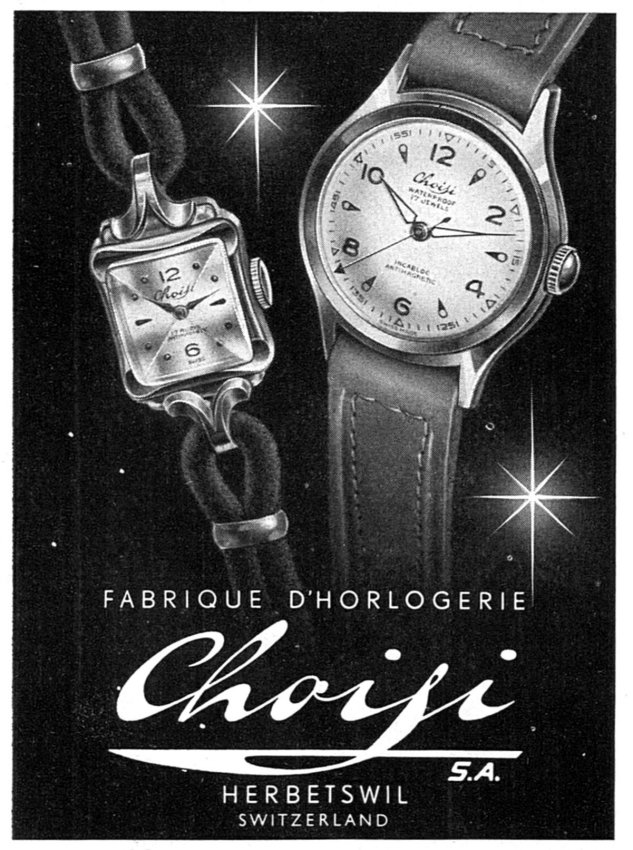
In 1950, the company was taken over by the Fluri family and moved to Herbetswil in the canton of Solothurn [4].

1951

In 1956, Peter Kunzli joined the company's board of directors [5]. He would play a key role in the factory's success.

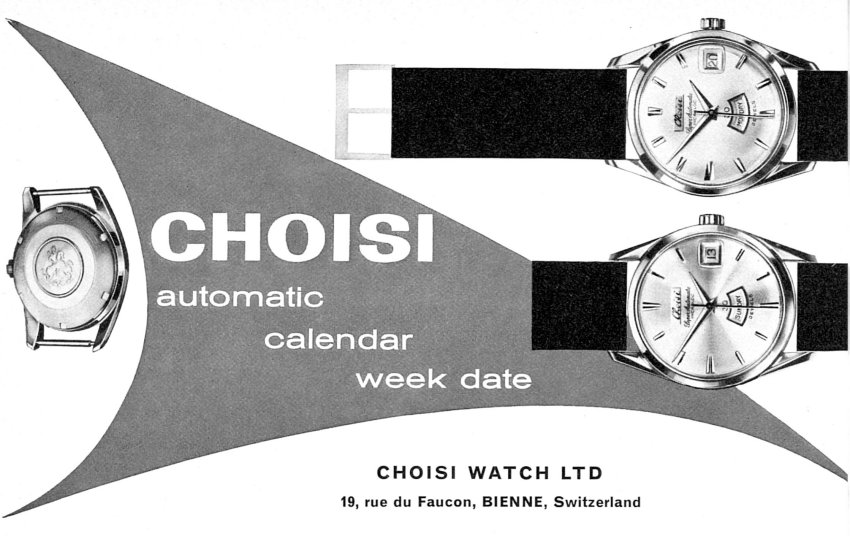
The watches were very classic in style and the calibers came from Ébauches SA.

1956

1957

In 1958, Choisi moved to Biel and Peter Kunzli became managing director [6].

Watch production continued, with the company engaging in a curious race for rubies that could be observed among several manufacturers in the early 1960s.

Jewels, more jewels [7]!

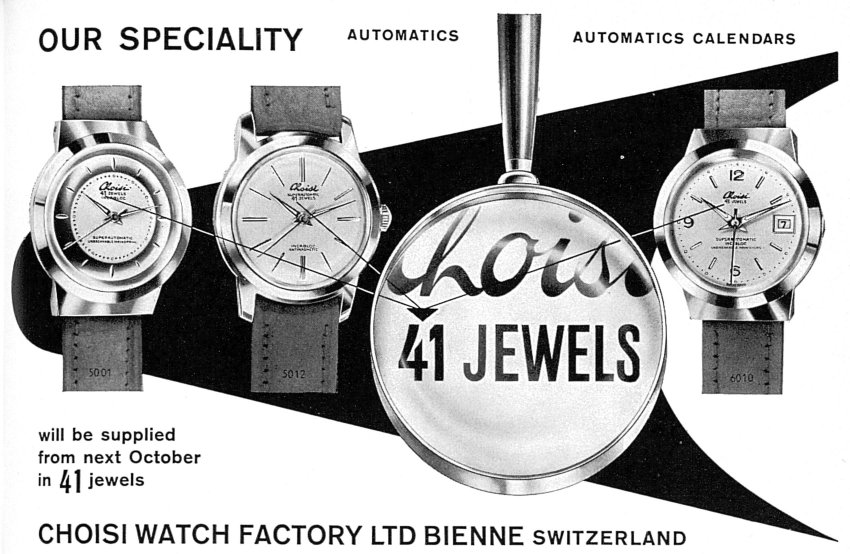
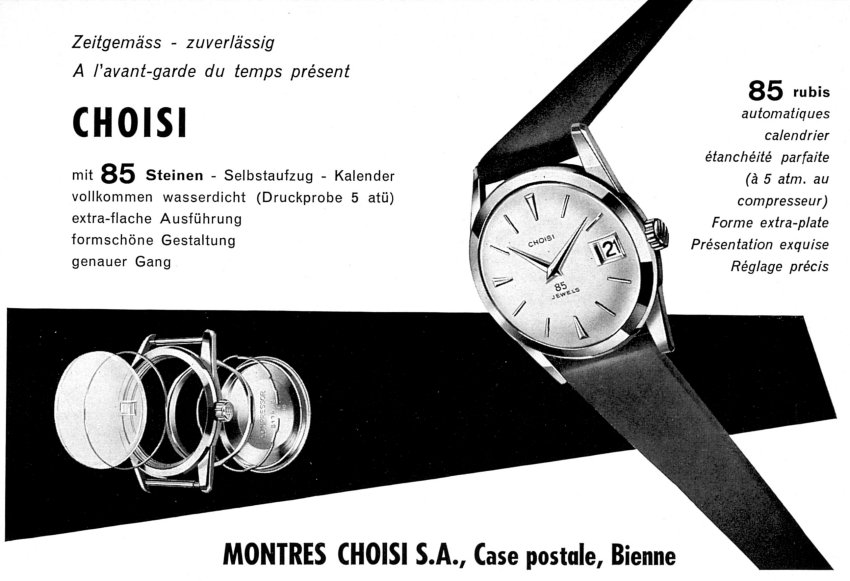
Starting in 1958, Choisi, along with other Swiss watch manufacturers, engaged in a curious competition to see who could fit the most jewelsinto their movements. As a result, some models from 1960 featured 41 jewels on the dial, while others had no fewer than 85!

1958

1960

1960

By replacing the steel balls in automatic movements with rubies, it is possible to increase their number without improving the quality of the movement.

Manufacturers who used the modified A.Schild automatic calibers displayed 41 on their dials: this was the case, for example, for Camy, Candino, Damas, Invicta, Tradition, Wega, Rotary, Precimax, and Dogma. A modification of the ETA automatic calibers (2450 or 2375) made it possible to advertise 57, 60, or 77 jewels. And with the FHF 65 caliber, with its peripheral rotor mounted on ball bearings, it was possible to replace the steel balls with ruby balls and increase the total to 51, 60, or even more.

These impressive figures were claimed for the Selza Datamatic, Octo Missilemaster, and Camy Sputnik models, as well as by Royce and Candino. Finally, the height of extravagance was reached by Cauny, which in 1962 offered models with a choice of 57, 81, or 110 jewels!

This exaggeration was enough to leave potential buyers rather perplexed. This is what the London court sought to punish in 1962 by condemning the practice of "up-jewelling" as contrary to the Merchandise Marks Act, or in short: false advertising. In any case, the English decision had the effect of putting a stop to ostentatious advertising of the number of rubies, even though the production of certain movements of this type continued until the end of the 1960s.

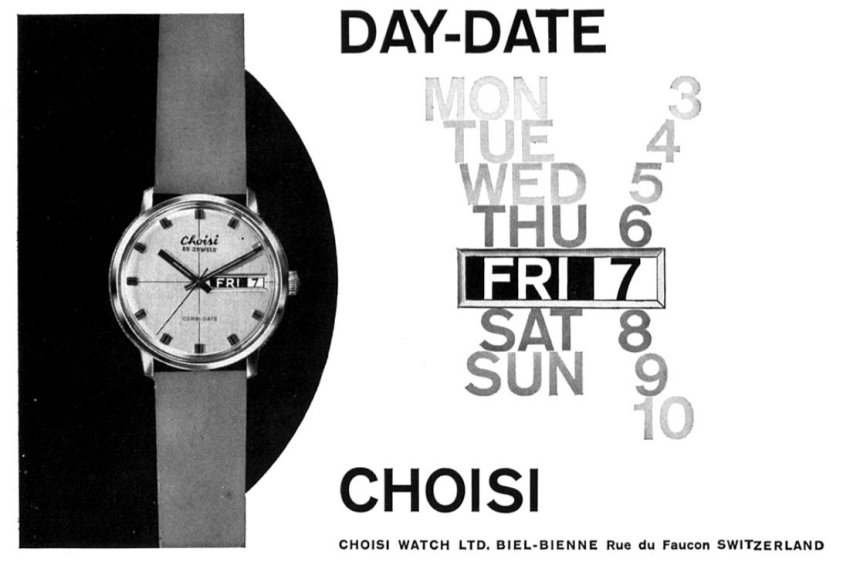
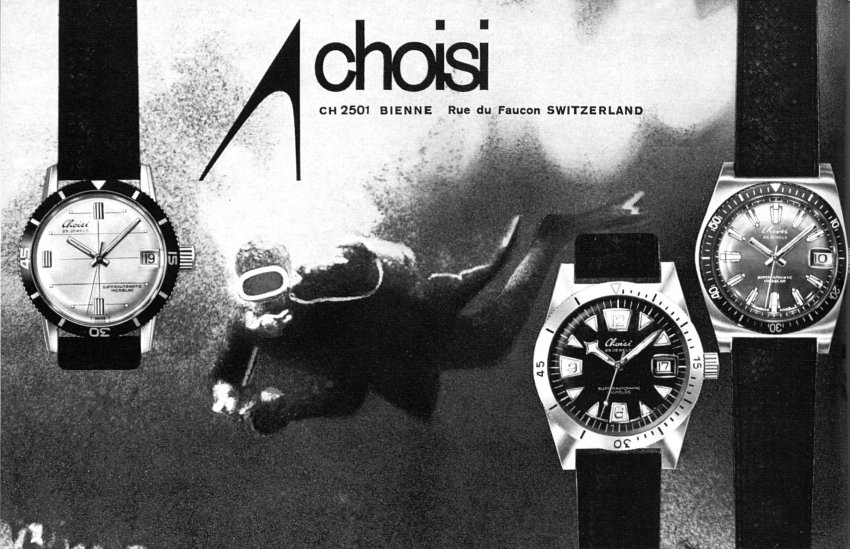
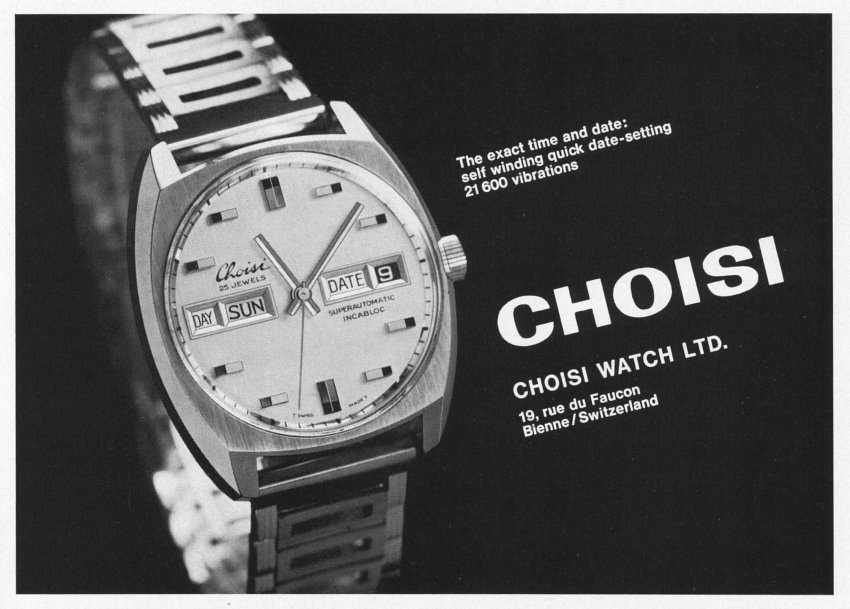
The 1960s were prosperous years for Choisi, with the launch of automatic watches with day and date displays and the first diving watches.

1963

1967

1968

1971

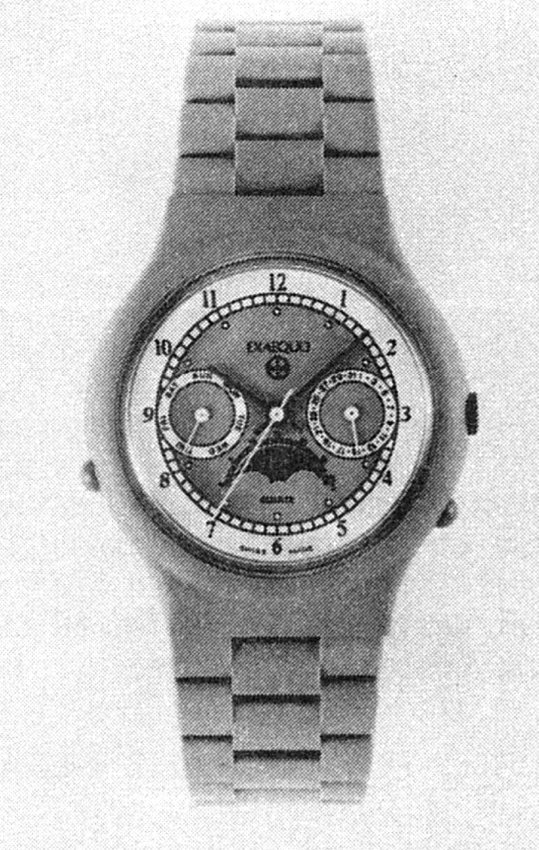
With the arrival of quartz watches in the 1970s, Choisi became less prominent but survived, probably thanks to the production of watches on a subcontract basis, as was the case for watches made by the Geneva-based company Exaequo in 1988 [8].

Exaequo plastic quartz watch manufactured by Choisi, 1988

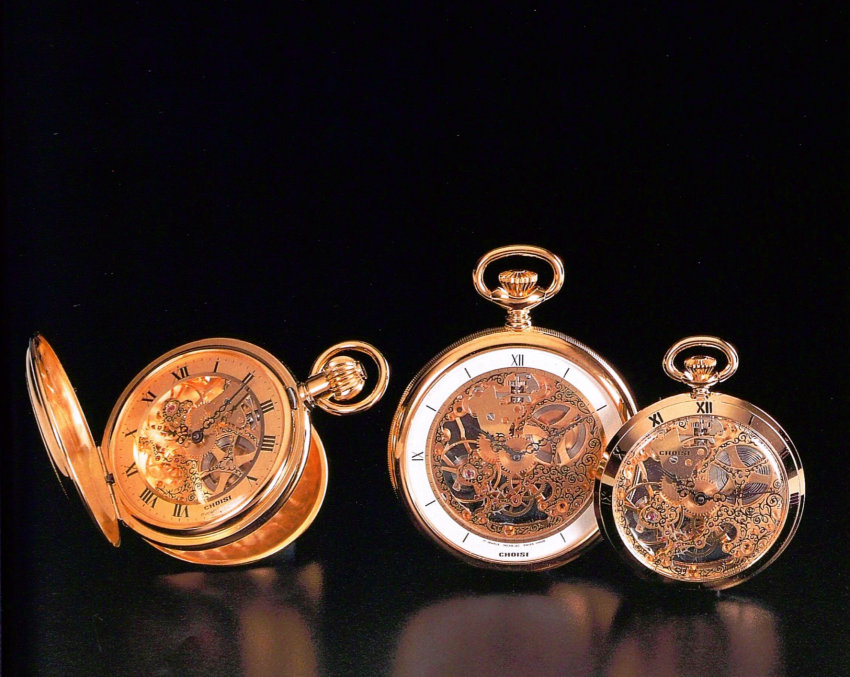
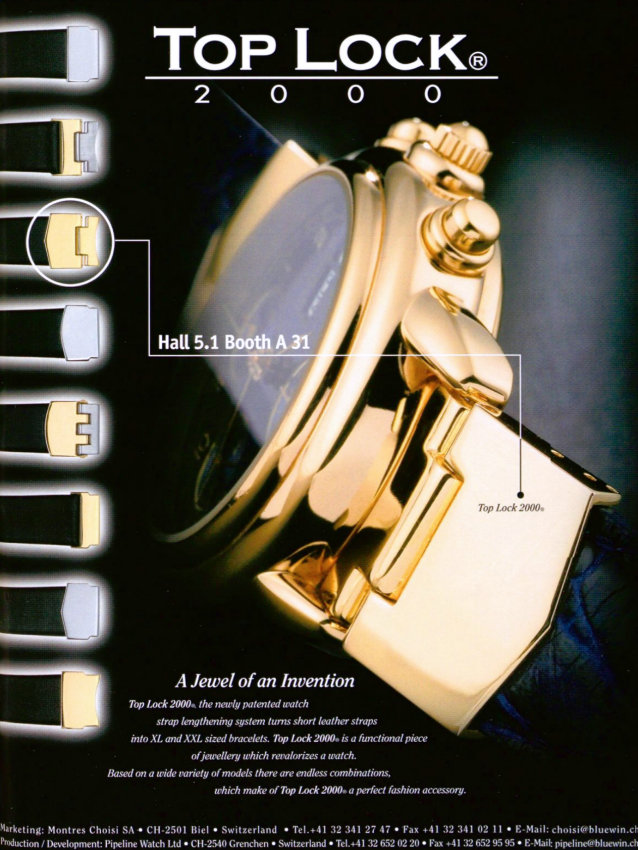
The company is also diversifying into the production of pocket watches and the distribution of Top Lock bracelets from Pipeline Uhren in Granges [9].

1990

2000

3. End and restart

In 2005, Peter Kunzli transferred his company to Jean-Pierre Duss, who integrated Choisi into the Synapse company in Biel [10].

However, Jean-Pierre Duss died in 2009 and Choisi went bankrupt in 2013 [11].

Since then, the Choisi brand has been taken over by a Singaporean entrepreneur who has relaunched the production of vintage-inspired mechanical watches in Neuchâtel, Switzerland:

http://www.choisiwatch.com/index.php?

https://choisidivewatch.com/


[1] FOSC 1929

[2] FOSC 1941

[3] FOSC 1942. Nivoc SA was originally called Nivac SA.

[4] FOSC 1950

|5] FOSC 1956

|6] FOSC 1958

[7] For more information on this subject, see our book La montre-bracelet Suisse, p. 274-275

[8] La Fédération Horlogère, 1988, 1, p. 31

[9] La Fédération Horlogère, 2000, 6, p. 63

[10] La Fédération Horlogère, 2007, 4, p. 9

[11] FOSC 2013

The FOSC (Swiss Official Gazette of Commerce) is available at E-periodica

Notes:

About Time To Tell: Time To Tell has one of the largest private digitized databases on the history of Swiss watchmaking, with over 2.5 TB of data on more than 1,000 Swiss watch manufacturers. This database has been built up over a period of around 30 years and continues to be updated with around 50 to 100 GB of data each year. The database consists of historical documents, mainly Swiss trade journals, dating from the late 19th century to the late 20th century. Most of these documents are not available on the Internet. The historical articles published on the time2tell.com website always cite the sources used.

Time To Tell is a private company, independent of any watch manufacturer.

©Time To Tell, 2026

Reproduction without permission is prohibited.

Any use of this article by artificial intelligence is strictly prohibited and will be considered a violation of copyright.

Product Details

Product added to wishlist

Nous utilisons des cookies afin de fournir une expérience utilisateur conviviale. En naviguant sur ce site, vous acceptez la politique d'utilisation des cookies.