The true story of Suter and Hafis watches

The true story of Suter and Hafis watches

Suter

The Suter family from Büren sur Aar is called Fritz from father to son. This doesn't make the historian's job any easier, as he has to be careful not to attribute to the father what belongs to the son. And vice versa.

Description

Joel Pynson

December 2024

1. The first two Suter generations

Büren was home to F. Suter & Cie, founded by Fritz Suter in 1873 [1]. Curiously, one of the company's trademarks was... Mont-Blanc!

In 1893, Fritz Suter Sr. joined forces with his son Fritz Suter [2], and the company expanded, in particular by marketing watches on the English market.

A major English manufacturer, probably already a customer of F. Suter & Co., was looking to manufacture its watches in Switzerland. The manufacturer was H. Williamson Ltd., the man behind the famous Buren Watch.

And in 1899, Williamson bought F. Suter & Cie. and placed Firtz Suter fils at the head of the branch [3].

Fritz Suter Jr. proved to be a remarkable technician and organizer: he turned the Williamson branch in Büren into one of the most modern watchmaking factories in Switzerland.

The Suter story could have ended there, but in 1914, Fritz Suter left the Williamson company and decided to launch his own watch factory.

To do so, he enlisted the help of his own son, appropriately named Fritz.

2. Third-generation Suter and the creation of Hafis watches

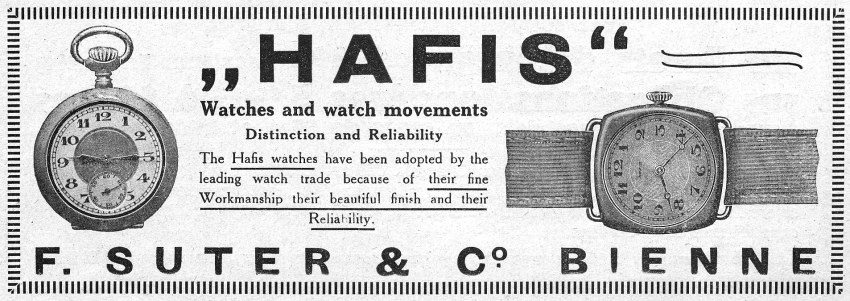
In 1916, the Suter sons and fathers joined forces to create the company F. Suter & Cie, Manufacture d'horlogerie Hafis, not in Büren but in Bienne [4].

1921

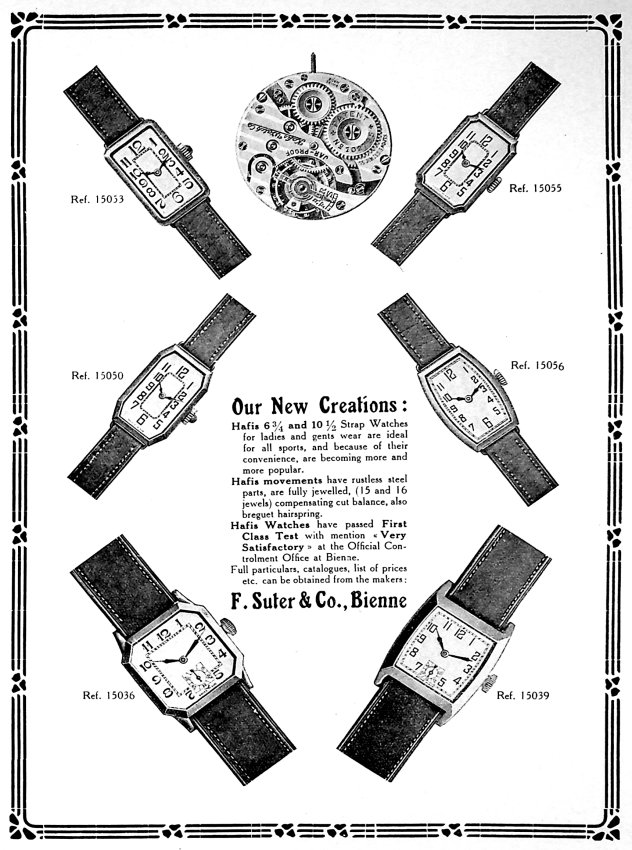
Hafis is a Manufacture, which manufactures its own movements and specializes in "small anchor timepieces", i.e. ladies' watches.

In 1921, for example, Hafis launched a remarkable square caliber measuring just 12 mm square, so small that it could be mounted in a ring.

1923

In 1922 the company became Manufacture de Montres Hafis [5] with a new shareholder, Roland Gsell, who organized the sale of Hafis watches in the USA [6].

In 1924, Fritz Suter senior retired from the company, and was replaced by his son-in-law Hans Liechti [7].

1929

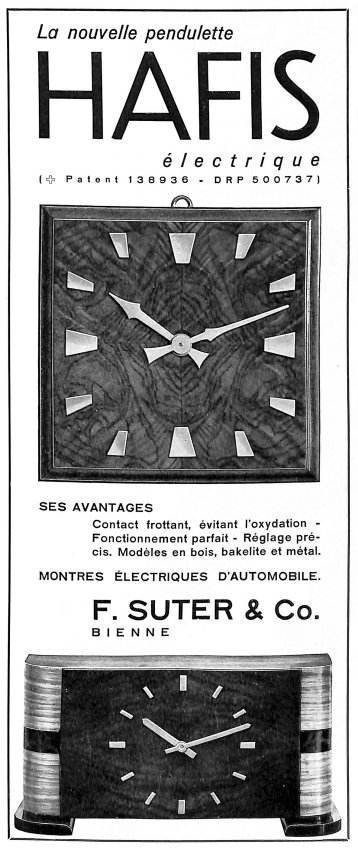
The early 1930s were difficult years for the Swiss watchmaking industry, and Suter decided to diversify into the production of electric clocks, still under the Hafis name [8].

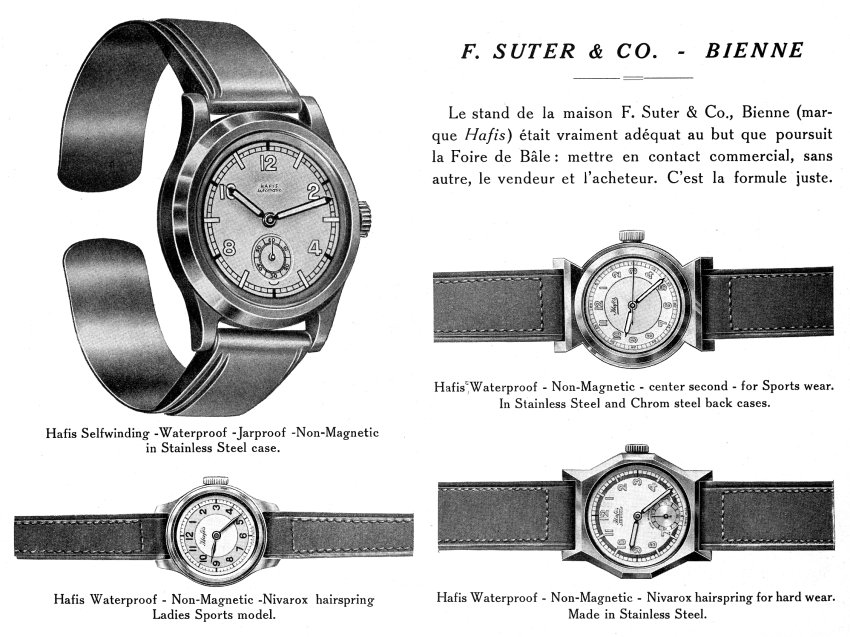
From 1935 onwards, business picked up again, and Hafis began offering watches that were increasingly in demand: waterproof and shock-resistant. In 1939, Hafis was one of the first companies to launch automatic watches, thanks to the EMSA system produced by Glycine [9].

1939

In the 1940s, Hafis specialized in water-resistant automatic watches.

1945

In the early 1950s, the Suter brand appeared on dials, and in 1951 Suter presented its first watch with a model name: the Suter Diamatic. Its name is linked to the use of an automatic caliber with a 360° rotating rotor that winds the movement in both directions. It is a version of the famous Felsa Permutator caliber, itself derived from the Felsa Bydinator. These are Ébauches SA calibers, so Suter was no longer a manufacturer at that time.

1951

Fritz Suter Sr. died in 1952, and the following year the company became Fabrique d'Horlogerie Suter SA: the name Hafis was dropped, and a new family member joined the company: Alfred Fritz Suter [10].

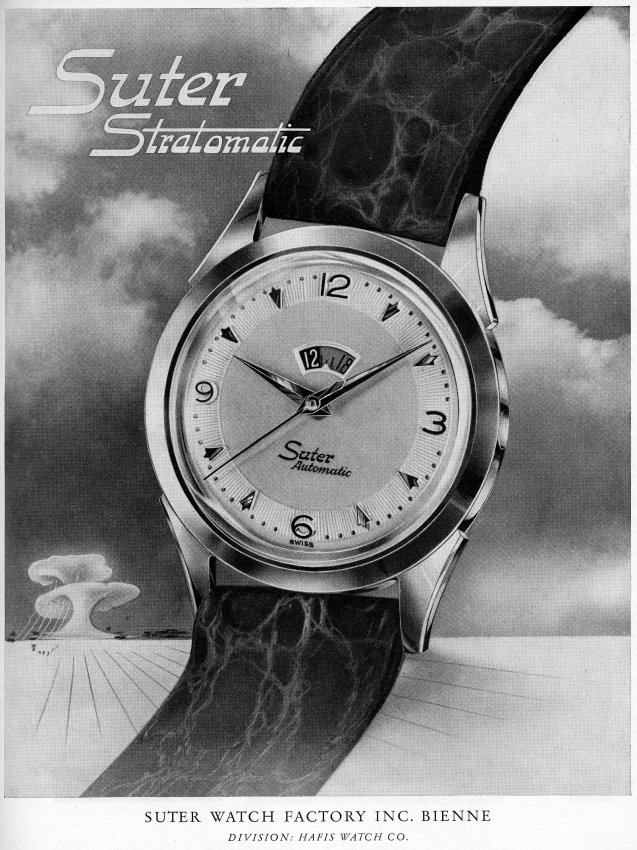
Specialization in automatic watches was reinforced with the launch of new models: Stratomatic and Cosmopolitan in 1956, Futurama in 1960, and Aquamaster in 1963.

Fritz Suter Jr. died in 1964. Even though the company produced electronic clocks, and a few electronic watches in 1974, it was unable to withstand the "quartz crisis" and was in serious difficulty in 1977.

Today, Montres Hafis SA still exists in Biel.

3. Main models of Hafis-Suter automatic watches

It is above all the automatic watch ranges that have made Suter famous.

- Suter Duamatic

1951

Introduced in 1951, Suter Duamatic watches have a specific logo on the dial. They were available with different case shapes, some in gold. The version with date, launched in 1952, was called Datomatic. The 1956 Cosmopolitan version features an improved automatic caliber.

- Suter Stratomatic

It's a version with a power reserve and a drowned crown, i.e. invisible because it's integrated into the case middle.

The caliber used was the Felsa 699.

- Suter Futurama 

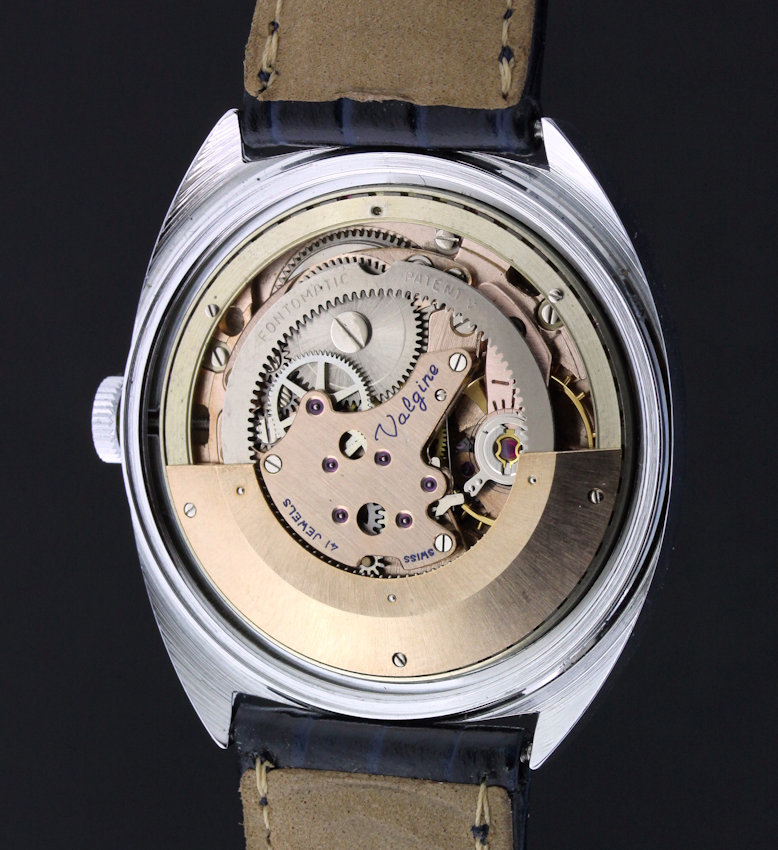
Fontomatic automatic movement, sho wn here on a Valgine watch

This watch, introduced in 1960, has a more modern design and, above all, is equipped with the remarkable Fontainemelon 65 Fontomatic caliber. The special feature of this caliber is a rotating mass at the periphery of the movement, which moves on ball-bearing rails. This caliber is quite rare and has only been used by a small number of Swiss manufacturers.

- Suter Aquamaster

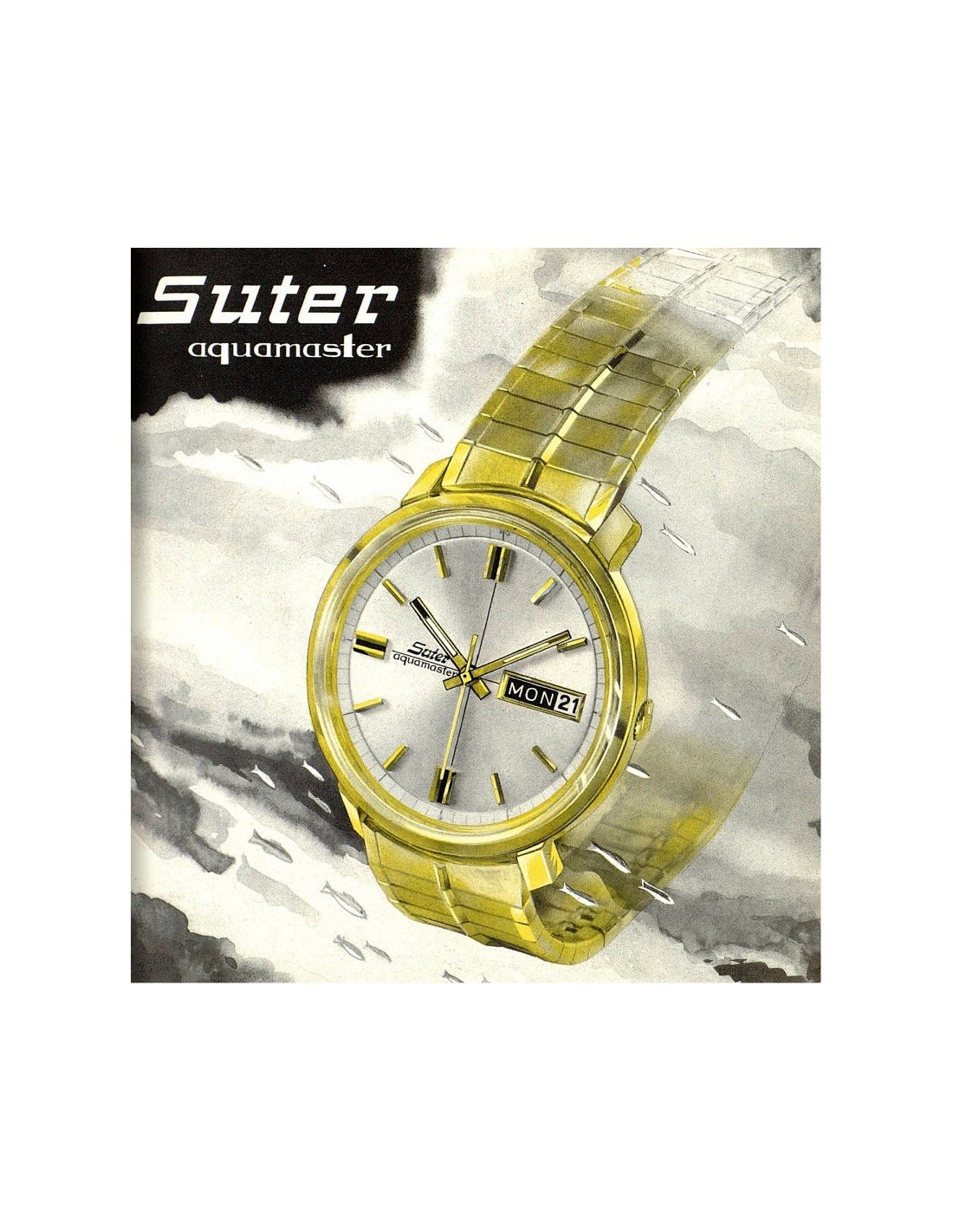
This has been Suter's most successful model, with the most variants.

The first version, launched in 1963, had a reduced bezel giving the appearance of a large dial. This type of design had been pioneered by Mido in 1959 with the Ocean Star model.

The watch claimed a "pressurized" case, perhaps a Glycine vacuum-type system.

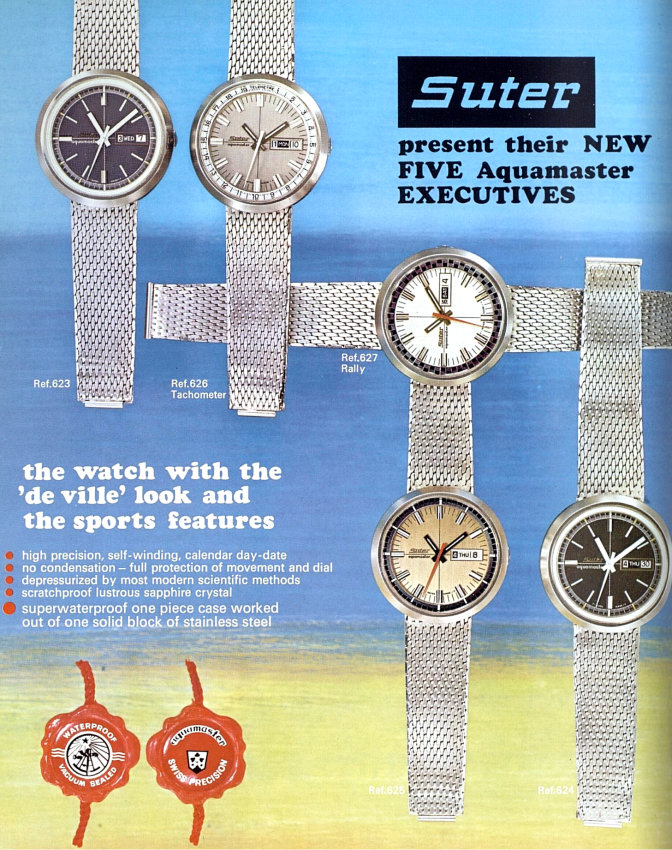
In 1964, the Executive version was equipped with a day and date display.

In 1966, the design was modified and, thanks to a new automatic caliber, the watch was only 4 mm thick.

A square-camber version of the Aquamaster was chosen as the official watch of the 1967Montreal World's Fair. After the exhibition, this version was renamed Cosmos.

Suter Aquamaster. Top: model from the 1967 Montreal show, right: 1966 model. 

1969 saw the launch of the Commander version, featuring a distinctive two-tone dial with day and date on either side.

In 1970, five new models of the Executive version were launched, and five dial versions of the Commander model.

- Suter Flash Light Timer (FLT)

These curious models, with their futuristic design, were fitted with a pusher to illuminate the dial. Launched in 1974, their career was short-lived.


[1] FOSC 1883

[2] FOSC 1893

[3] FOSC 1899

[4] FOSC 1916

[5] FOSC 1922

[6] Kathleen Pritchard, Swiss Timepiece makers, Phoenix Publishing, 1997, II, S. 108-110

[7] FOSC 1924

[8] Revue Internationale d'Horlogerie, 1933, 1, pp. 3-4

[9] Revue Internationale d'Horlogerie, 1939, 10, p. 147

[10] FOSC 1953

The archives of Fédération Horlogère, Davoine and l'Impartial are available online at www.doc.rero.ch

The archives of Journal Suisse d'Horlogerie, Europa Star, Revue Internationale d'Horlogerie and Suisse Horlogère are available at The Watch Library

The FOSC (Feuille Officielle Suisse du Commerce) is available on E-periodica

Notes :

About Time To Tell: Time To Tell has one of the largest private digitized databases on the history of Swiss watchmaking, with over 2.3 TB of data on more than 1,000 Swiss watch manufacturers. This database has been built up over a period of some thirty years, and continues to be fed with around 50 to 100 GB of data every year. The database is made up of old documents, mainly Swiss trade journals, dating from the late 19th to the late 20th century. Most of these documents are not available on the Internet. Historical articles published on the time2tell.com website always cite the sources used.

Time To Tell is a private company, independent of any watch manufacturer.

©Time To Tell, 2025 

Reproduction forbidden without authorization.

Any use of this article by artificial intelligence is strictly forbidden and will be considered an infringement of copyright. 
Product Details

Product added to wishlist

Nous utilisons des cookies afin de fournir une expérience utilisateur conviviale. En naviguant sur ce site, vous acceptez la politique d'utilisation des cookies.