The true history of Phenix watches

The true history of Phenix watches

Phenix

After watchmakers, the Porrentruy factory, which enjoyed its heyday in the 1950s, has seen a succession of bankers.

Description

Joël Pynson

April 2025

1. From the Société d'Horlogerie to the Société Horlogère

Porrentruy's Phenix Watch Co. had a turbulent early history.

In 1878, Jules, Adolphe and Louis Dubail joined forces with Jean-Baptiste Monnin, Joseph Frossard and Emile Roussel-Gall to create the Dubail, Monnin, Frossard & Cie watchmaking factory in Porrentruy [1].

The company's watches were highly appreciated, winning numerous medals at the World's Fairs: London 1884, Antwerp 1885, Paris 1889, etc.

1899

Sales offices are opened in France, Germany and Denmark.

The Phenix trademark is registered in 1888.

In 1889, Joseph Dubail joined the company [2].

10 years later, in 1899, the situation became a little chaotic. Dubail, Monnin, Frossard & Cie became Société d'Horlogerie de Porrentruy, but the shareholders were mainly administrative: bankers, notaries and industrialists. Of the original team, only Jean-Baptiste Monnin remained [3]. This is probably a sign of the company's delicate financial situation. But Jean-Baptiste Monnin left the company in 1902, and in 1904, together with Léon and Jules Rebetez, set up the watchmaking firm Monnin, Rebetez & Cie [4] in Porrentruy.

1905

Then, in 1902, the Société Horlogère de Porrentruy was created, which also included bankers, notaries and merchants [5].

Finally, the following year, the Société d'Horlogerie de Porrentruy was dissolved and its assets put up for auction. However, the Société Horlogère de Porrentruy took over the brands [6], and moved into the same buildings.

2. Phenix Watch Co.

A succession of directors took over, and the company's name was changed to Phenix Watch Co. in 1918, which did little to improve the situation.

1921

1931

However, the company survived the crisis years of 1920-1930, and the situation improved significantly in the late 1930s, probably due to the arrival of Henri Knecht, a talented watchmaker who reorganized production [7].

In addition, Phenix took over the brands of Monnin & Cie, which was about to close down.

This change was also reflected in the inventive activity of the company, which filed patents on water-resistant watch cases and balance bearings in 1939, on shock-absorbing devices in 1943, and so on. [8]

1941

1942

Around 1940, Phenix developed its own automatic winding system with oscillating weight. Mounted in a water-resistant case patented by the company, these water-resistant automatic watches were among the first to be made in Switzerland.

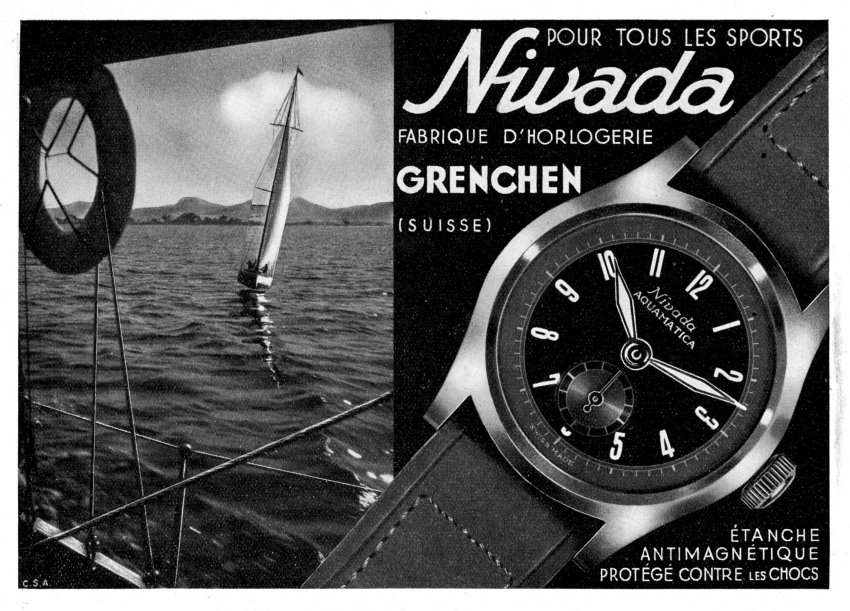
In 1942, Phenix received the backing of the Schneider family, shareholders in the Nivada factory in Grenchen [9]. It's possible that this tie-up was linked to Phenix's expertise in water-resistant watches, since Nivada was launching this type of watch at around the same time, and the water-resistant watch cases of the two factories were very similar.

1943

1940

By the end of the Second World War, Phenix was a medium-sized factory, occupying beautiful buildings of over 6,000 m2 and producing around 120,000 watches a year [10].

1946

1950

In 1953, Phenix launched an innovative new automatic caliber: the Rollamatic. This is an automatic movement whose rotor pivots in a roller bearing. The diameter is 26.0 mm and the thickness 6.35 mm.

1953

1956

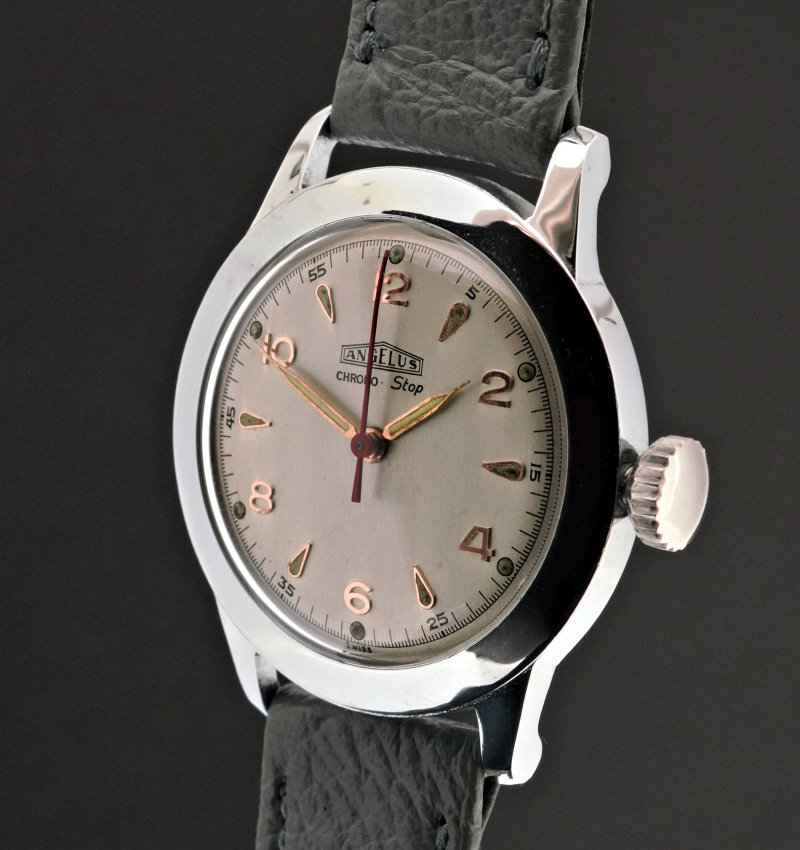
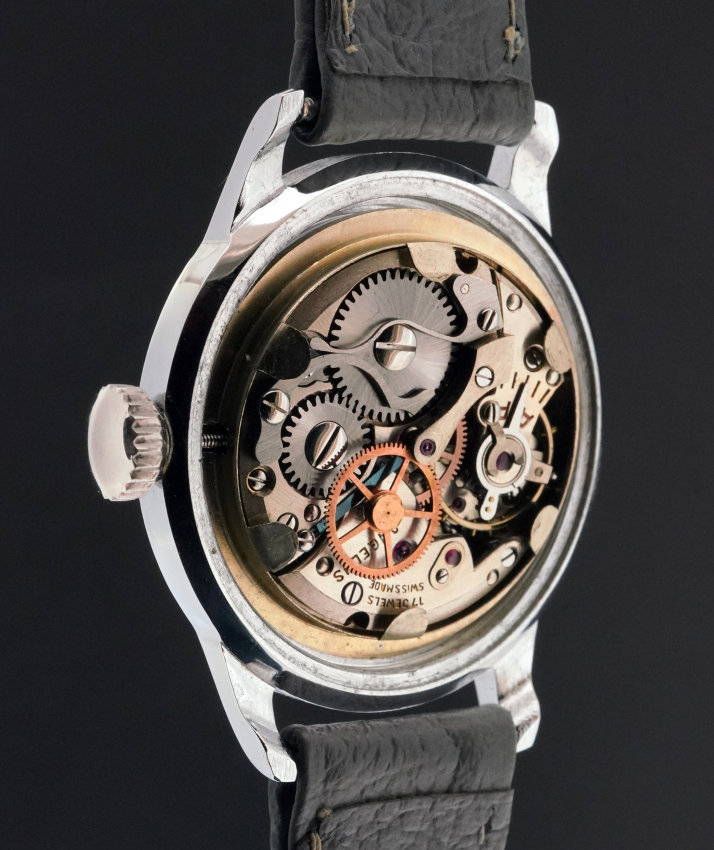
In 1956, Phenix launched a remarkable chronograph watch, the Chronostop. There are no pushers or counters, yet the chronograph functions are present. Phenix has created its own movement, calibre 132 with 10.5 lines, which achieves the tour de force of having complete chronographic functions without a column wheel: pulling the crown to the first stop stops the seconds hand, at the second stop the hand returns to zero, and pushing the crown back to its initial position restarts the seconds hand.

1956

1958

Phenix calibre 132. Noter le système antichoc spécifique

This original calibre was used by other manufacturers such as Richard and Angélus.

3. Les Manufactures d’Horlogerie Suisses Réunies (MSR)

With the end of the statut horloger, which had protected the Swiss watchmaking industry since the 1930s, Swiss manufacturers faced stiff competition from abroad in the early 1960s. This marked the beginning of company mergers, encouraged by the Fédération Horlogère and ASUAG, with the aim of pooling resources and skills. Four companies joined forces to become more competitive: Revue Thommen, Vulcain, Phénix and Buser Frères. In 1961, this led to the creation of Manufactures d'Horlogerie Suisses Réunies, or MSR [11].

1962

MSR is a substantial group: with its 760 employees, it has a production capacity of over 600,000 watches/year [12]. Revue Thommen is the largest company in the group, but to avoid having too much decision-making power, it holds only 48% of the holding company.

All blanks are now manufactured at Revue Thommen, but each factory has its own strategy and sales department. The administrative side of the business is still located in La Chaux-de-Fonds, and the separation will gradually become clearer: instruments and machines in Waldenburg, watchmaking in La Chaux-de-Fonds.

1967

In 1967, Revue Thommen launched a new automatic caliber, Exactomatic, with 54 hours of power reserve, for all MSR members.

In the same year, Phenix begins production of electronic modules for Ebauches SA [13].

During the difficult years of the "quartz crisis", MSR's business was rationalized. The Buser and Phénix brands were discontinued in 1973, in favor of Revue and Vulcain, but even the Vulcain brand was gradually abandoned.

In 1984, Phenix ceased all activity.


See also: Revue-Thommen

[1] FOSC 1883

[2] FOSC 1889

[3] FOSC 1899

[4] FOSC 1904

[5] FOSC 1902

|6] FOSC 1903

|7] https://www.cliniquehorlogere.ch/fr/archives-diverses/manufacture-montre-phenix.html

[8] For example patents CH 208 781, 208 984 and 236 615

|9] FOSC 1941

[10] Revue Internationale de l'Horlogerie, 1945, 24, pp. 13-15

[11] La Suisse Horlogère, weekly edition, 1961, 37, p. 824

[12] Journal Suisse d'Horlogerie, 1962, 1, p. 63

[13] La Suisse Horlogère, weekly edition, 1974, 1, p. 17


The archives of Fédération Horlogère, Davoine and l'Impartial are available online at www.doc.rero.ch

The archives of Journal Suisse d'Horlogerie, Europa Star, Revue Internationale d'Horlogerie and Suisse Horlogère are available at The Watch Library

The FOSC (Feuille Officielle Suisse du Commerce) is available on E-periodica

Notes :

About Time To Tell: Time To Tell has one of the largest private digitized databases on the history of Swiss watchmaking, with over 2.3 TB of data on more than 1,000 Swiss watch manufacturers. This database has been built up over a period of some thirty years, and continues to be fed with around 50 to 100 GB of data every year. The database is made up of old documents, mainly Swiss trade journals, dating from the late 19th to the late 20th century. Most of these documents are not available on the Internet. Historical articles published on the time2tell.com website always cite the sources used.

Time To Tell is a private company, independent of any watch manufacturer.

Time To Tell, 2025

Reproduction forbidden without authorization.

Any use of this article by artificial intelligence is strictly forbidden and will be considered an infringement of copyright.

Product Details

Product added to wishlist

Nous utilisons des cookies afin de fournir une expérience utilisateur conviviale. En naviguant sur ce site, vous acceptez la politique d'utilisation des cookies.