The true story of Lanco and the Société d'Horlogerie de Langendorf

The true story of Lanco and the Société d'Horlogerie de Langendorf

Lanco

The Société d'Horlogerie de Langendorf, the birthplace of the Lanco brand, was once Switzerland's most important watch manufacturer. It no longer exists, and its eventful history is difficult to reconstruct.

Description

Joël Pynson

October 2022

Update : April 2025

Most of the information available on Wikipedia [1] is unsourced and unabashedly repeated on sites such as FAM [2], chronographes.net [3] and The Watch Forum [4], without it being clear who the original author was.

One sentence in particular is surprising, to say the least: "Absenteeism and alcoholism were so entrenched among the employees that, from 1880 onwards, this firm came close to bankruptcy." This is not an accusation to be made lightly, and would have required at least precise references.

Fabrizio Bottini, who wrote an article on Lanco in the magazine Chronométrophilia [5], does not mention any troubling events in the company's early history.

In fact, a little more detailed research in watchmaking archives will shed light on the history of this remarkable company, which made more than just watches...

1. Creation and expansion

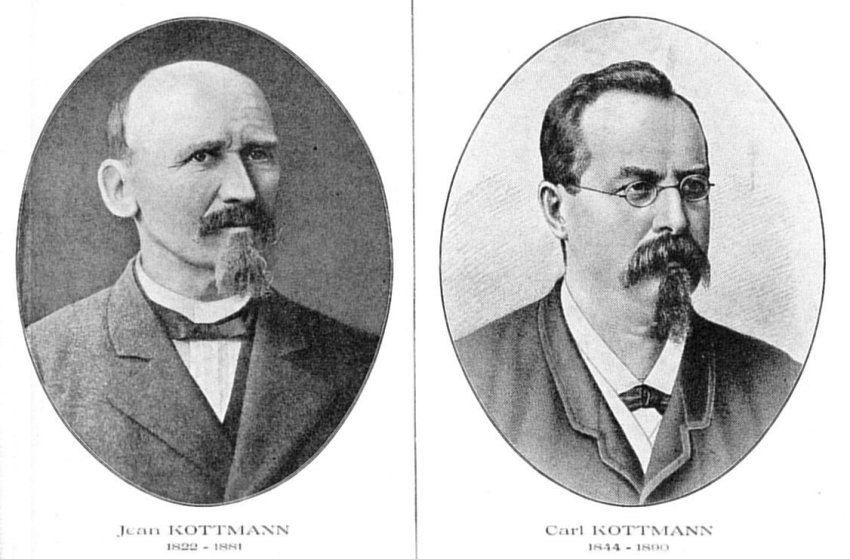
The Langendorf Watchmaking Company was founded in Langendorf, above Solothurn, in 1873 by Johann Viktor Kottmann [6]. He was quite an exceptional entrepreneur, having already set up tobacco, chicory, tinplate and acetic acid factories in Solothurn [7].

At the time, the Solothurn region was essentially agricultural, and far removed from watchmaking regions such as Le Locle, La Chaux-de-Fonds or even Biel. Finding watchmakers in Langendorf was therefore difficult, as was convincing farmers to manufacture timepieces. It was therefore necessary to bring in watchmakers from outside and train workers on site, which was not without its difficulties. Production began with key-winding movements. In 1879, the company was transformed into a public limited company and began manufacturing winding movements.

In 1881, Johann's nephew Carl Kottmann took over the company, and it was indeed a time of crisis [8]. But the crisis was general, not specific to the company or its workers. In fact, the company had been founded in 1873, the year in which the "Great Depression [9]" began. Initiated by the collapse of hundreds of Austrian banks, "this crisis was new in its kind, and not only in its scale. It was not linked to the agricultural economy, nor was it confined to one region, for example due to weather conditions, but its effects were felt throughout the world, due to the ever closer links between the markets for industrial goods and the financial markets [10]".

Swiss industrial production plummeted, returning to pre-crisis levels only in 1885 [11].

Carl Kottmann was another remarkable man. In less than 10 years, he tripled the size of the company from 300 to 900 workers, producing 600,000 parts a year, and extended the premises.

He also introduced a social policy well ahead of its time, with the proliferation of workers' housing, initiated by his uncle, and the creation of a health insurance fund. In 1888, he was the first to introduce the 10:00 a.m. workday in his factories [12], something that would not be done at national level until 1919! His vision of the organization of the watchmaking industry was uncommonly far-sighted.

In an article published in 1888, he imagined what his factory would look like 20 years later [13]: "On either side of the road, once almost deserted, lined pretty workers' houses, surrounded by well-kept gardens, where flowers and vegetables grew in abundance. (...) I had just entered the main street, where the great factory stands, when the whistle of the machine gave the signal for the midday rest. An imposing stream of a thousand workers, like a swarm of active bees, poured out onto the road."

But the future was bleak: "Manufacturers were producing in excess of requirements. Everyone reasoned: I'll make twice as much to achieve a lower cost price, by spreading overheads over a larger output, and I'll still earn more, since I'll increase sales by lowering my prices. The market became clogged with goods, and hasty, excessive manufacturing resulted in poor-quality products."

With an astonishing premonition, Carl Kottmann foresaw the creation of the trusts of the 1920s-1930s and the resistance of dissent: "Manufacturers were forced, as a result of this stagnation of business, to form unions. Groups of ébauches, case assemblers and watchmakers were successively formed. These chambers drew up price lists, regulated payment conditions, and imposed heavy fines to ensure strict compliance. At first, this system of production seemed to give good results, but soon the flaws of this organization were noticed. It had never been possible to group together all the interested parties, nor to force them to act in concert. The industrialists, keeping their distance from the unions, took advantage of this state of affairs to give the federated members disastrous competition."

Remember that these lines were written 40 years before the turbulent creation of Ébauches SA, UBAH and ASUAG!

Carl Kottmann died in 1890, and was succeeded by Lucien Tièche, a remarkable technician and one of Carl's closest collaborators.

1898

Lucien Tièche transformed the company with two objectives in mind: to manufacture the complete watch and to be independent of anyone else. To achieve this, in addition to ébauches, he introduced the manufacture of cases and dials, which necessitated further expansion. Only the balance springs and hands are sourced externally.

To ensure his independence, Lucien Tièche organizes the manufacture of the machines needed to produce the various parts. This activity was to play a vital role in the company's future.

In 1893, Société d'Horlogerie de Langendorf produced its first watches, albeit exclusively for wholesalers. In 1894, the company took part in the creation of the Comptoir Général des Ébauches [14], an initiative that had no future, but which paved the way for the upheavals of the 1920s.

2. Watches, screw-cutting and machinery

In 1899, a member of the Kottmann family, Ernest, once again took the helm of the company. He remained at the helm for 45 years!

Ernest Kottmann was a leading industrialist who played an active role in organizing the Swiss watchmaking industry. In 1900, he joined the Central Committee of the newly-created Chambre Suisse d'Horlogerie [15].

He continued Lucien Tièche's policy of independence: in 1903, watches were sold directly by the company under the Cavalier, Wengia and Soletta brands [16].

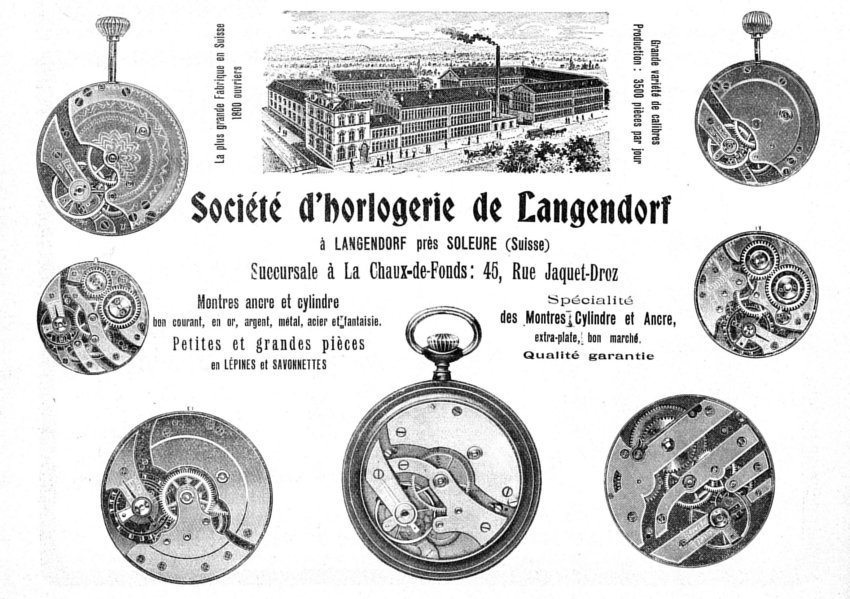
By 1904, with the opening of a sales branch in La Chaux-de-Fonds, the company had 1,000 employees, produced 500 different calibers, anchor, cylinder and Roskopf, and claimed to be the largest watch factory in Switzerland. [17]

1905

1907

Langendorf Watch grew exponentially: from 1905, the first alarm pocket watches, 1500 workers, 3000 watches a day. That year, the company stopped producing ébauches for other companies. In 1907: 1,800 workers, 3,500 watches a day!

The company produces its own screws, pinions, wheels, etc., whose quality is remarkable and noticed: products from this screw-cutting activity are offered to other companies from 1913 onwards, and orders flood in, even beyond the watchmaking industry. In the same year, the Lanco trademark was registered.

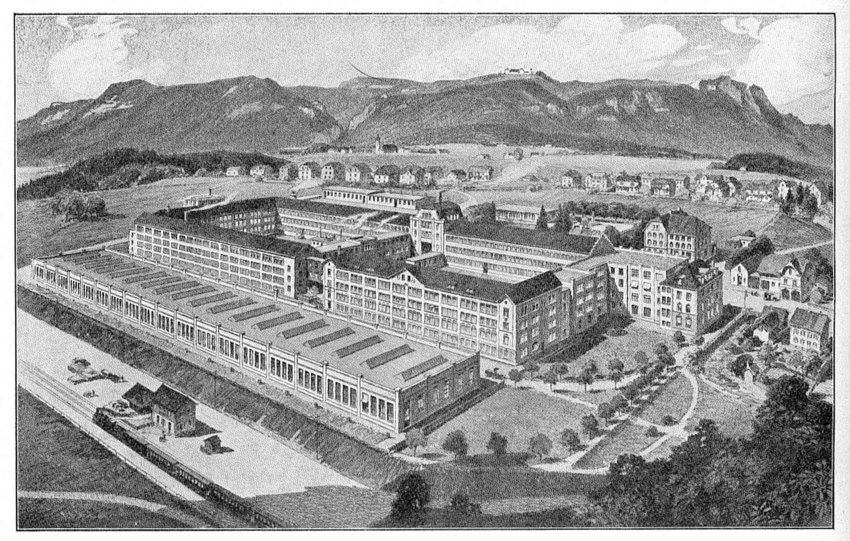
The Société d'Horlogerie de Langendorf buildings in 1924

In 1924, the Société d'Horlogerie de Langendorf celebrated its fiftieth anniversary [18]. Post-war difficulties reduced the workforce to 1,200 workers, but they still produced 720,000 watches a year. Mechanization is very advanced: there are 1,350 machines in the various workshops, and they are manufactured on site.

The organization is ultra-modern and extremely rational. The key department is the Technical Office, which builds gauges and machines and carries out the various controls. The Technical Office manufactures standards (called "origins") for all parts, which are then used as references for stamps. The Technical Office is also in charge of what we now call quality control, both of the machines and of the finished product.

SHL's impressive bar turning workshop in 1924

The Fabrique has its own watchmaking school, and working conditions for workers are far ahead of their time: there are workers' houses, of course, but there's also a large canteen, cooperative stores, a kindergarten, a ballroom, an orchestra and sports clubs. In addition to the health insurance fund, there is now an unemployment insurance fund. Later, in 1939, a pension fund was added.

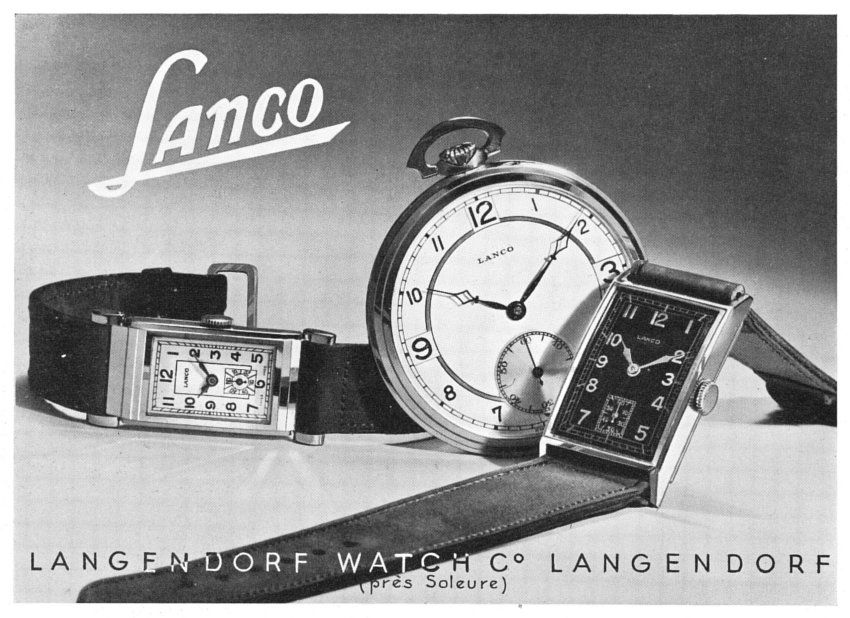
In the 1920s, a number of brand names are registered: Vera, Trovato, L.W.C., Langendorf, Wengia, Solo, Scepter, Lanco, Lonville, Méphisto, Verax. However, from 1935 onwards, Lanco was the brand most frequently featured on dials.

1938

The company's success is linked to its industrial and commercial policy, perfectly summed up by its slogan: " the least expensive brand-name watch " [19].

The watches, with anchor or cylinder escapement, are simple, well-made, solid and reliable. There are no complications: no automatic watch, no chronograph, no date, just two hands and at best a small seconds hand at 6 o'clock!

Ernest Kottmann retired in 1944, but the company remained in the family: his sons Hans and Guido, and his brother Rudolf Kottmann, succeeded him [20].

After the Second World War, the world watch market underwent a profound transformation. The Roskopf watch made considerable progress and now competes with the economical anchor watch. Models from other Swiss manufacturers proliferate: chronographs, whose prices continue to fall, automatic watches, calendar watches, alarm clocks, and more.

1949

Creativity, however, was not the forte of the Fabrique d'Horlogerie de Langendorf. At most, the first watches with center seconds appeared in 1948, to celebrate the company's 75th anniversary!

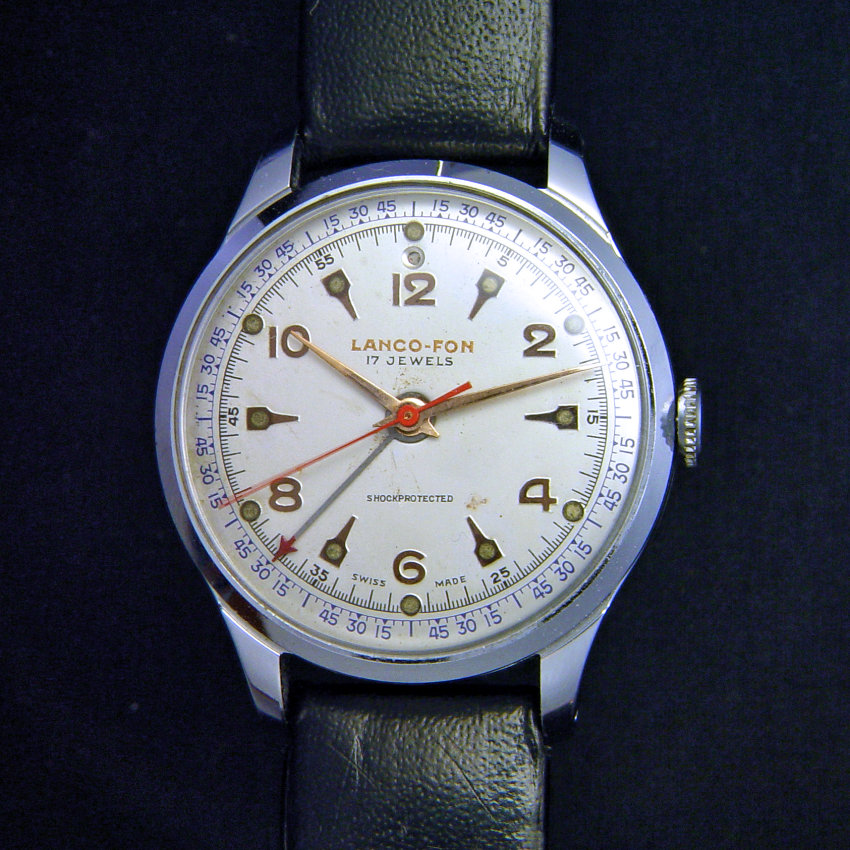
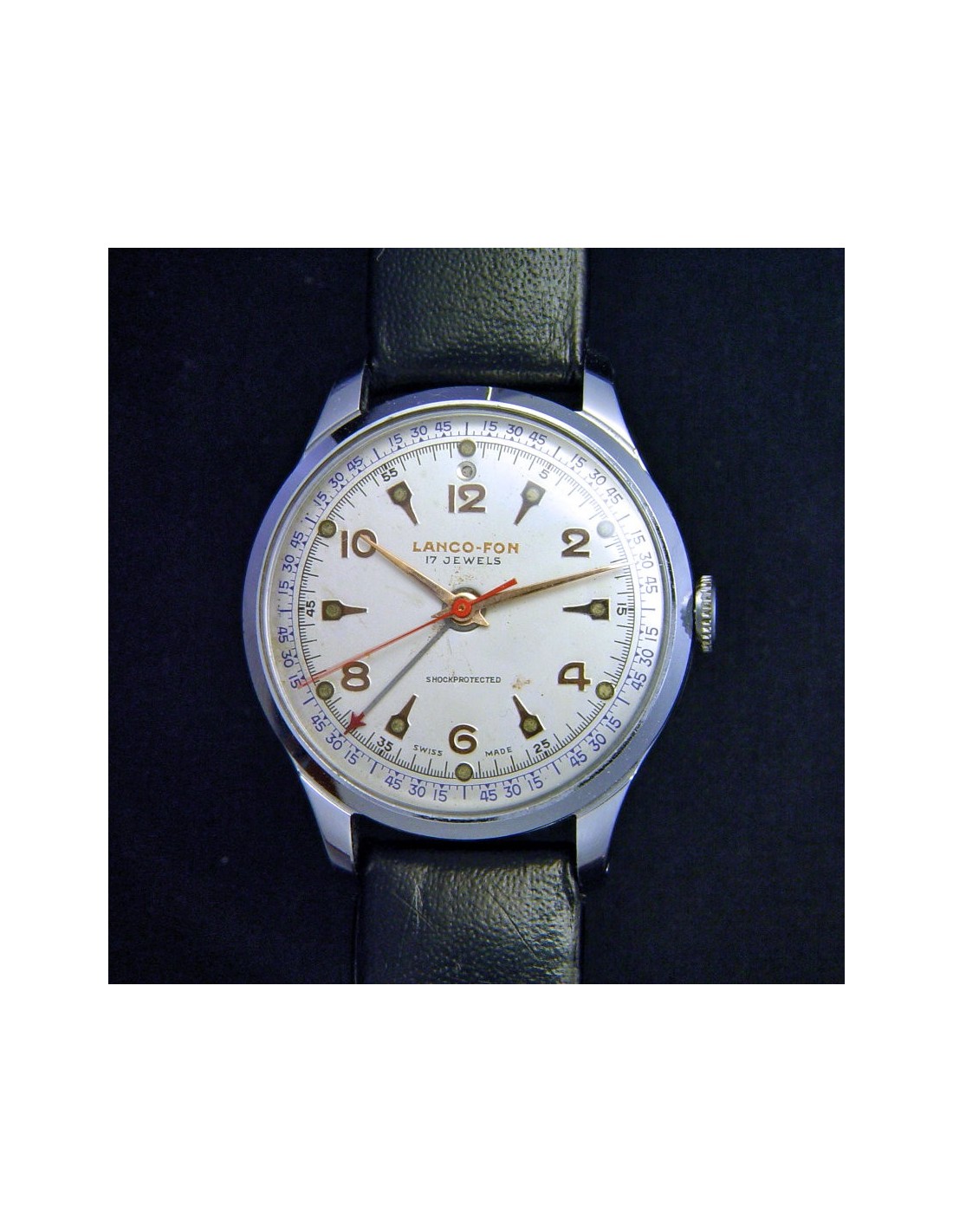
1950 was an exception, with the launch of the first automatic calibers, Lanco-Matic, very classic with stop oscillating weight, and the first alarm caliber, Lanco-fon.

The latter caliber is technically original, as Vulcain's patents for its "Cricket" version were solid. On the dial, a small aperture at 12 o'clock reveals either a red disc (striking armed) or a white disc (striking blocked). All functions are controlled by a single crown at 3 o'clock.

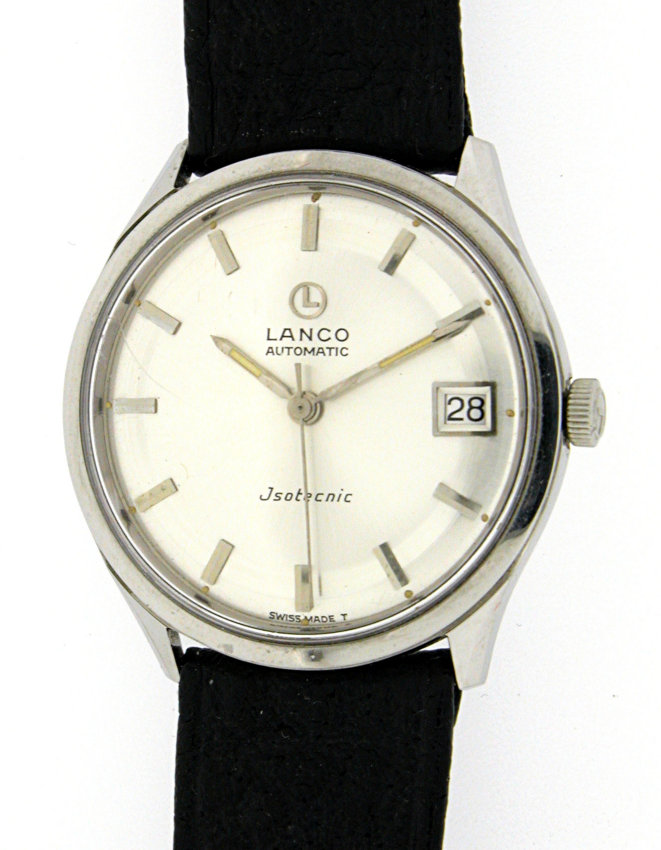
In 1952, Lanco introduced its second, more modern automatic caliber, 1233N, with rotor and date window at 3 o'clock.

In the years that followed, Lanco models became much more original. The University model, automatic with date at 6 o'clock, has a beautiful facetted bezel and a magnifying glass for easy viewing of the date. The Futurama model has a superb asymmetrical case, part of which is engraved.

1960

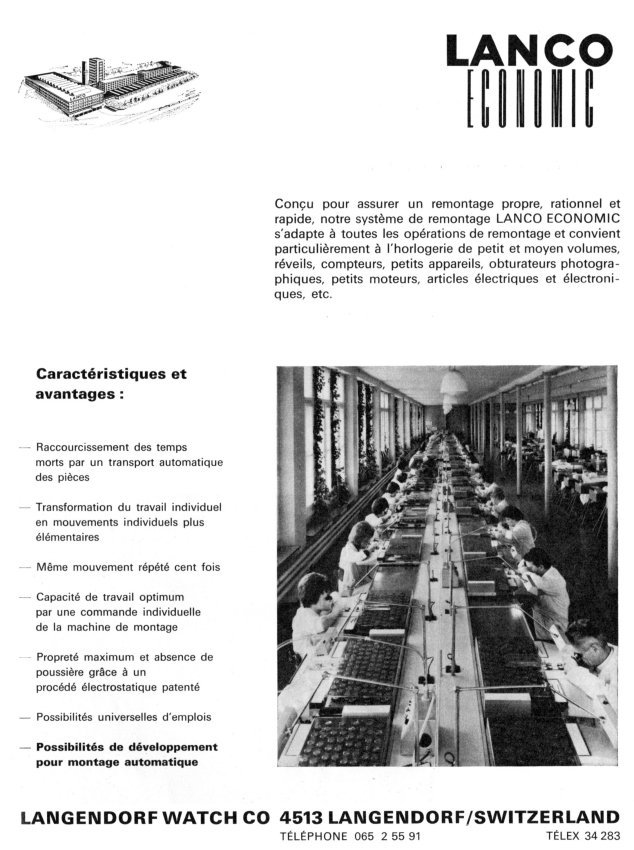
The bar-turning activity continues, with the addition of a remarkable diversification: the manufacture of assembly lines for the mass production of watches. This new activity naturally benefits from the company's years of experience in machine manufacturing and in automating the various stages of watch production.

Baptised Lanco-Economic, these chains were a great success and were adopted by many companies. They rationalize all winding operations for small and medium-volume watchmaking, but can also be adapted for small electric motors, electronics, etc.

1966

3. SSIH integration and decline

Fate then befell the Kottmann family. In 1964 Hans was killed in a road accident [21], and in 1965 his brother Guido Kottmann died. That year, the Société d'Horlogerie de Langendorf was absorbed by the Société Suisse d'Horlogerie Industrielle (SSIH), which already included Omega, Tissot, Lémania, Marc Favre and Rayville-Blancpain [22].

The fast-growing SSIH was looking for new production capacity, and saw the Lanco brand as a complement to its range of simple quality watches, below Tissot [23].

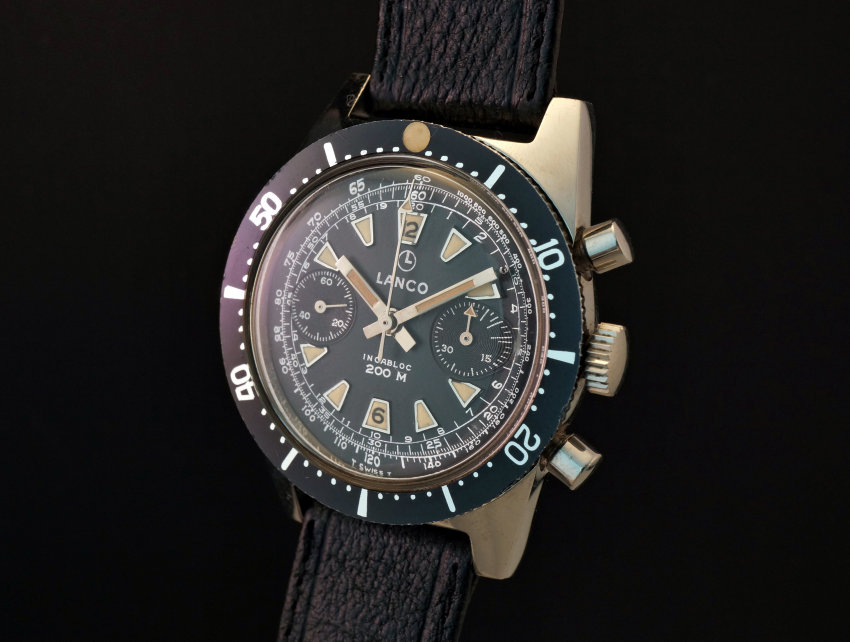
SSIH implemented a severe rationalization of Lanco's activities. Only two calibres were retained, with or without automatic functions, and with or without date. A new logo appears on the dials.

Always on the lookout for growth levers, in 1969 SSIH acquired Aetos, a specialist in economical anchor watches sold under the Aetos, Rénis and private label brands [24].

It should be remembered that at the time, the American company Timex, which produced only Roskopf watches, manufactured 20 million pieces a year, whereas the SSIH, all companies combined, produced only 4.5 million anchor watches [25]. This undoubtedly explains the 1971 takeover ofESTH (Economic Swiss Timing Holding) by SSIH. Under its Agon, Buler, Ferex and Continental brands, ESTH produced 5.7 million Roskopf timepieces [26].

With so many inexpensive watches in the group, the production of economy watches at Langendorf was doomed. This was confirmed in 1972 with the closure of Lanco's ébauches and supply workshops [27]. The Lanco brand was not abandoned, but Lanco watches were now produced by Aetos.

In 1973, the premises of the Société d'Horlogerie de Langendorf were sold to Migros [28], which then rented part of the premises to the SSIH.

From 1975 onwards, the situation deteriorated. Aetos was in difficulty, and in 1976 tried to launch a quartz watch with LED display. The rapid fall in quartz watch prices put paid to this attempt: in 1979 Aetos closed its doors, and that was the end of Lanco watches [29].

But not the Lanco-Economic assembly lines, which were bought from SSIH in 1981 by Christoph Ruprecht, then Sales Director of the Langendorf-based company [30]. As a result, the Lanco company still exists: under the name Lanco Integrated, it still specializes in automated assembly lines [31], but there are no longer any production units in Switzerland.

[1] https://en.wikipedia.org/wiki/Langendorf_Watch_Company_SA. Consulted in February 2022

[2] https://forumamontres.forumactif.com/t213343-langendorf-watch-company-lanco Consulted in February 2022

[3] https://chronographes.net/2016/07/11/lanco/ Accessed in February 2022

[4] https://thewatchforum.co.uk/index.php?/topic/42057-lanco-can-you-help-with-some-history/ Accessed February 2022

[5] Chronométrophilia n° 79, pp 91 ss.

[6] Henry Buhler, La Société d'Horlogerie de Langendorf, Revue Internationale d'Horlogerie, 1924, 6, pp 81 ff.

[7] https://hls-dhs-dss.ch/fr/articles/023949/2007-08-17/

[8] Les 75 ans de la Langendorf Watch Co, Journal Suisse d'Horlogerie, 1948, pp 362 ff.

[9] https://fr.wikipedia.org/wiki/Crise_bancaire_de_mai_1873

[10] Thomas Meissen, Histoire de la Suisse, Septentrion, 2019, p.227

[11] Christophe Koller, L'industrialisation et l'Etat au pays de l'horlogerie, Editions CJE, 2003, pp 102-103

[12] La Fédération Horlogère, 1888, 83, p.375

[13] La Fédération Horlogère, 1888, 97, pp 452-453

[14] Indicateur Davoine, 1894-1895, p.1

[15] La Fédération Horlogère, 15, 64, p.1

[16] Revue Internationale de l'Horlogerie, 1903, 1, p.1

[17] Revue Internationale de l'Horlogerie, 1904, 1, p.8

[18] Henry Buhler, La Société d'Horlogerie de Langendorf, Revue Internationale d'Horlogerie, 1924, 6, p. 81 ff.

[19] Revue Internationale de l'Horlogerie, 1935, 16, p. 196

[20] Les 75 ans de la Langendorf Watch Co, Journal Suisse d'Horlogerie, 1948, p. 362 ff.

[21] L'Impartial, December 12, 1964, p. 18.

[22] Journal Suisse d'Horlogerie, 1965, p.757

[23] Marco Richon, Omega Saga, 1998, p.43

[24] Marco Richon, Omega Saga, 1998, p.45

[25] L'Impartial, October 1, 1970, p. 9

[26] Journal Suisse d'Horlogerie, 1971, 1, p.138. It should be noted that Basis, one of the ESTH companies, remained independent.

[27] Journal Suisse d'Horlogerie 1972, 3, p.274

[28] La Suisse Horlogère, weekly edition, 1973, p.597

[29] L'Impartial, September 11, 1979, p.13

[30] L'Impartial, February 25 1981, p.15

[31] https://lancointegrated.com/about-us/ Accessed February 2022

Notes :

About Time To Tell: Time To Tell has one of the largest private digitized databases on the history of Swiss watchmaking, with over 2.3 TB of data on more than 1,000 Swiss watch manufacturers. This database has been built up over a period of some thirty years, and continues to be fed with around 50 to 100 GB of data every year. The database is made up of old documents, mainly Swiss trade journals, dating from the late 19th to the late 20th century. Most of these documents are not available on the Internet. Historical articles published on the time2tell.com website always cite the sources used.

Time To Tell is a private company, independent of any watch manufacturer.

©Time To Tell, 2022-2025 

Reproduction forbidden without authorization.

Any use of this article by artificial intelligence is strictly forbidden and will be considered an infringement of copyright.
Product Details

Product added to wishlist

Nous utilisons des cookies afin de fournir une expérience utilisateur conviviale. En naviguant sur ce site, vous acceptez la politique d'utilisation des cookies.