The true story of Election watches

The true story of Election watches

Election

This fine manufacture in La Chaux-de-Fonds almost disappeared in the 1930s. After recovering, it didn't survive the quartz crisis. It was behind the famous Incabloc shock absorber.

Description

Joël Pynson

May 2025

1. the dynasty Braunschweig

The Braunschweig family came to the La Chaux-de-Fonds region from Alsace in the mid-19th century. The beginnings of the Braunschweig family's watchmaking activity are uncertain: it seems to have all started with Abraham Braunschweig, around 1850, who then went into partnership with his son, Lazare [1].

In 1884, Lazare's sons Isidore and Alphonse founded the watchmaking factory Les fils de L. Braunschweig [2].

The company began manufacturing watches and movements and grew rapidly. It specializes in beautiful, thin anchor watches.

In 1900, on the death of Lazare, the third son, Moïse, joined the company to take charge of a sales office in Hamburg [3]. The Election trademark was registered in 1901.

1904

1905

In 1905, the company adds Fabrique Election to its name and inaugurates a new factory in La Chaux-de-Fonds. Several members of the Braunschweig family join the company: Paul, Camille, Arnold and Lucien [4].

Election has become a major factory in La Chaux-de-Fonds, and is highly integrated: it manufactures its own wheels, calibers and machines. It has its own design offices and several workshops, under the responsibility of Technical Director François Tenconi.

1905

Election watches are flat, but also precise: in 1911, a watch measuring just 11 lines (24.75 mm) obtained a chronometer bulletin from the Kew Observatory in England, two years before Les Fils de Jean Aegler repeated the feat for Rolex.

1913

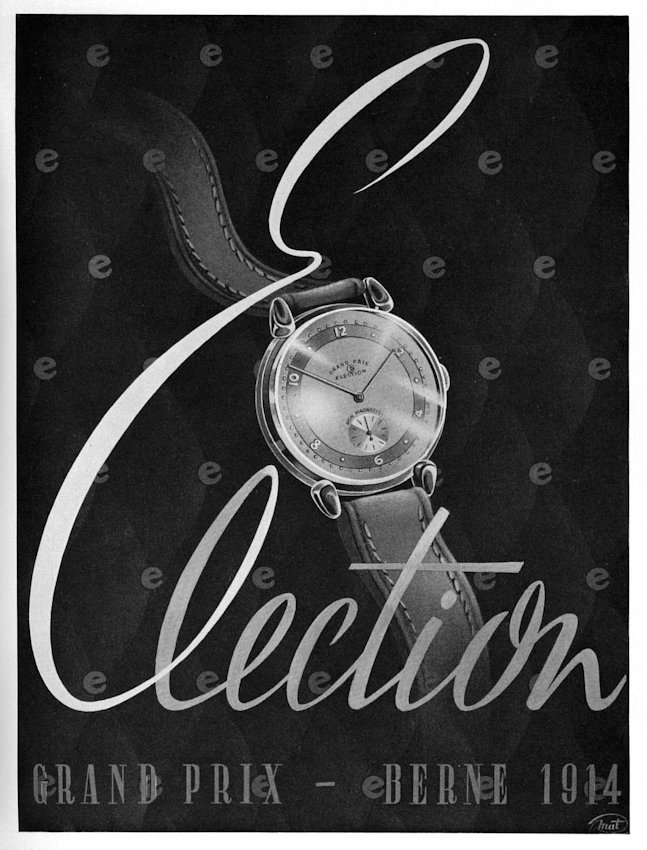
Election began making wristwatches in 1914, and soon specialized in this type of watch. In the same year, Election receives a Grand Prix at the National Exhibition in Berne.

In 1916, Georges Braunschweig joins the Board of Directors [5].

1918

1916

1920

The period of crisis that followed the First World War was terrible for Fabrique Election. In great difficulty, the company was declared bankrupt in 1930, and Lucien, Georges and Paul even had to explain themselves in court [6].

Two important events then occurred.

2. Nouvelle Fabrique Election

Shortly before the bankruptcy, the company had diversified into the manufacture of platform escapments, and a talented engineer, Fritz Marti, had created and patented [7] a shock-proof device for escapment bearings, with a promising future.

Due to bankruptcy, this first patent was taken over by the Doxa factory, which then passed it on to the Zodiac factory in Le Locle, which used it from 1934 on its own "unbreakable" watches [8].

1930

1929

The bankruptcy of the Election factory forced Fritz Marti to pursue his activities by creating his own company in 1931: Le Porte-Échappement Universel SA with Henri Quaile (a remarkable technician whose father was a watch manufacturer) and Roland Bloch (an industrialist). Three years later, Georges Braunschweig joined the company [9], and Le Porte Echappement Universel became a flagship of the Swiss watchmaking industry thanks to the Incabloc shock absorber.

But the story isn't over for Election.

In 1931, the Nouvelle Fabrique Election SA was founded in La Chaux-de-Fonds [10]. It was headed by René Didisheim of the Marvin factory in La Chaux-de-Fonds, who undoubtedly brought in the necessary funds due to the Braunschweig family's difficulties.

In 1935, Lucien Braunschweig became director of the new company [11]. Calibre production continued, as did the manufacture of high-quality but very classic watches. A few chronographs and calendar watches were produced, but these remained the exception.

1946

1954

1944

1950

In 1944, Robert Braunschweig joined the Board of Directors [12].

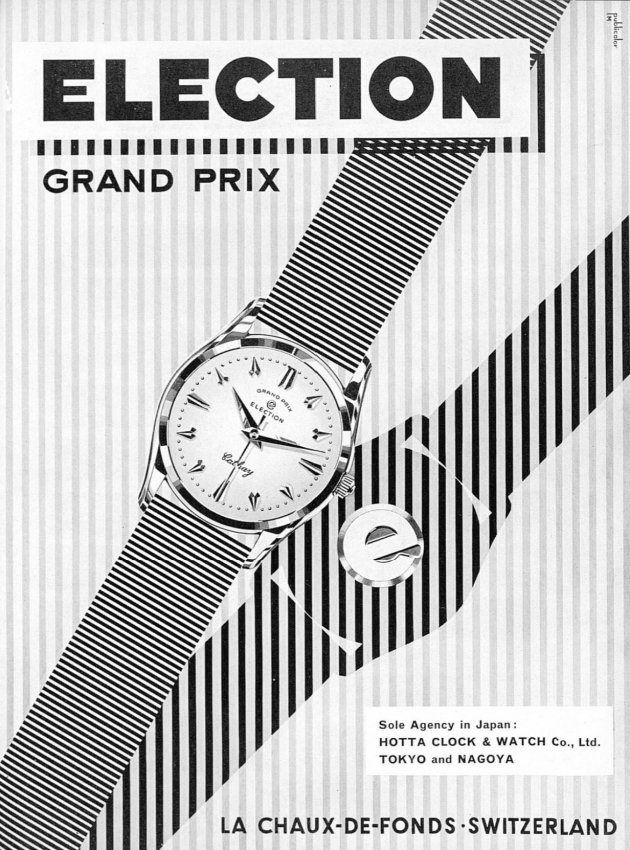
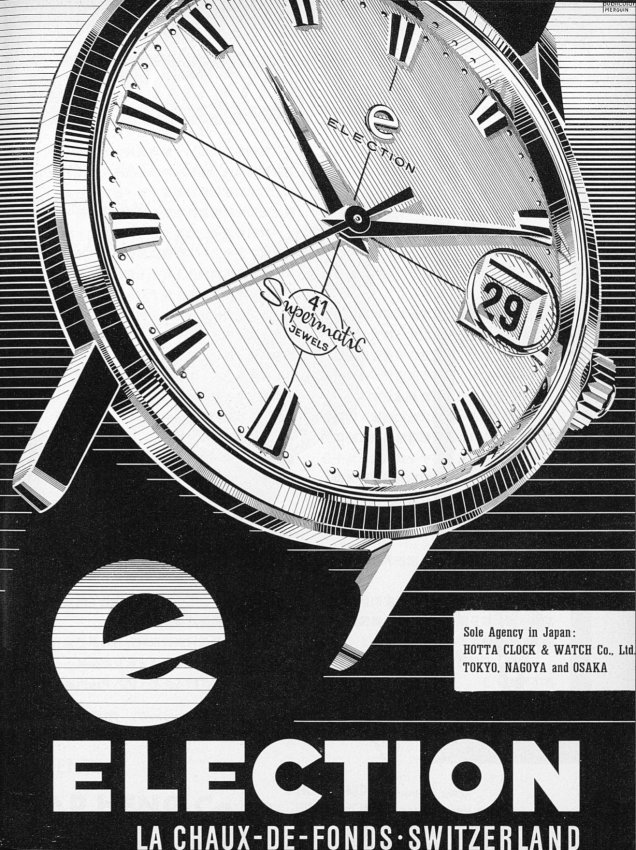
In the 1950s and 1960s, Election launched several models, including automatic watches, but unfortunately without a strong design to distinguish them from the competition, and without a model name. Some names are registered, such as Cathay or Connoisseur, but they can be found on several watches, which are virtually identical.

1957

1958

1961

1962

1962

1963

An attempt at promotion took place in 1959 with the watch of a member of the Tahiti Nui expedition who had successfully rafted from South America to Tahiti, but this event did not lead to the creation of a new model.

1959

René Didisheim left the company in 1964, and the factory gradually ceased trading. The company went bankrupt in 1985, and the factory's trademarks were transferred to a company in Liechtenstein [13].


[1] Pierre-Yves Donzé, Les patrons horlogers de La Chaux-de-Fonds, Editions Alphil, 2007, pp. 65-67

[2] FOSC 1884

[3] FOSC 1900

[4] FOSC 1905

[5] FOSC 1916

[6] FOSC 1930

[7] Patent CH 141 098

[8] Revue Internationale d'Horlogerie, 1934, 16, p. 187

[9] FOSC 1934

[10] FOSC 1931

[11] FOSC 1935

[12] FOSC 1944

[13] FOSC 1987

The FOSC (Feuille Officielle Suisse du Commerce) is available on E-periodica

Notes :

About Time To Tell:

Time To Tell has one of the largest private digitized databases on the history of Swiss watchmaking, with over 2.3 TB of data on more than 1,000 Swiss watch manufacturers. This database has been built up over a period of some thirty years, and continues to be fed with around 50 to 100 GB of data every year. The database is made up of old documents, mainly Swiss trade journals, dating from the late 19th to the late 20th century. Most of these documents are not available on the Internet. Historical articles published on the time2tell.com website always cite the sources used.

Time To Tell is a private company, independent of any watch manufacturer.

©Time To Tell, 2025 

Reproduction forbidden without authorization.

Any use of this article by artificial intelligence is strictly forbidden and will be considered an infringement of copyright.

Product Details

Product added to wishlist

Nous utilisons des cookies afin de fournir une expérience utilisateur conviviale. En naviguant sur ce site, vous acceptez la politique d'utilisation des cookies.