The true story of Montilier watches

The true story of Montilier watches

Montilier

Quite a distance from the watchmaking regions of the Neuchâtel mountains and Biel, the Montilier factory has nonetheless succeeded in becoming a major watch factory employing several hundred watchmakers. It disappeared in the 1960s.

Description

Joël Pynson

May 2025

1. Creation on Lake Murten

Lake Murten is part of the Seeland region of Switzerland, which includes the lakes of Neuchâtel, Murten and Biel. Morat is off the beaten track of the watchmaking region that runs from Biel to Le Locle. Yet it was here, on his way from La chaux-de-Fonds, that Etienne-Ovide Domon set up shop as a watchmaker in 1851 [1].

In 1852, he set up a watchmaking factory in Montilier, a small village near Murten, initially specializing in watch cases, under the name Domon & Cie.

In 1864, Etienne-Ovide passed the company on to his son Ovide and his partner Constantin Dinichert. The company became Domon Fils et Dinichert. It produced ébauches and watches, and even had a bronze foundry. The company supplies watches to merchants in La Chaux-de-Fonds, who distribute them worldwide.

1871

In difficulty in the 1870s, the factory was taken over in 1876 by a La Chaux-de-Fonds company, probably created by some of its major customers, the Société suisse d'Horlogerie [2]. This company's shareholders included the merchants Lucien and Léon-Louis Gallet.

The Fabrique de Montilier thus became a branch of the Société Suisse d'Horlogerie, with Constantin Dinichert as its director.

2. Société Suisse d'Horlogerie, Fabrique de Montilier

In 1882, Constantin Dinichert's son Constant joined the company. A talented watchmaker, he quickly took over the technical management of the factory. At the time, the factory employed over 500 workers and produced more than 120,000 pieces a year [3]. Even aluminum and plastic (celluloid) cases were produced!

1899

In 1904 Constant Dinichert fils took over the management of the factory.

1908

In 1917, the Montilier factory was no longer a branch but the main company, with headquarters in Montilier.

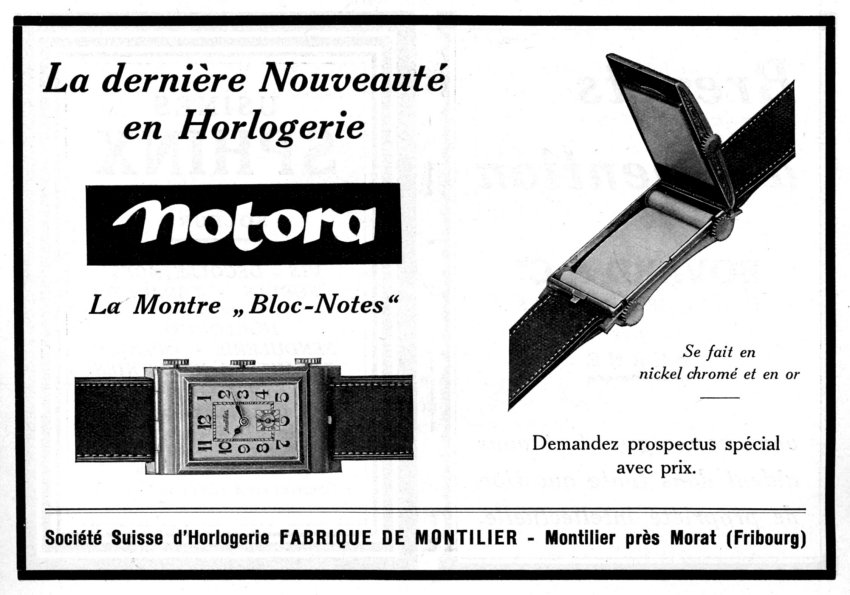
The factory began producing wristwatches late, in the 1920s, but in 1931 launched a highly original model, Notora, with a small roll of paper for taking handwritten notes.

1931

1929

1931

In 1934, two new members of the Dinichert family joined the company: Roger and Charles. But times were hard, and the company decided to dissolve, to start afresh under the name Compagnie des montres Montilier SA (Montilier Watch Co.) [4].

3. Montilier Watch Co.

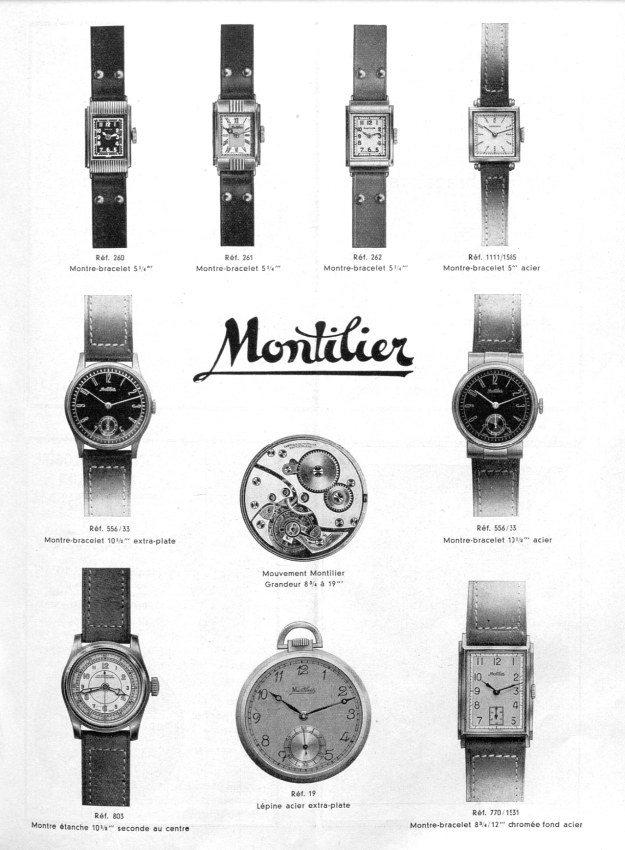
Numerous new watch models were launched. They are more modern: some are waterproof and shockproof.

1941

1941

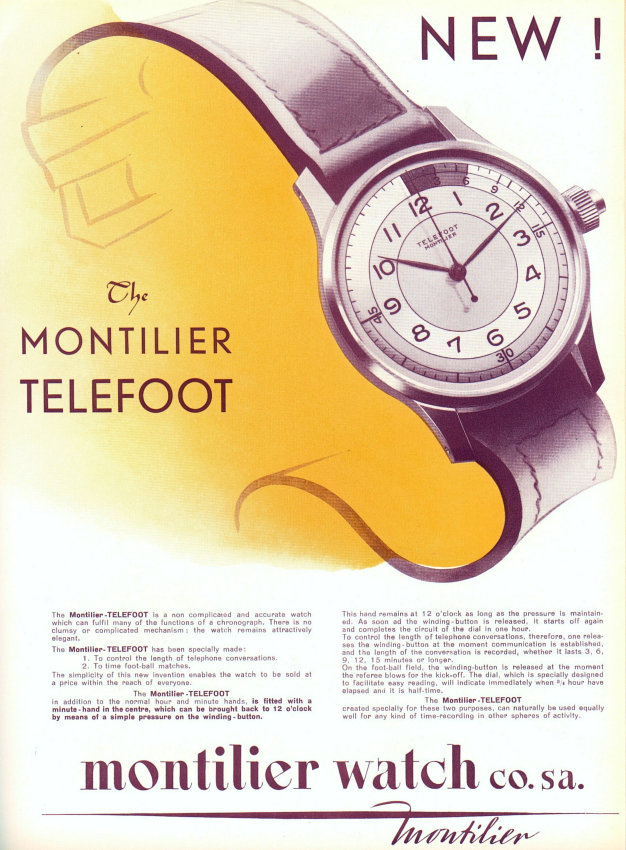
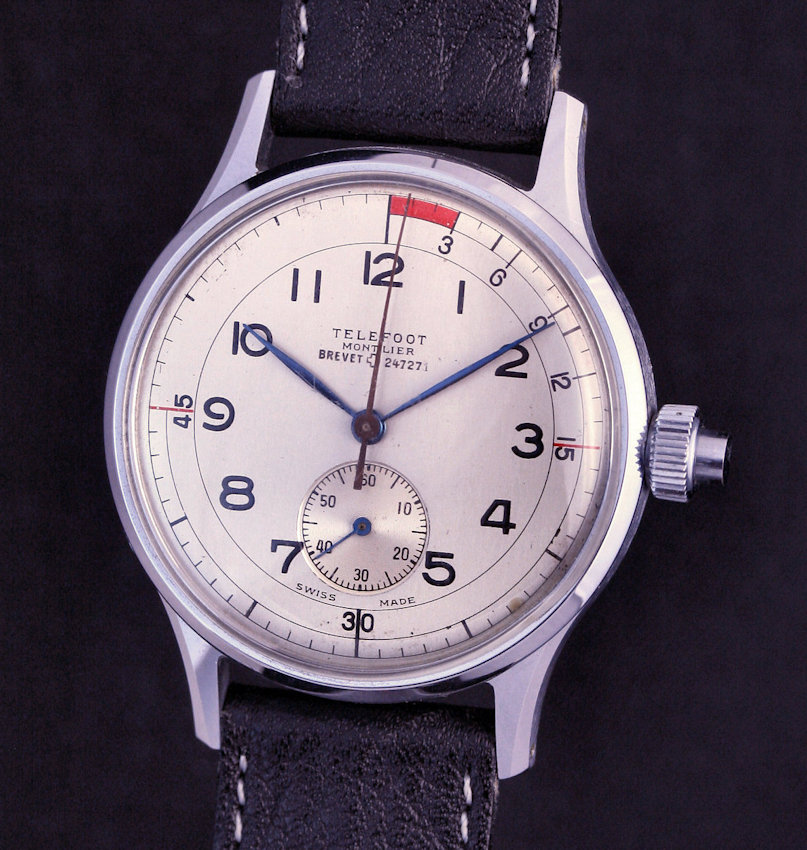
In 1946, Montilier launched its most remarkable model: the Montilier Telefoot, patented in 1945 [5].

1946

The Montilier Telefoot is a stop-en-vol (stop-in-flight) watch. The unique push-button returns the central hand to zero, counting down the minutes rather than the seconds. The time scale on the periphery of the dial highlights the first forty-five minutes, recalling the duration of half-time at soccer matches. The movement is a Montilier caliber.

In the early 1950s, Montilier ceased to be a manufacture. Automatic watches and chronographs based on Ébauches SA began to appear.

1952

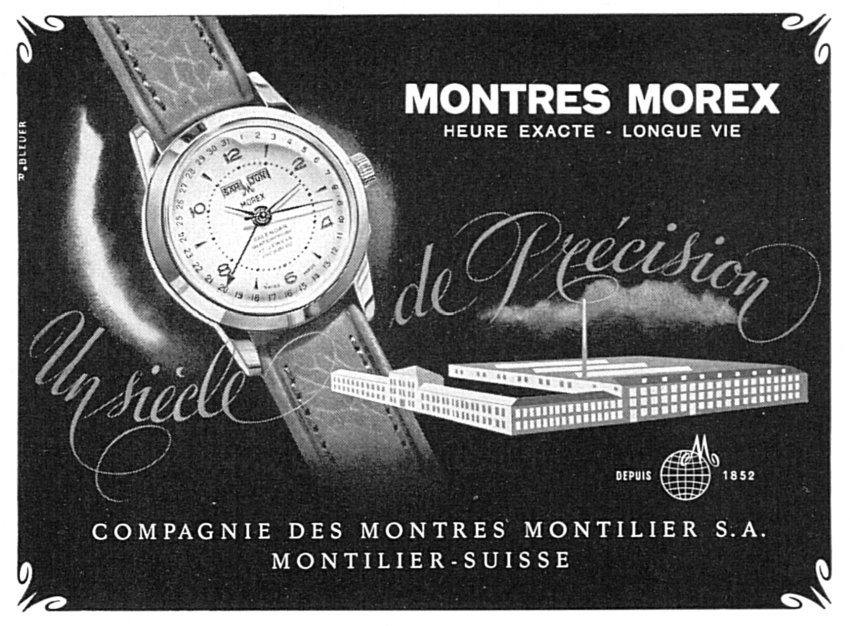
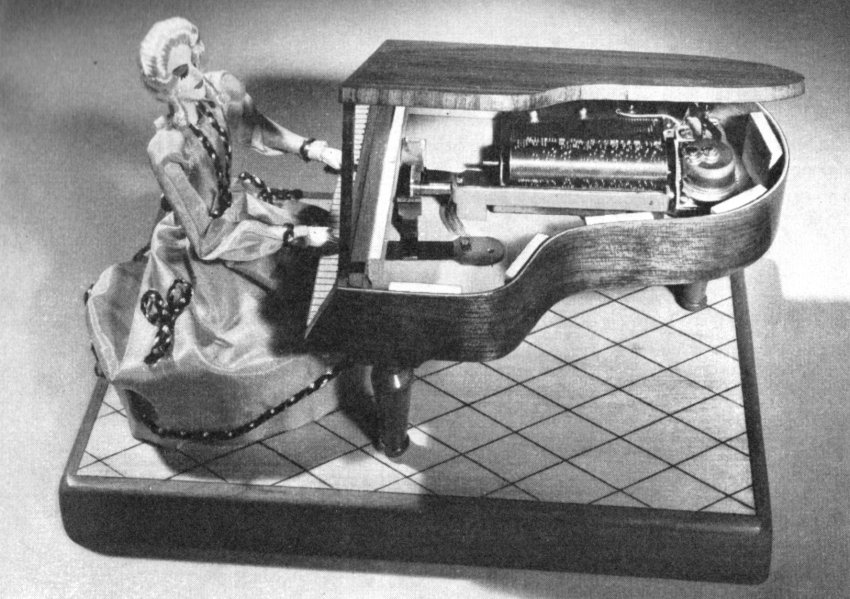
Montilier also uses the Morex brand, and in the early 1950s the company embarked on an astonishing diversification: the manufacture of automatons. These were actually automatons designed by Roger Reymond in Geneva, showing different trades: watchmaker, optician, shoemaker, etc. These automatons could be displayed in shop windows.

1953

1953

Roger Reymond automatons in Geneva [6]

Roger Reymond was a remarkable engineer and inventor who registered numerous patents in the 1930s and 1940s, particularly in the medical field.

He also had a passion for miniatures and automatons. For example, he created highly precise miniature factories, such as a steel mill, an automobile factory and a chocolate factory. Miniature landscapes too, like New York harbor or the famous Fram ship on expedition to the North Pole.

These were one-off pieces, but in the 1940s, Roger Reymond teamed up with the famous music box factory Reuge & Cie, in Ste Croix, to produce small series of musical automatons: pianists, guitar or bagpipe players, or musical dancers.

In the 1950s, the Montilier factory took over production of automatons depicting various trades.

In 1955, Montilier launched a new model [7]. It was a watch with a 24-hour display. But the company was in difficulty and decided to dissolve in 1964 [8].

[1] Journal Suisse d'Horlogerie, 1952, 9-10, pp. 334-335, and Journal Suisse d'Horlogerie, 1880, 4, pp. 76-77

[2] FOSC 1883 and 1885

[3] https://www.laliberte.ch/articles/regions/quand-montilier-produisait-des-montres-840491

[4] FOSC 1936

[5] Patent CH 247 271

[6] Journal Suisse d'Horlogerie, 1946, 7-8, pp. 385-388

[7] A similar model was also launched by Miramar SA in Geneva the same year.

[8] FOSC 1964

Notes :

About Time To Tell: Time To Tell has one of the largest private digitized databases on the history of Swiss watchmaking, with over 2.3 TB of data on more than 1,000 Swiss watch manufacturers. This database has been built up over a period of some thirty years, and continues to be fed with around 50 to 100 GB of data every year. The database is made up of old documents, mainly Swiss trade journals, dating from the late 19th to the late 20th century. Most of these documents are not available on the Internet. Historical articles published on the time2tell.com website always cite the sources used.

Time To Tell is a private company, independent of any watch manufacturer.

©Time To Tell, 2025 

Reproduction forbidden without authorization.

Any use of this article by artificial intelligence is strictly forbidden and will be considered an infringement of copyright.

Product Details

Product added to wishlist

Nous utilisons des cookies afin de fournir une expérience utilisateur conviviale. En naviguant sur ce site, vous acceptez la politique d'utilisation des cookies.