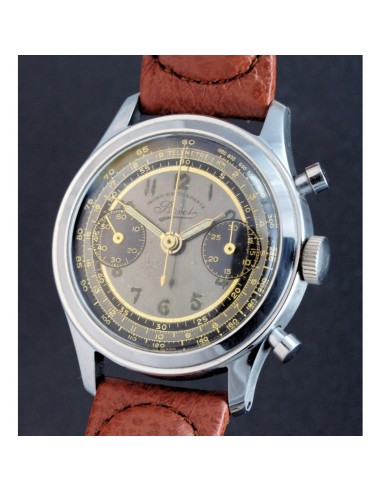
The true story of Bovet Frères et Cie in Fleurier

The true story of Bovet Frères et Cie in Fleurier

Bovet

Bovet is an illustrious name in Swiss watchmaking, cited as one of the pioneers of the Chinese watch in the 19th century. This is another branch of the Bovet family that has made a name for itself in Fleurier in the field of chronographs.

Description

Joël Pynson

June 2025

1. From the Landry brothers to the Bovet brothers

Ulysse-Alexis Landry founded his watchmaking factory in Fleurier, Val-de-Travers, in 1890 [1].

In 1898, he formed a partnership with his brothers Alcide-Edouard, Eugène William and Paul-Henri, under the name Landry frères et Cie [2].

The partnership was short-lived: in 1901, Ulysse-Alexis and Paul-Henri remained alone under the name Landry et Cie, successors to Landry frères et Cie, and the other two brothers set up their own company in 1904 [3].

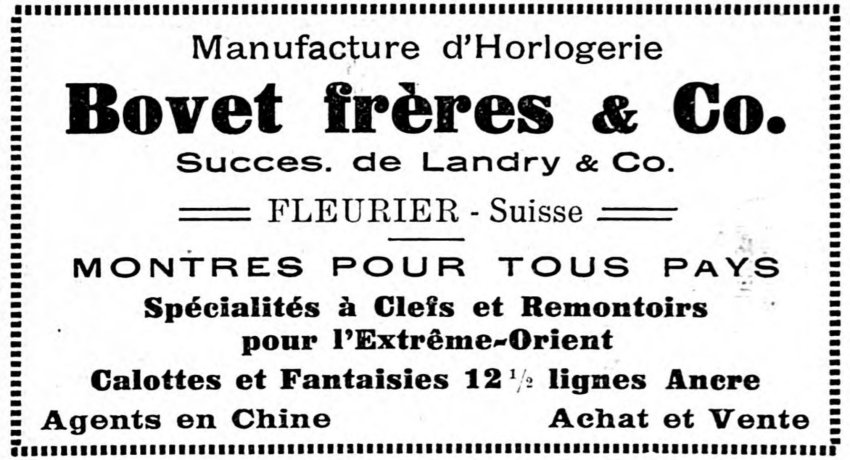
In 1916, Ulysse-Alexis joined forces with Albert Bovet-Bolens and the company became Landry et Cie. [4]. In 1918 Albert and Jean Bovet took over with William Jacque under the name Bovet Frères et Co. as successors to Landry et Co. and finally in 1924 the company became a public limited company under the name Bovet Frères & Co. SA [5].

2. Bovet Frères & Co.

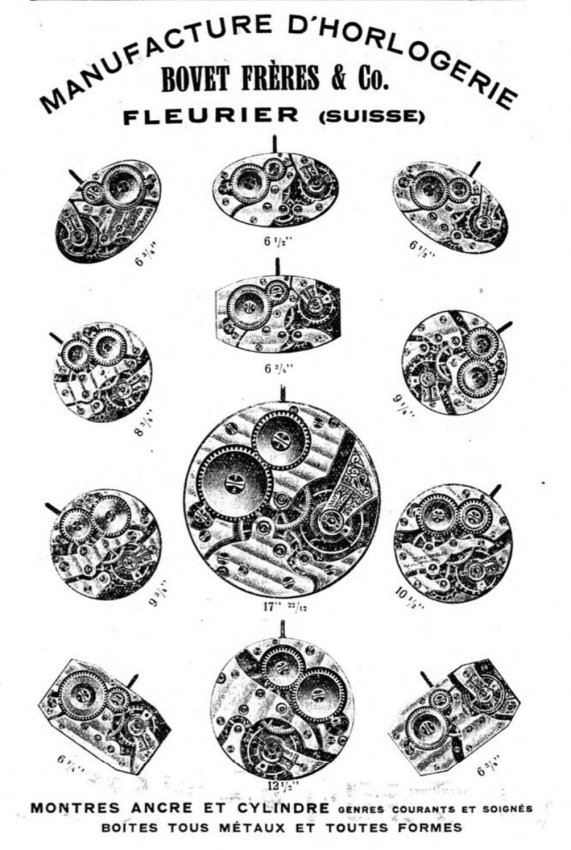
The Bovet brothers' factory produces round and shaped calibres. It often uses the Mathema brand and, as Fleurier is obliged to do, has agents in China.

1928

1924

1930

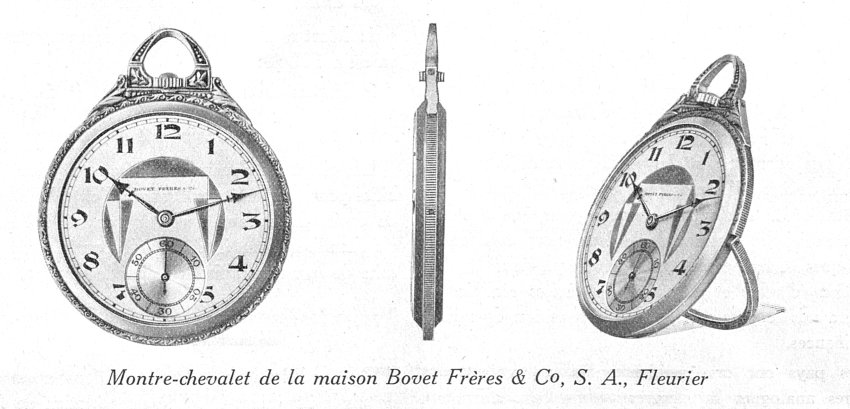
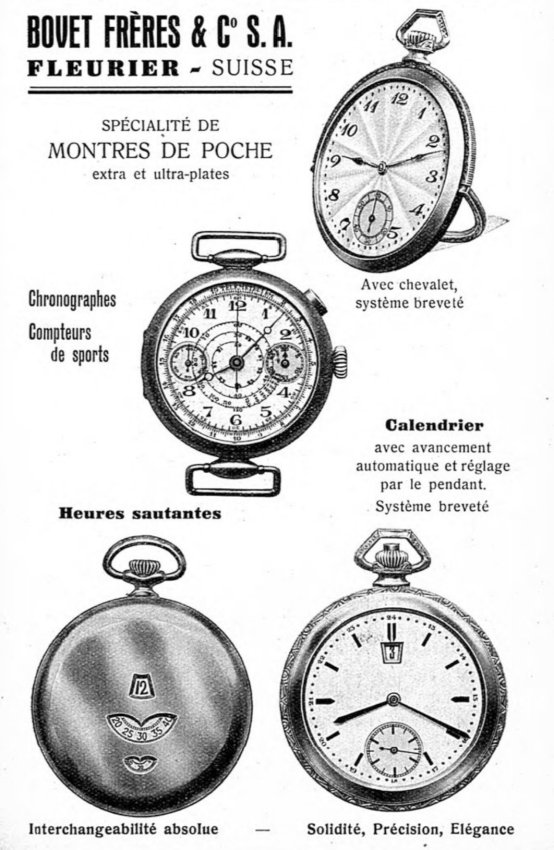
During the severe economic crisis of the late 1920s, Bovet Frères sold its ébauches factory to Ébauches SA and thus ceased to be a manufacture. But this did not prevent the company from developing its own modifications on Ébauches SA calibers, such as a calendar pocket watch patented in 1932 [6].

1933

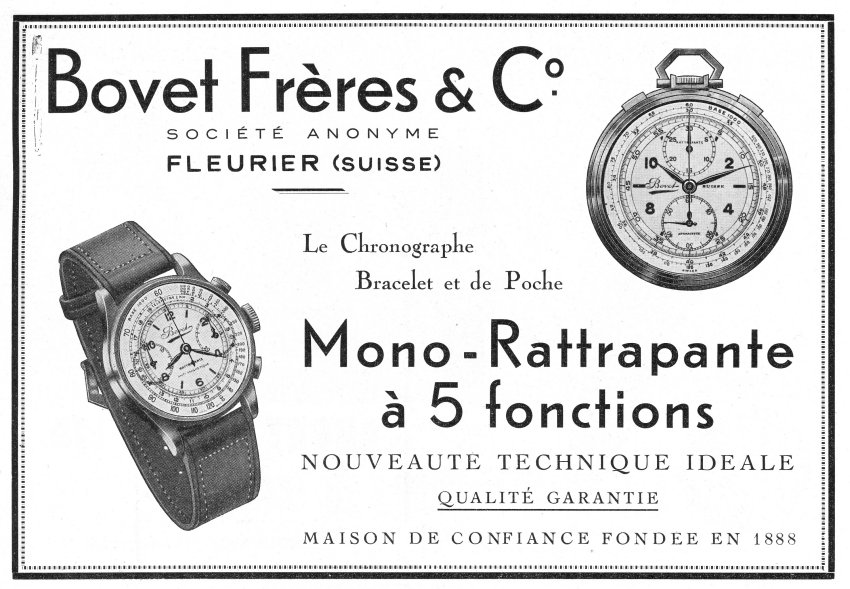
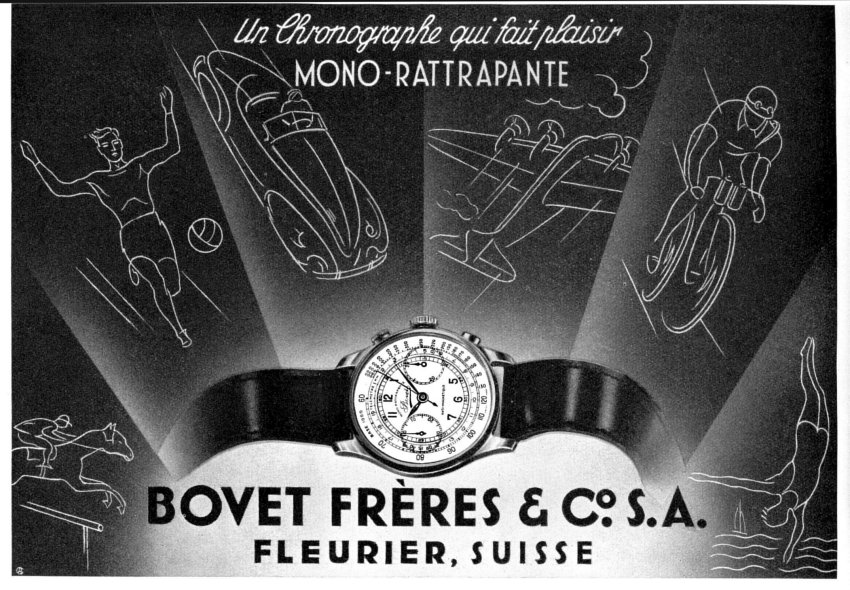
As Bovet was able to use Ébauches SA calibers, the company launched all kinds of watches, particularly chronographs and counters from 1933 onwards. Chronographs became a company specialty in 1935 with the launch of the famous mono-rattrapante chronograph.

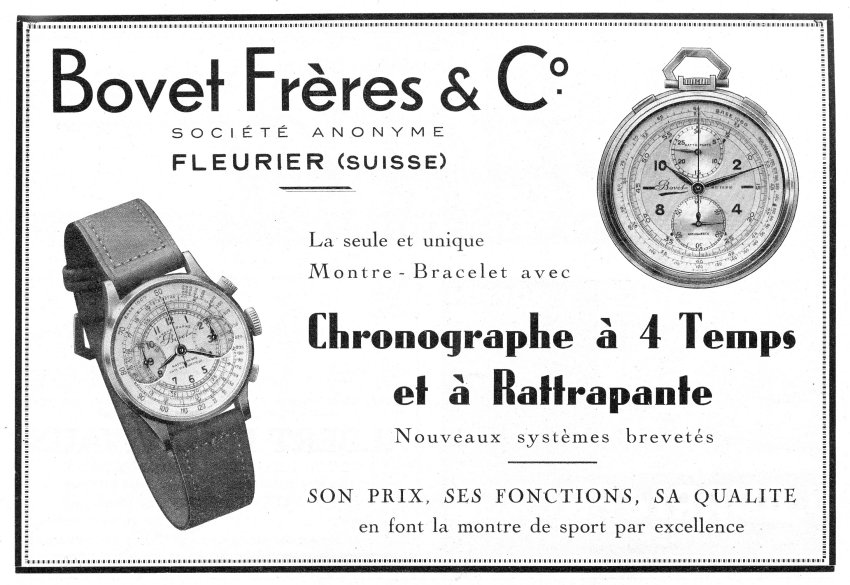
Bovet Frères created a surprise in 1935 with "the 4-stroke chronograph with optional reset. How it works can be described as follows: "This is a new technical application as simple as it is practical, enabling the usual chronograph to be given an additional function, i.e. optional restart, after stopping, without returning to zero. By ingeniously modifying the shape of the end of the lever that operates the pawl, the column-wheel can be returned to its original time by moving it back one step. Once the chronograph is stopped, it can be restarted or returned to zero at will, using the same pusher. The three ordinary beats are set as usual, i.e. by pressing on the pusher, while the optional restart is achieved by withdrawing the pusher outwards, which is fitted with a grooved plate enabling the said function to be performed with ease [7]."

1935

The idea actually came from Charles Jeanrenaud of Fleurier, who patented it in March 1935 [8]. Charles Jeanrenaud may well have been related to the Bovet family, since another patent bears the name Charles Jeanrenaud-Bovet. The association of a wife's name with her surname was common in Switzerland at the time.

But Bovet didn't stop there. The following year, in 1936, and still based on a Jeanrenaud patent, Bovet produced a surprising split-seconds chronograph: "Up to now, only the 2-hand split-seconds had been known, the manufacture of which was the speciality of a few companies, given the difficulties involved in perfecting them; even then, these were only large-diameter calibres for pocket watches. The system we have before us is completely new; a single hand acts as both chronograph and split-seconds hand, and its adaptation to the wristwatch since 13 lines makes it the sports watch par excellence; it also fills a gap in the usual chronograph which, once stopped, can only be used once reset [9]."

1938

1939

1941

There is, however, a drawback to this system based on an ingenious spiral spring mounted on the field wheel or driven wheel: the stopping time of the seconds hand during the rattrapante function cannot exceed one minute: beyond that, the entire watch stops. It is perhaps for this reason that the word "chronographe rattrapante", which appeared on the first models, was replaced towards the end of 1938 by the term " mono-rattrapante ", under which this chronograph is known today.

The Mono-rattrapante Bovet was initially developed on 15-, 14- and 13.5-line Landeron calibers [10], but was later adapted to a Valjoux caliber, the 84, reserved for Bovet. It can also be found under the Lowenthal or Recta brand names. Recta was a factory founded in Bienne in 1897 by Alcide Vaucher and Antoine Muller, but it did not produce chronographs. The agreement with Bovet was signed by Maurice Vaucher, Alcide's son and an important figure in his own right, as he was also President of the Fédération Horlogère.

3. The Favre-Leuba watch company

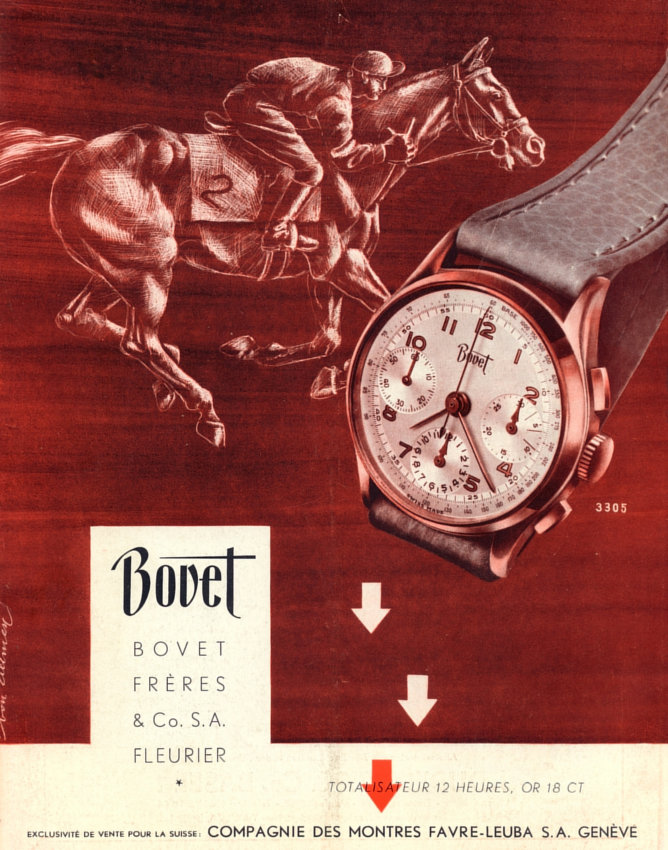
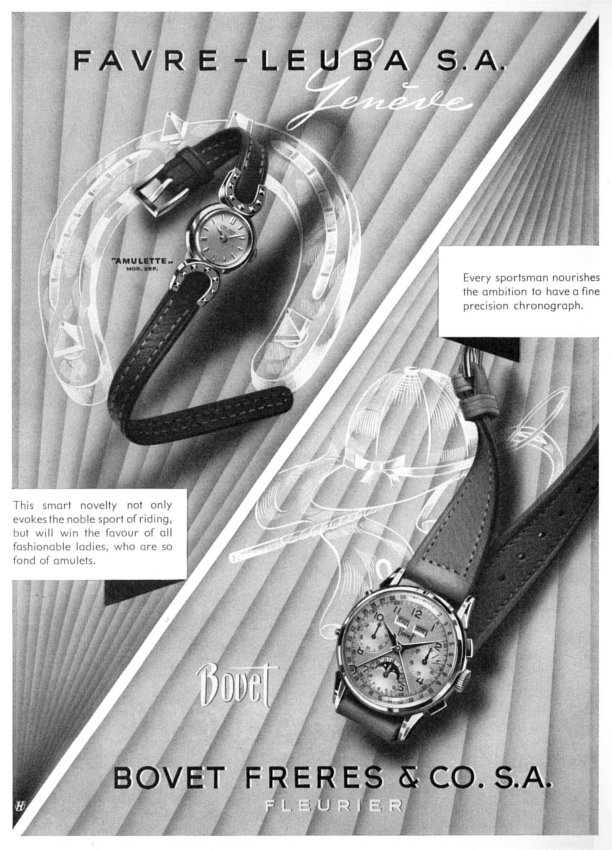
In 1945, Henry-Auguste Favre, who had founded the Compagnie des Montres-Favre-Leuba in Geneva a year earlier, joined the Board of Directors of Bovet Frères & Co [11]. This was the beginning of a takeover that would become a reality in the following years.

Bovet thus became Favre-Leuba's "technical" brand, with a range of chronographs and calendar watches.

1950

1951

But the Bovet brand was used less and less, and was abandoned in 1969 when Bovet Frères became Favre-Leuba, Fabrique de Fleurier [12].


[1] FOSC 1890. Officially, the date 1888 was used.

[2] FOSC 1898

[3] FOSC 1901 and 1904

[4] FOSC 1916

[5] FOSC 1918 and 1924

[6] Patent CH 161 356

[7] Revue Internationale de l'Horlogerie, 1935, 12, p. 143

[8] Patent CH 182 127

[9] Revue Internationale de l'Horlogerie, 1936, 21, p. 291

[10] Journal Suisse d'Horlogerie, 1938, 11-12, p. 229

[11] FOSC 1945

[12] FOSC 1969

Notes :

About Time To Tell: Time To Tell has one of the largest private digitized databases on the history of Swiss watchmaking, with over 2.3 TB of data on more than 1,000 Swiss watch manufacturers. This database has been built up over a period of some thirty years, and continues to be fed with around 50 to 100 GB of data every year. The database is made up of old documents, mainly Swiss trade journals, dating from the late 19th to the late 20th century. Most of these documents are not available on the Internet. Historical articles published on the time2tell.com website always cite the sources used.

Time To Tell is a private company, independent of any watch manufacturer.

©Time To Tell, 2025 

Reproduction forbidden without authorization.

Any use of this article by artificial intelligence is strictly forbidden and will be considered an infringement of copyright.

Product Details

Product added to wishlist

Nous utilisons des cookies afin de fournir une expérience utilisateur conviviale. En naviguant sur ce site, vous acceptez la politique d'utilisation des cookies.