• New
The True Story of Eberhard & Co.

The True Story of Eberhard & Co.

Eberhard

This renowned watchmaker from La Chaux-de-Fonds, which has produced remarkable chronographs, faced difficult times during the “quartz crisis.” It made a brilliant comeback, thanks to its Italian subsidiary, which eventually took control of the company.

Description

Joël Pynson

April 2026

1. The Eberhard Family

Georges-Lucien Eberhard and Henri Rosselet went into business together in 1887 to establish a watchmaking factory in La Chaux-de-Fonds [1].

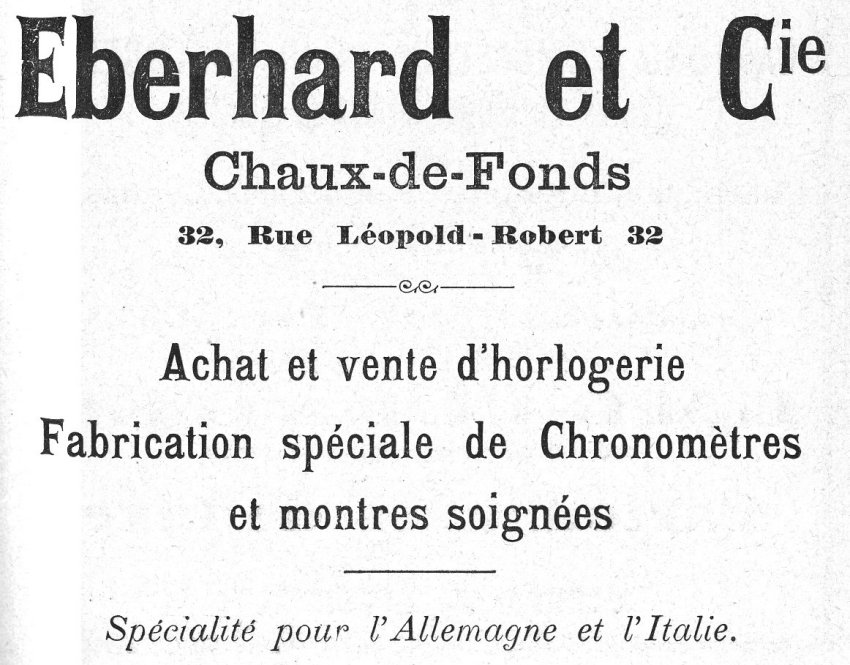
This partnership was short-lived: as early as 1892, Georges-Lucien partnered with Bertrand Eberhard to establish the company Eberhard & Cie [2]. The company bought and sold timepieces, but also manufactured chronometers and gold watches, particularly for Germany and Italy.

1894

Georges Eberhard was also involved in other companies: the Louis Audemars factory in La Chaux-de-Fonds in 1899 [3], and the Société des Fabricants de montres système Roskopf in 1906 [4]. Around 1900, Eberhard & Cie diversified into affordable watches, as evidenced, for example, by the 1901 registration of the Système Roskopf trademark.

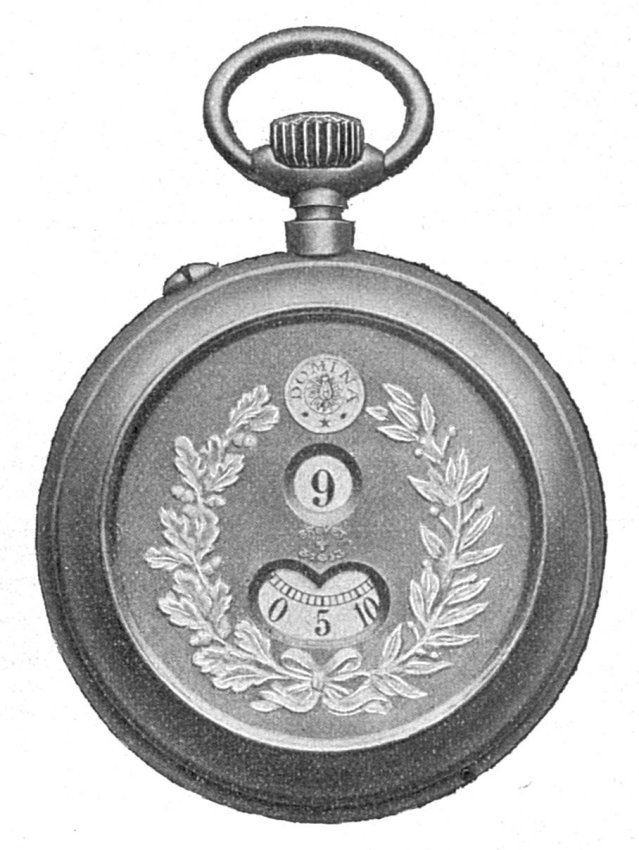
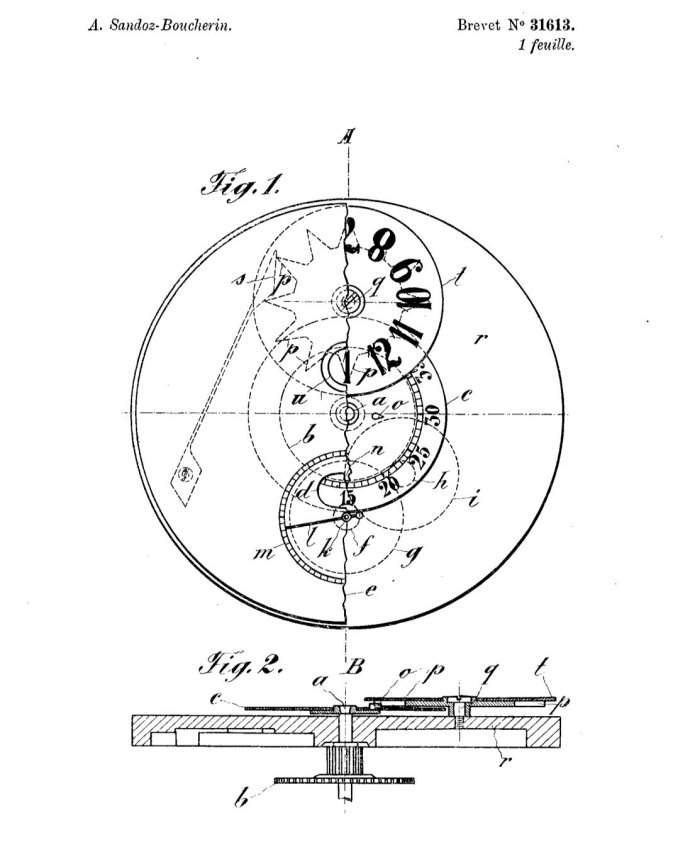
In 1906, Eberhard acquired the license for the patents of Adamir Sandoz-Boucherin and Gustave-Adrien Quartier relating to a digital time display [5]. These watches were marketed under the Domina brand and were equipped with a Roskopf-type caliber.

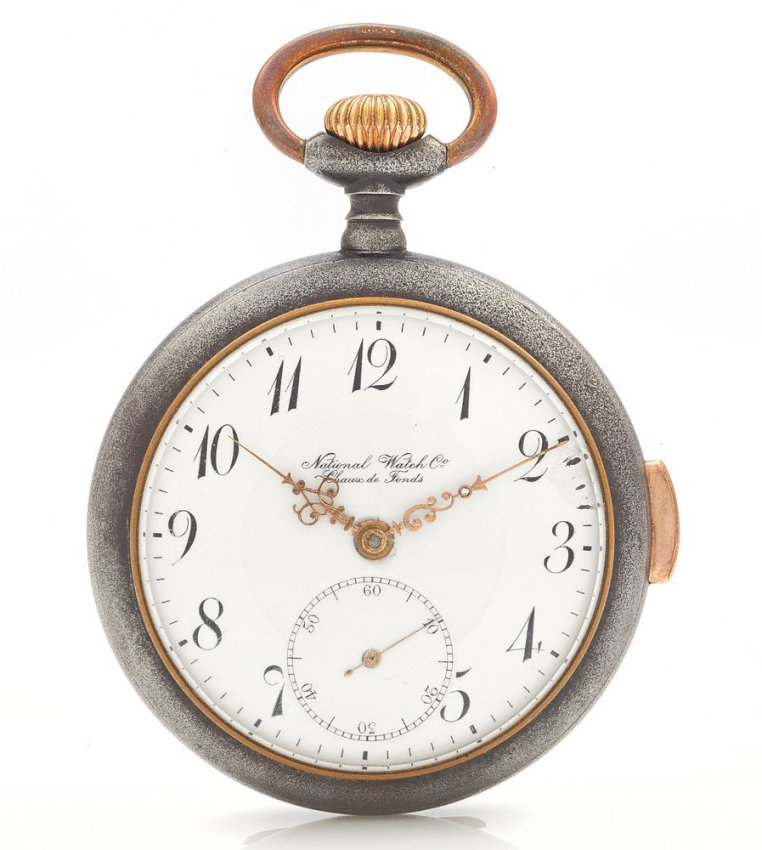
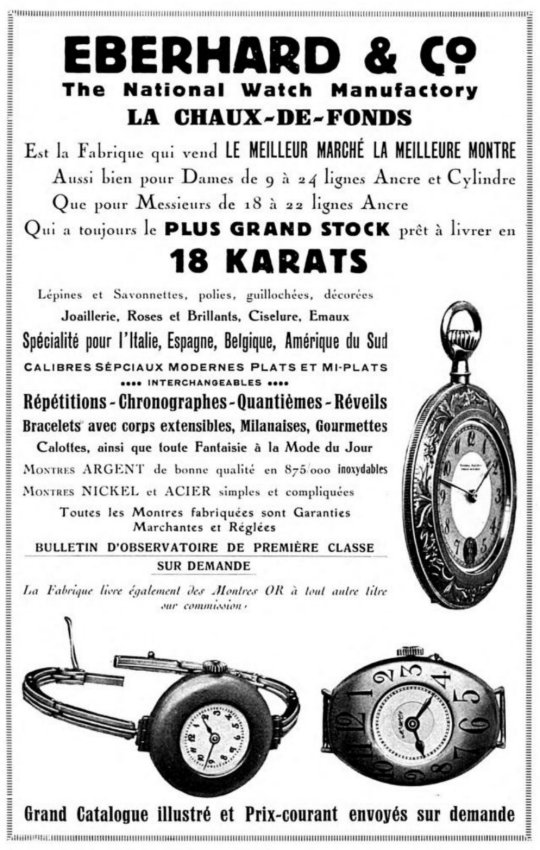
In 1907, Eberhard added "Fabrique Audax & The National Watch Manufactory" to its name [6]. The National Watch brand, registered in 1897, was in fact used regularly.

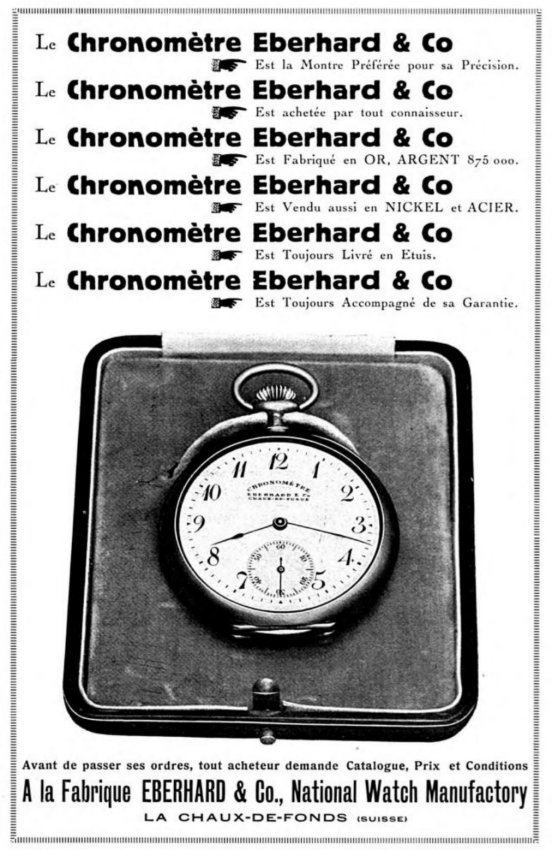
In 1914, Georges’s son, Georges-Emile, joined the family business, which was renamed Eberhard & Cie, National Watch Manufactory [7]. The company’s reputation for producing chronometers was further established, as evidenced by the 83 first-class certificates it received in La Chaux-de-Fonds in 1914 [8].

1916

1916

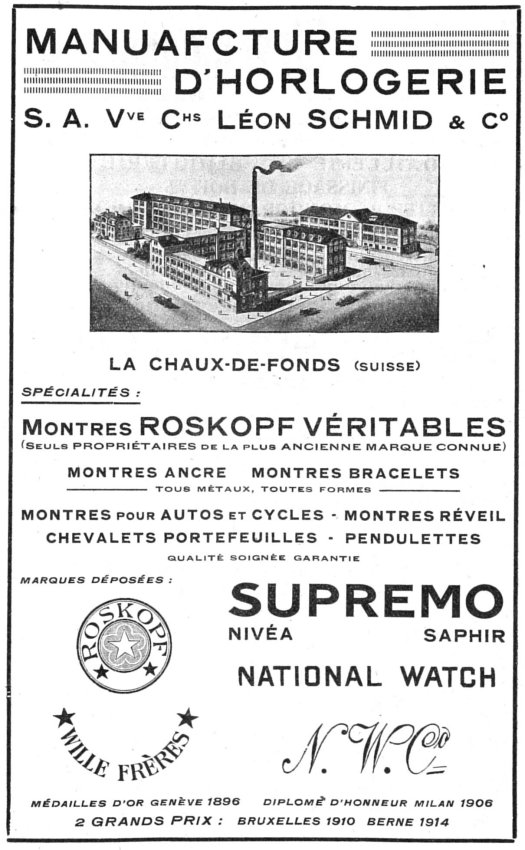
But selling gold watches and chronometers during World War I must have been extremely difficult: in 1918, Eberhard & Cie was absorbed by the Comptoir général de vente de la montre Roskopf, and Georges Eberhard became its sales director [9]. Thus, the brands of Eberhard & Cie, particularly National Watch, became brands of the Comptoir de la montre Roskopf, also known as Veuve Charles Léon Schmid & Co.

1923

But the Eberhard family did not lose heart. In 1919, Georges Eberhard left the Comptoir de la montre Roskopf and, together with his son Georges-Emile, founded a new company, Eberhard et Cie [10].

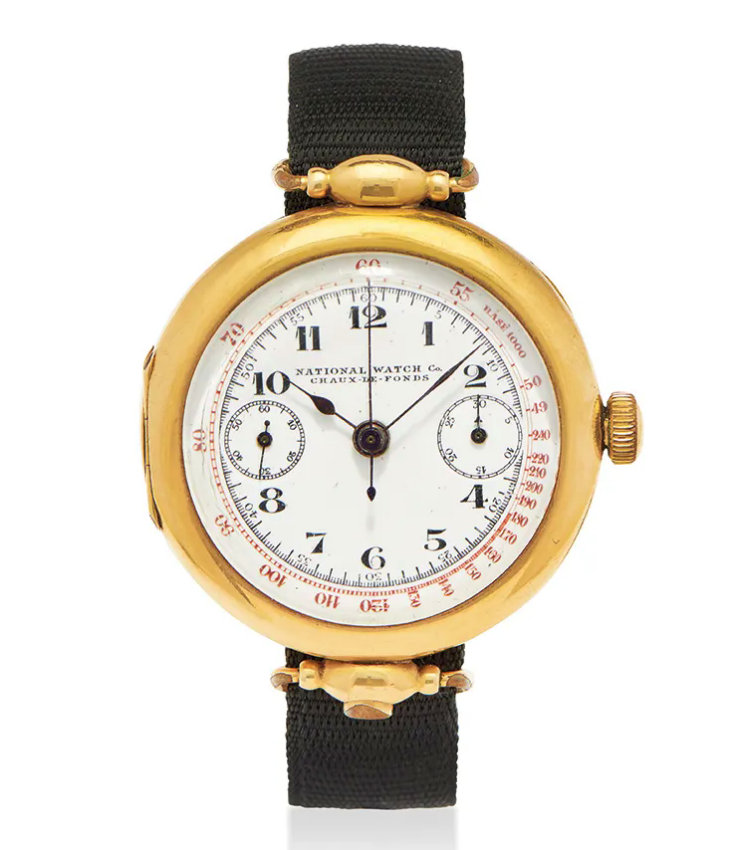
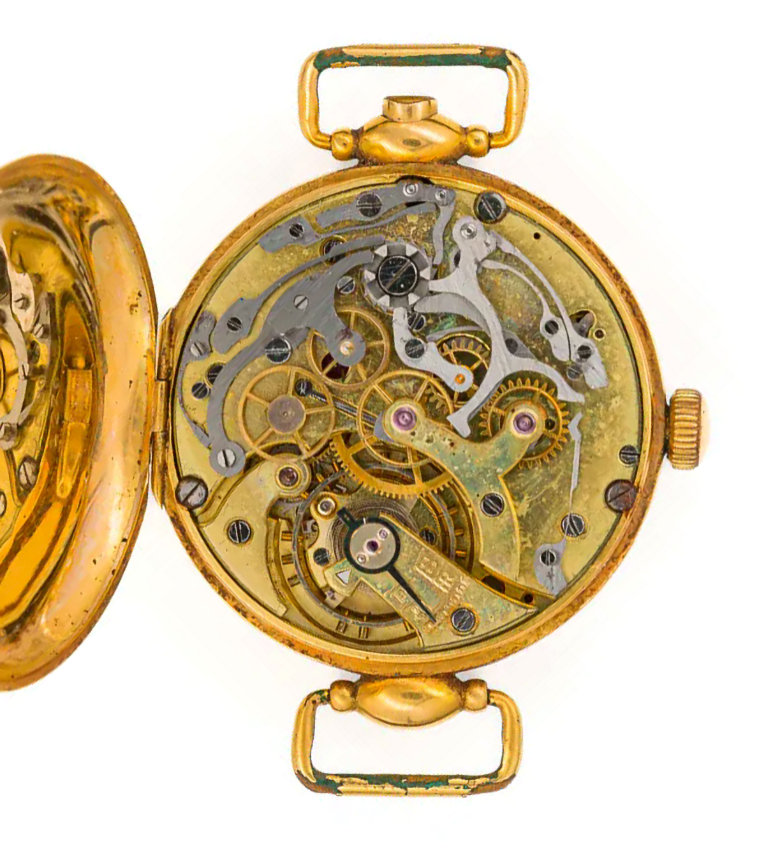
According to the official history [11], Eberhard produced its first wrist chronographs in 1919. However, there are National Watch Co. chronographs in existence. It is therefore possible that Eberhard produced wrist chronographs before 1918.

National Watch Chronograph, c. 1918, calibre Martel

Credit everywatch.com

In 1925, Maurice, Georges-Emile’s brother, joined the company [12]. Their father died in 1926.

Despite the difficult interwar period, Eberhard continued to manufacture a variety of watches and chronometers, and became a supplier to the Italian railways [13].

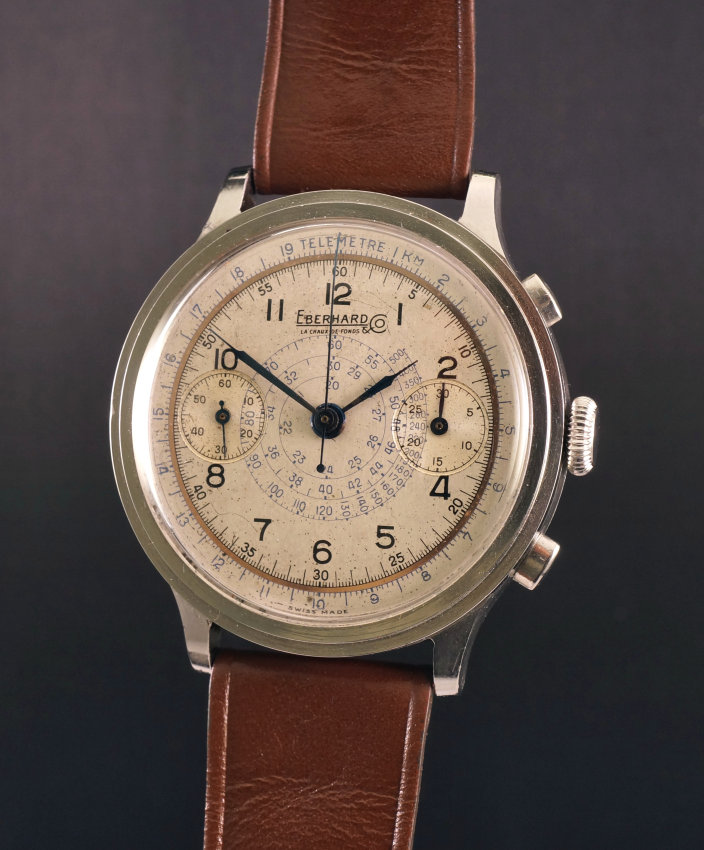
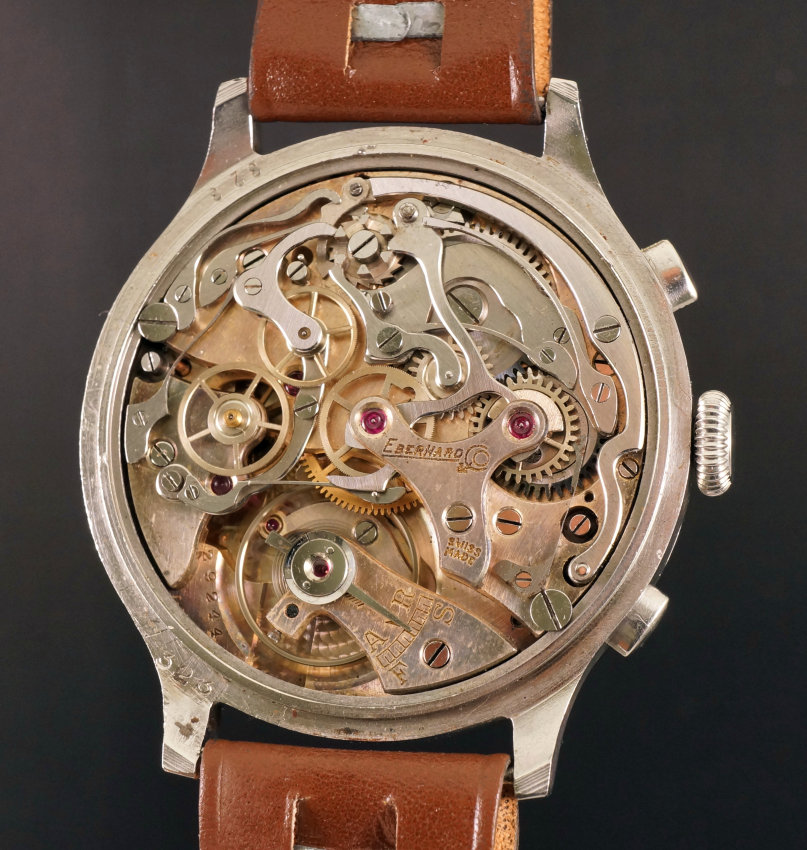
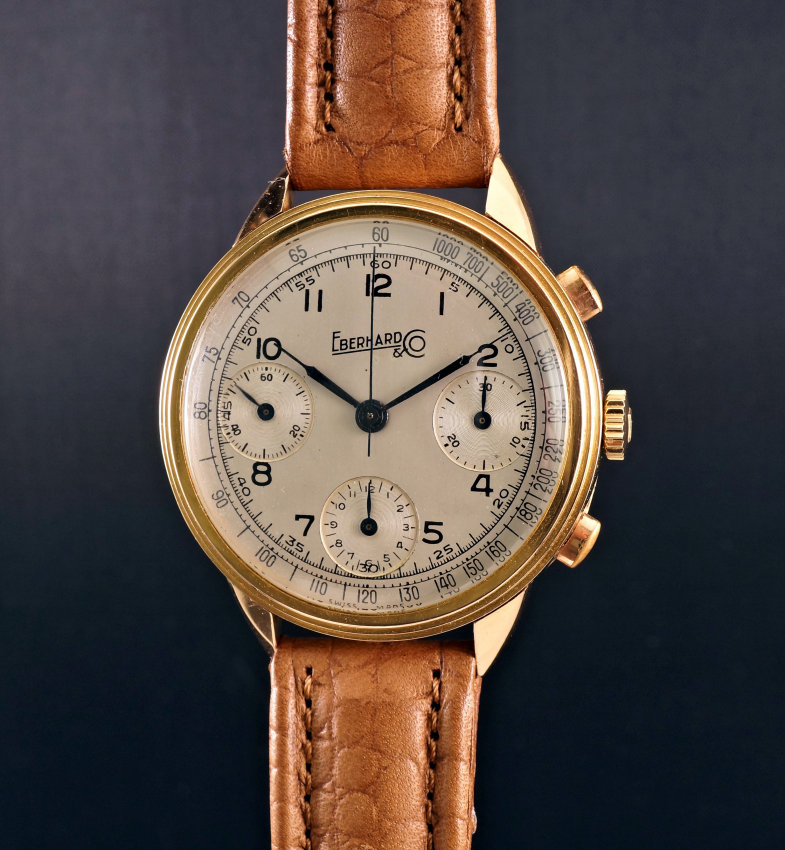
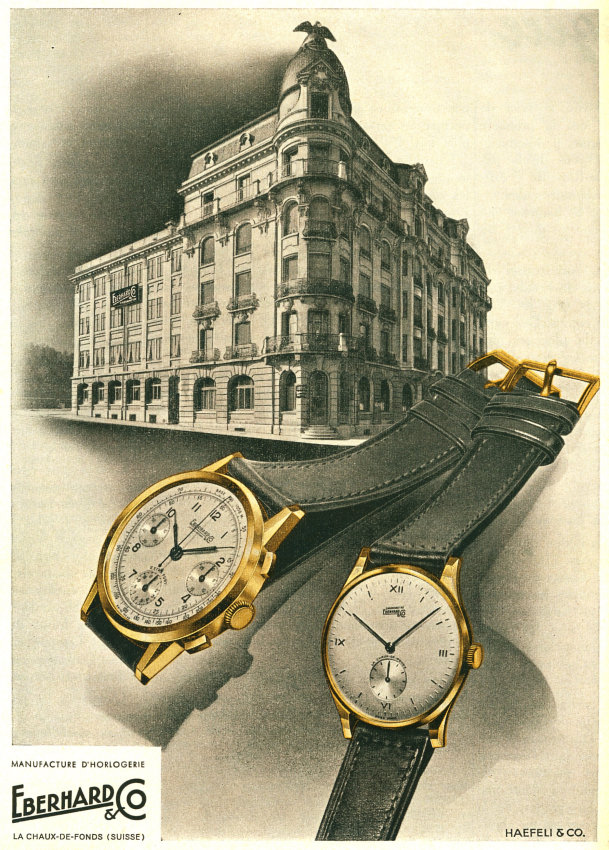
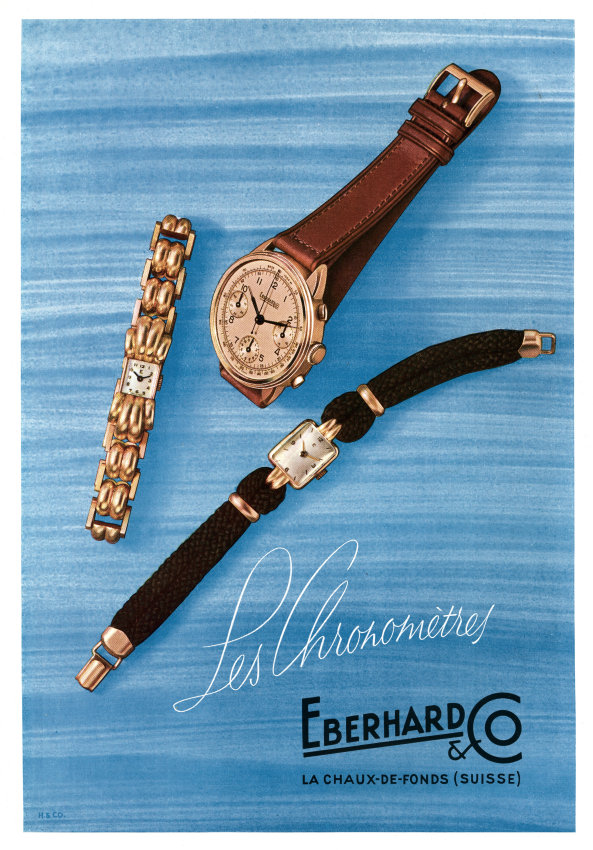
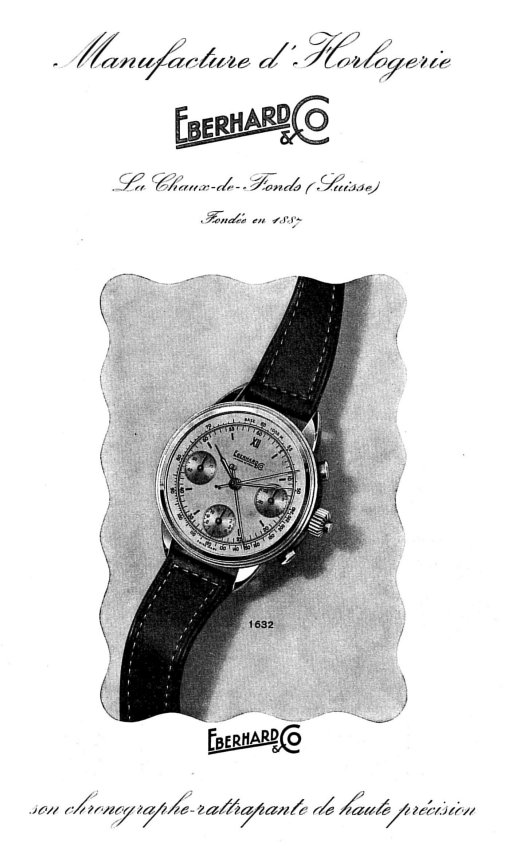
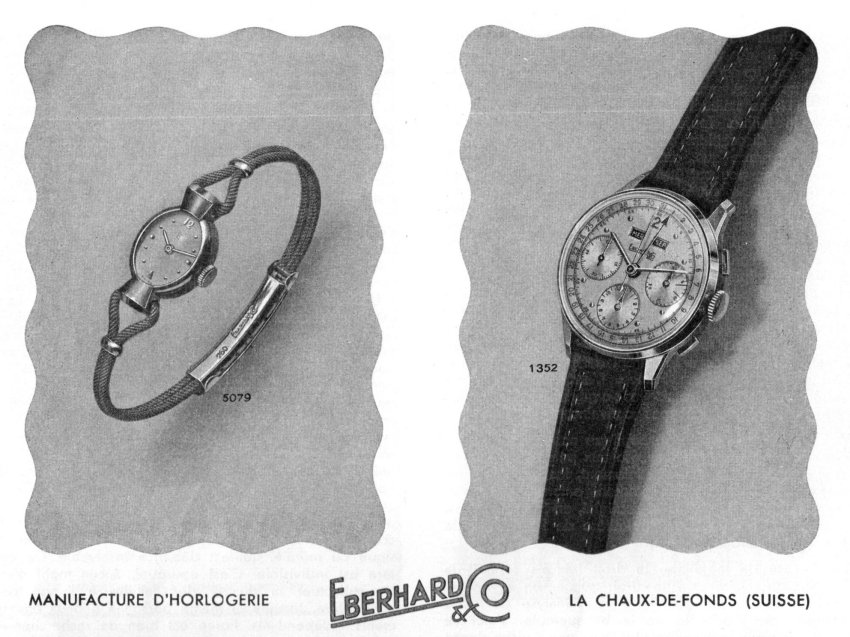
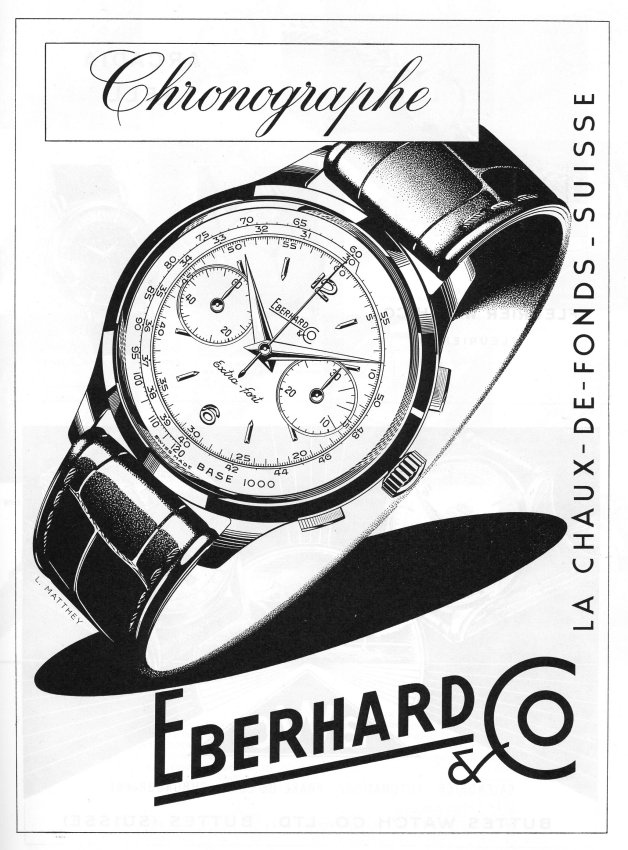
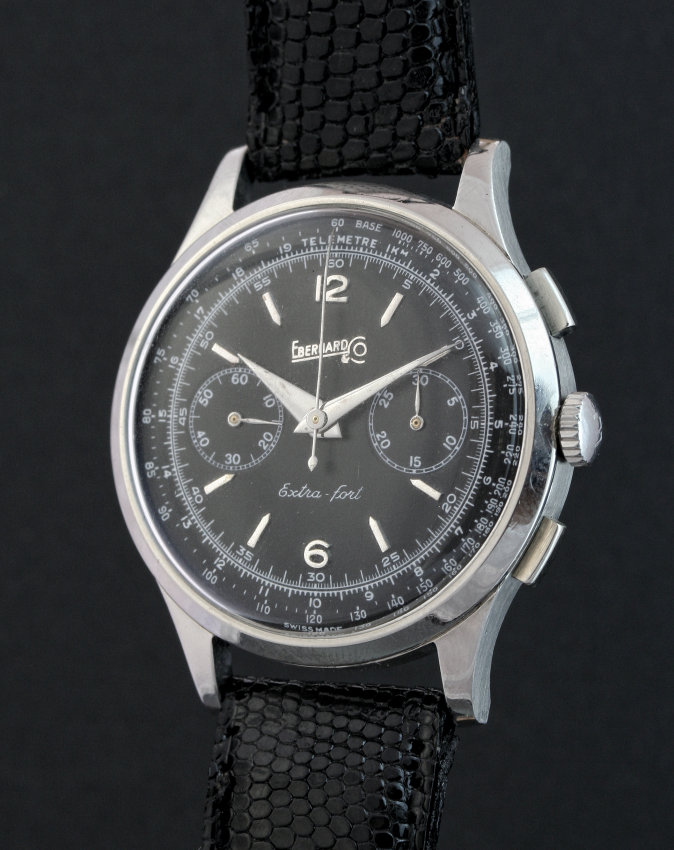
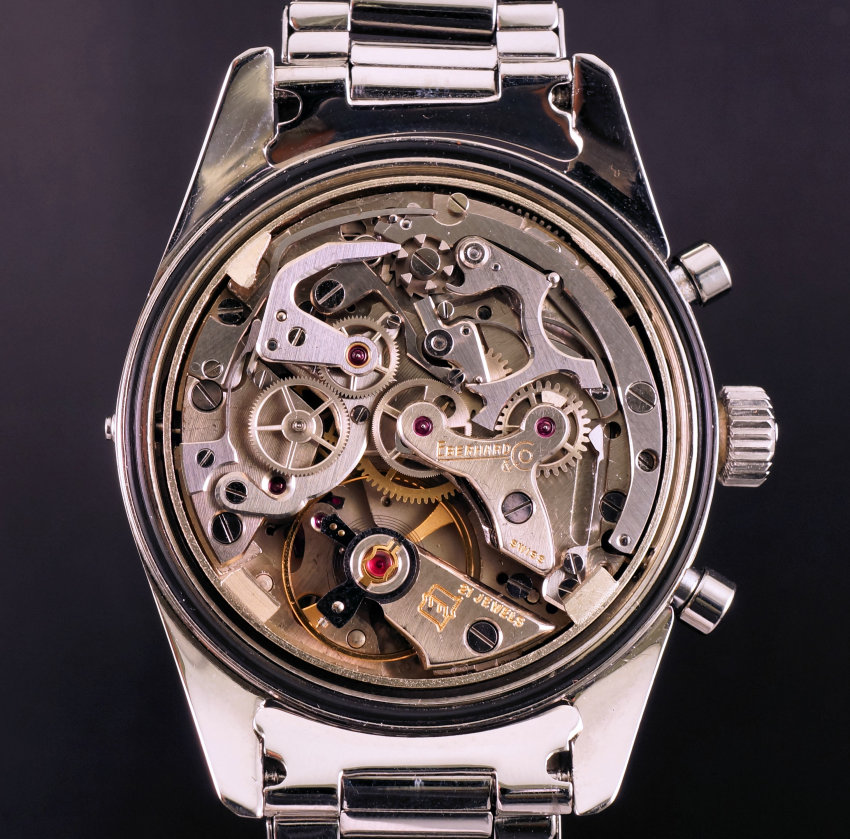
Eberhard & Co. made the chronograph one of its specialties. According to the official history [14], the first two-push-button chronographs allowing the restart of timing date from 1935, those with hour counters from 1938, and the remarkable wrist chronographs with split-seconds from 1939.
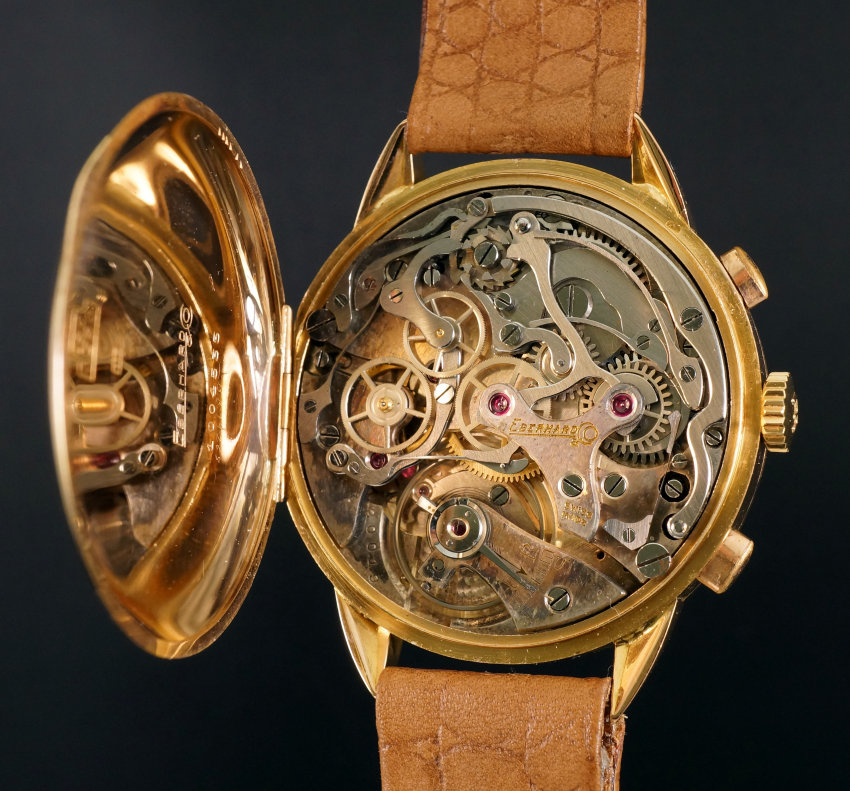
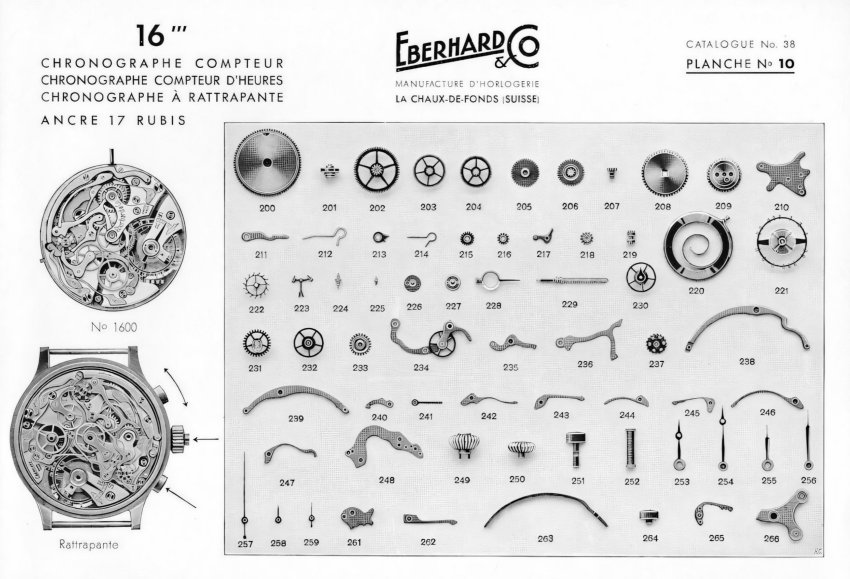
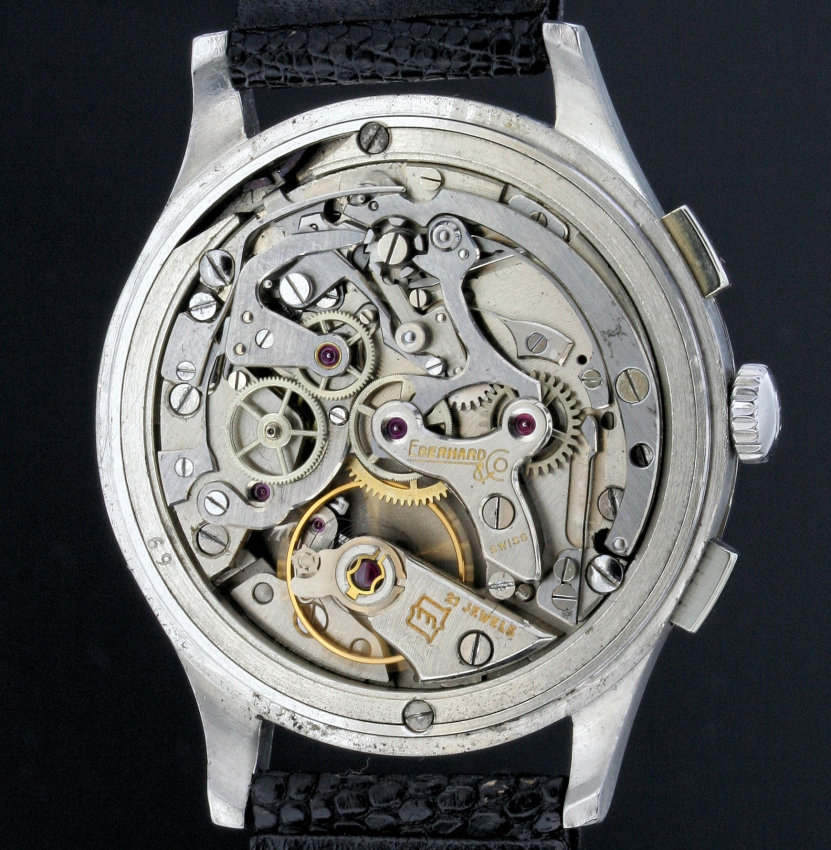
But Eberhard also produced very rare jumping-hour chronographs, likely around 1932. There is, however, some debate regarding the origin of these movements, which may in fact have been produced by Breitling [15]. For the other chronographs, the dates do indeed correspond to the launch of the various versions of the beautiful Eberhard 1600 caliber, developed in collaboration with the chronograph manufacturer Huga in La Chaux-de-Fonds.

Some authors claim that Eberhard produced its first automatic watches in 1930 [15-2]. This may refer to Eugène Meylan’s automatic caliber (EMSA), launched in 1931.

Georges-Emile died in 1942, at which point Maurice and his wife Bluette took over the company, giving it new momentum, bolstered by strong demand for Swiss watches after World War II.

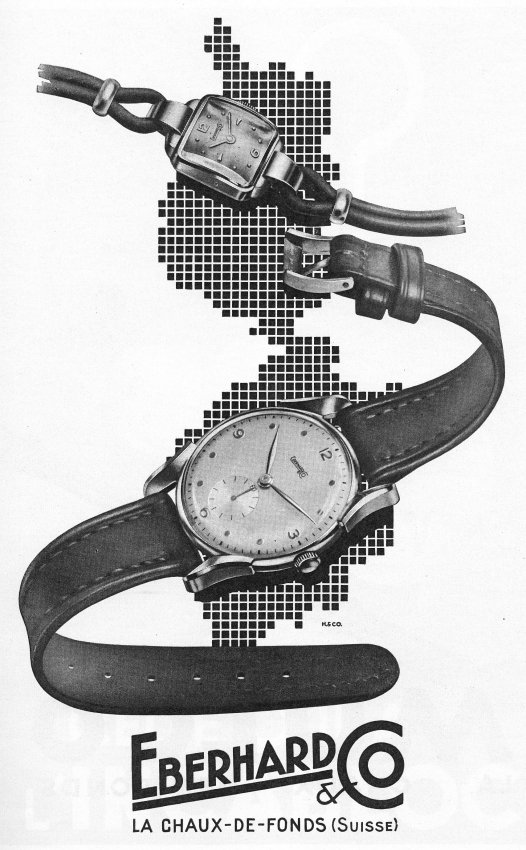
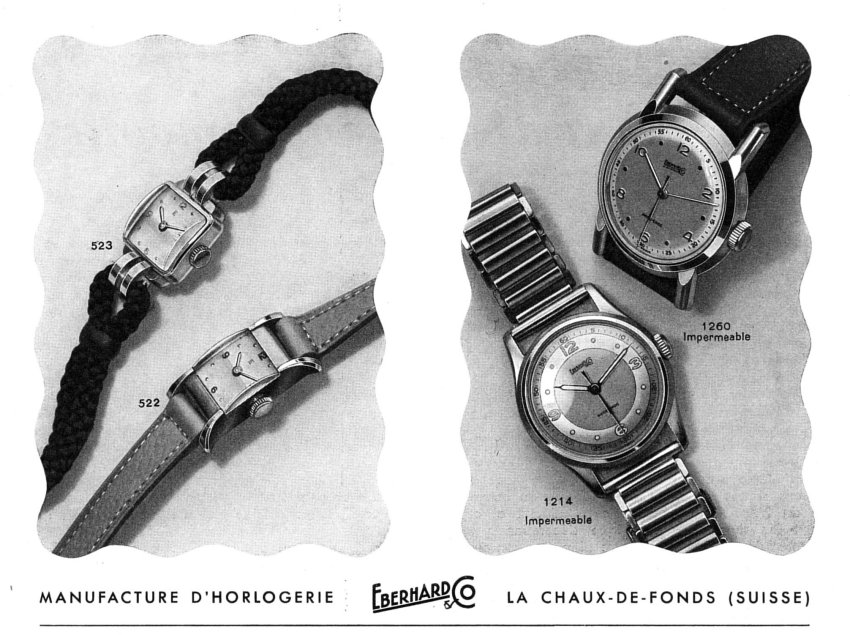
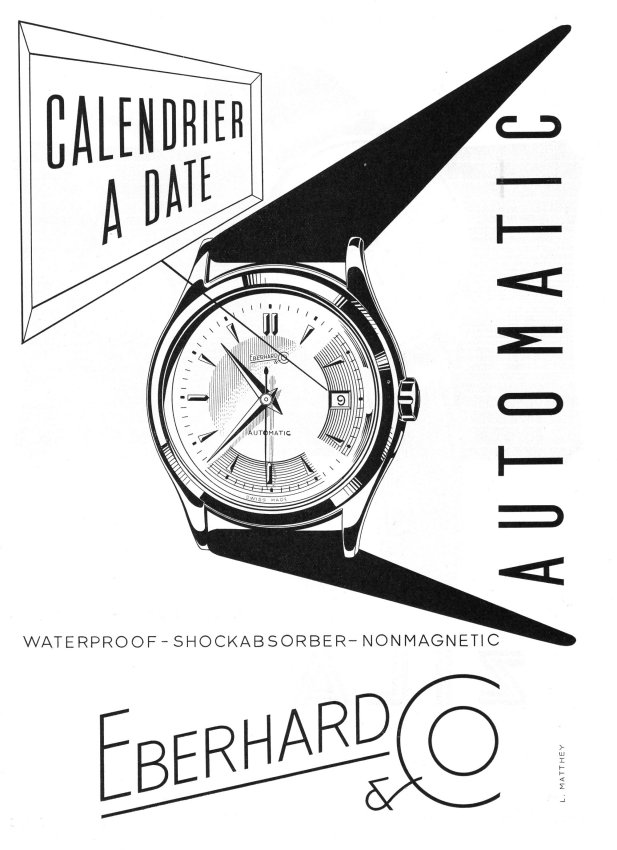
The product lines were then very comprehensive: ladies’ watches, water-resistant watches, automatic watches, calendar watches, chronographs, etc.

1942

1943

1945

1947

1945

1945

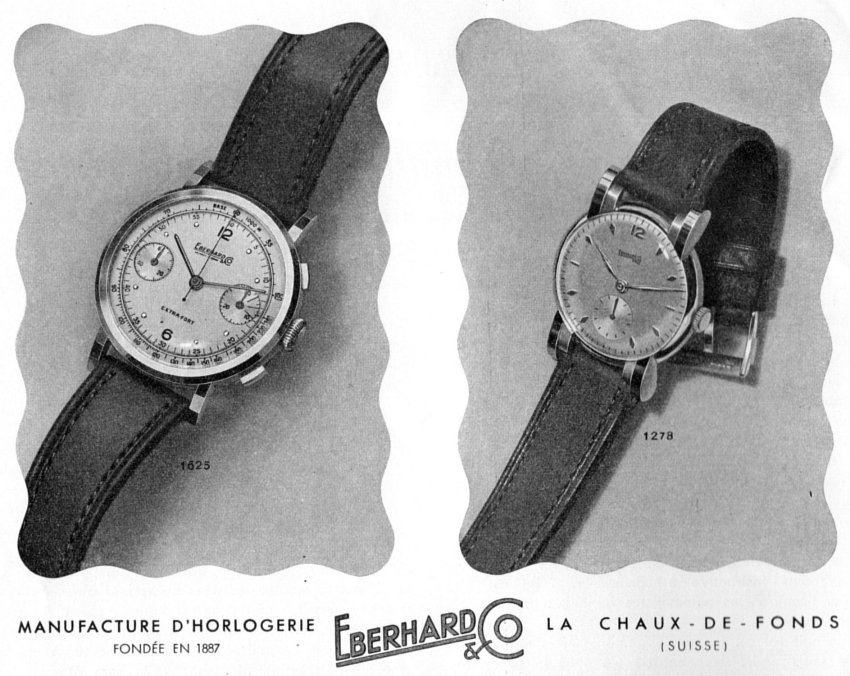
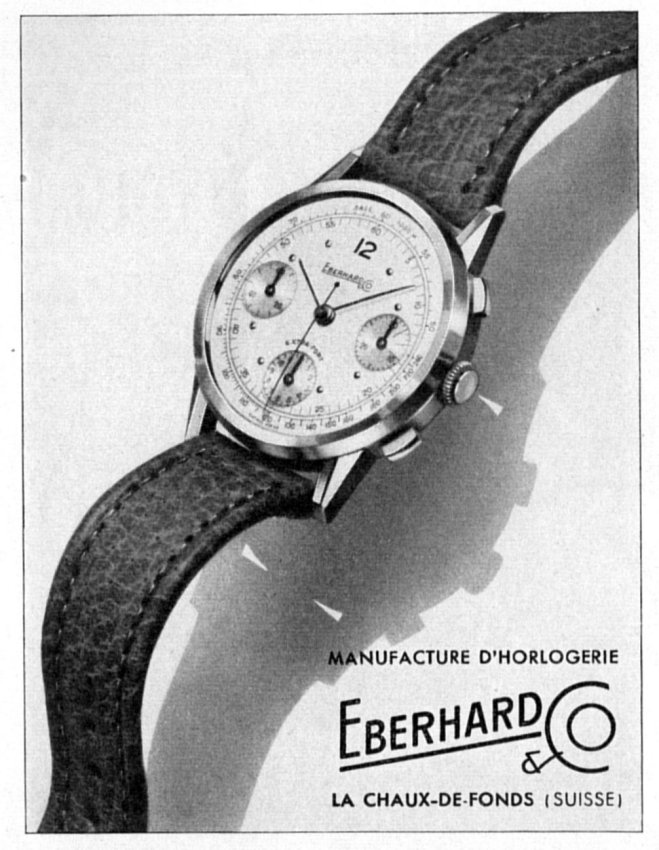
Starting around 1945, Eberhard began using the designation "Extra-Fort" for some of its chronographs, likely those equipped with shock protection.

1946

1948

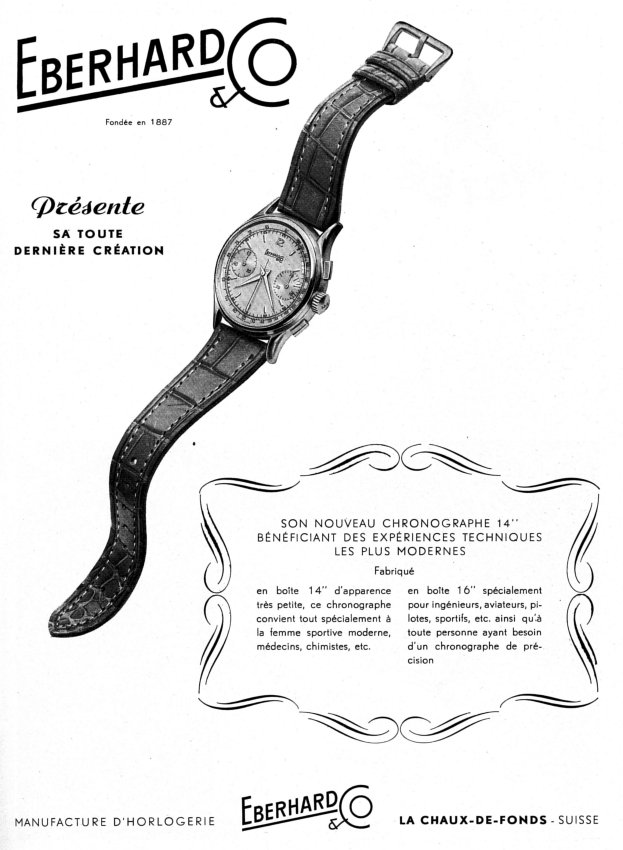
In 1951, Eberhard launched a new chronograph caliber, one of the finest produced in Switzerland at the time: the 14-line Caliber 74, developed by Dépraz & Cie (now Dubois Dépraz) in the Vallée de Joux [16]. This caliber has a unique operating mechanism because it features a push-piece and a lever: “the push-piece, through three successive presses, activates the start, stop, and reset functions of the chronograph hand (large seconds hand) and the small minutes counter; the lever controls only the optional stopping of the large seconds hand and the small minutes counter. It prevents any unintended reset to zero during intermittent monitoring. This mechanism neutralizes any momentary interruption in monitoring and thus, without tedious calculations, allows for the determination of the actual duration of a series of consecutive observations” [17].

1951

1953

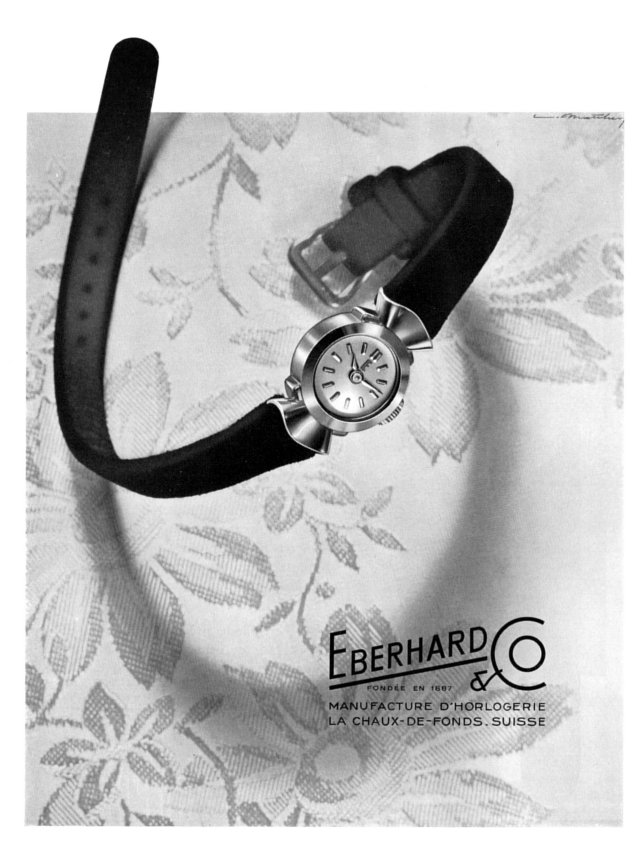
Eberhard's product line isn't limited to chronographs; it also includes beautiful automatic watches and ladies' watches.

1953

1954

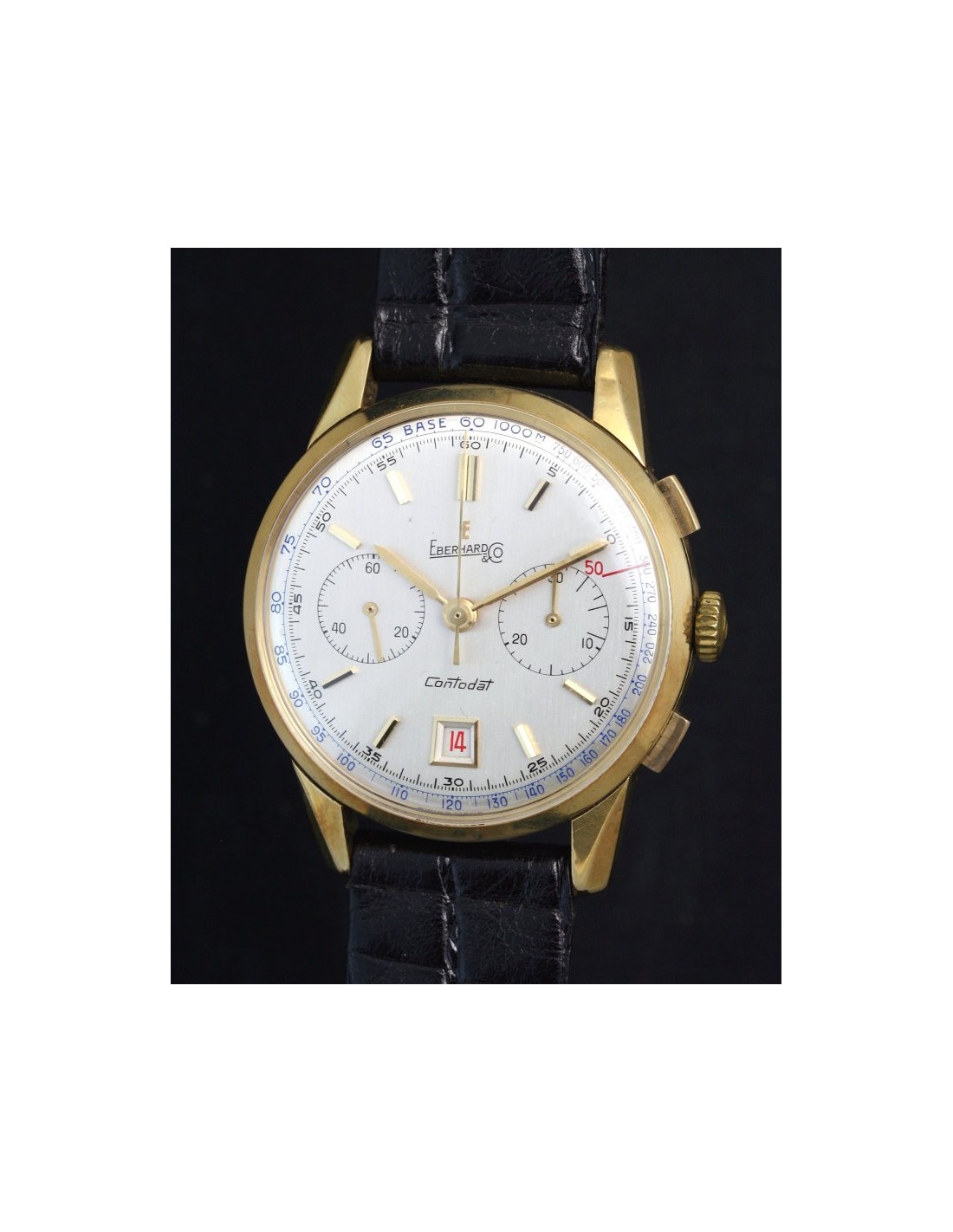
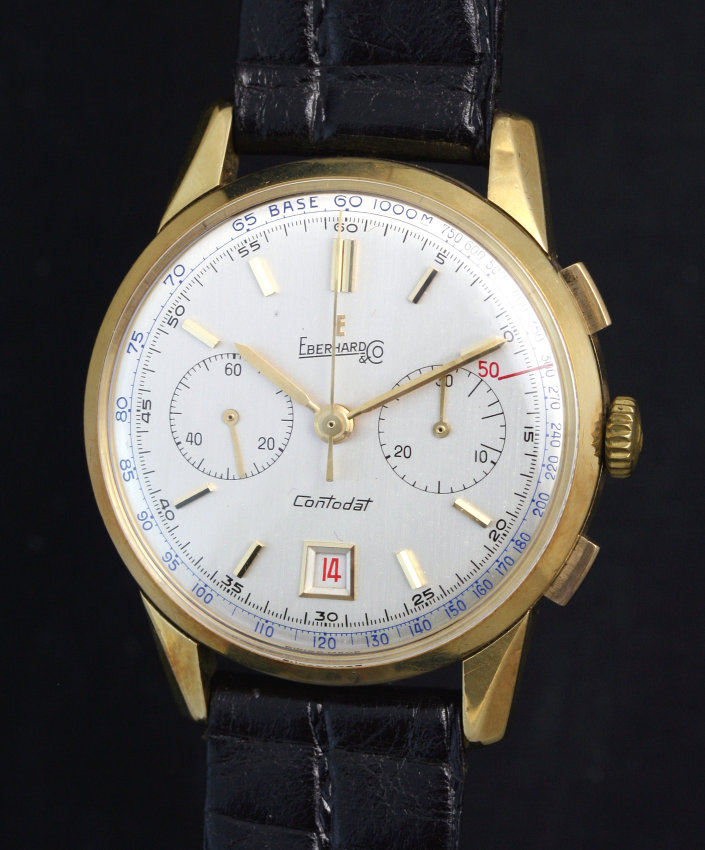
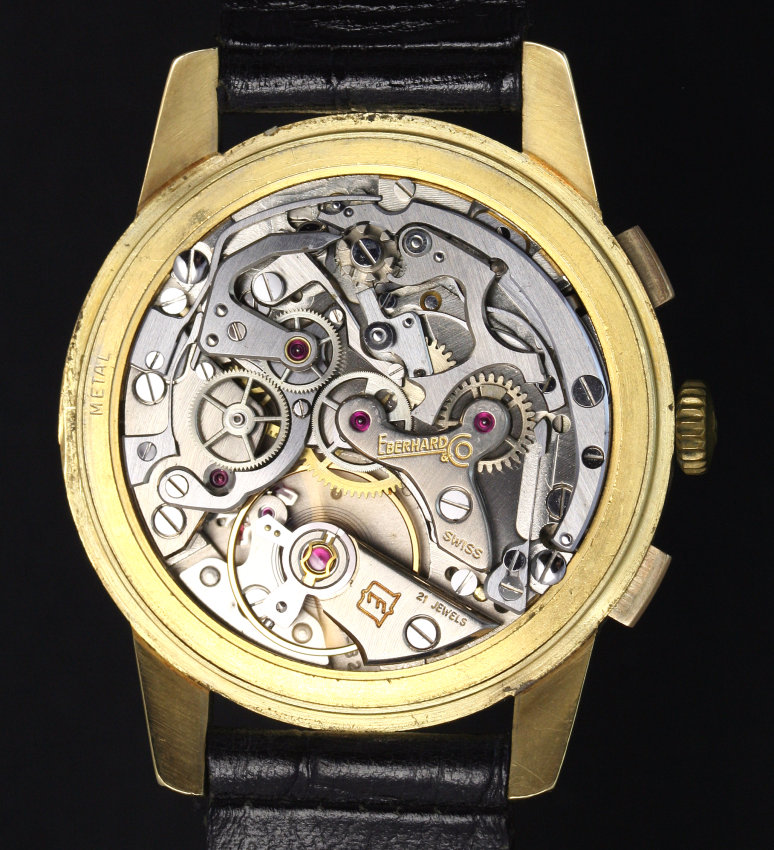
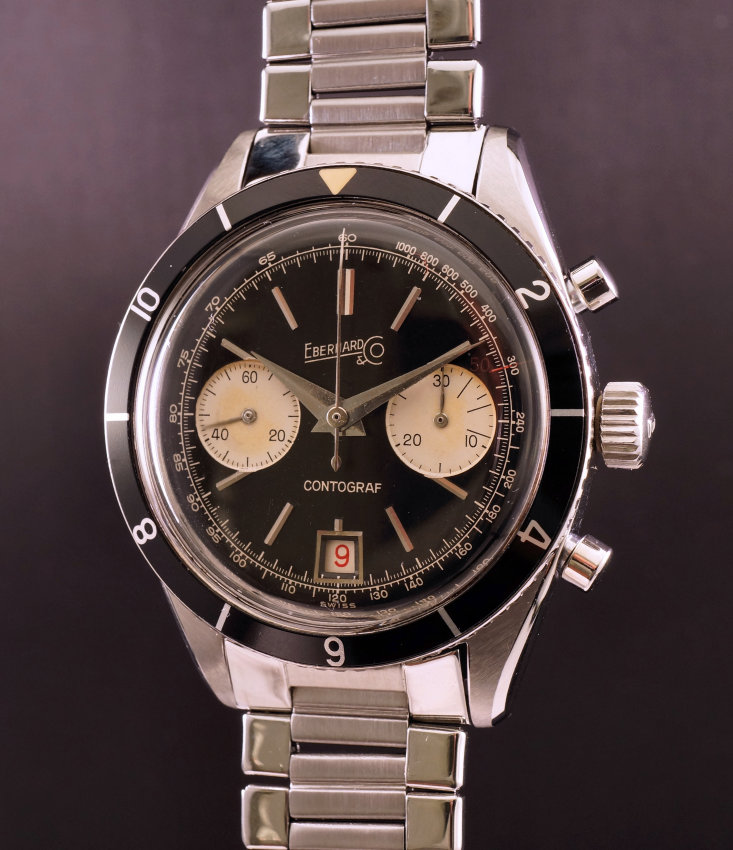
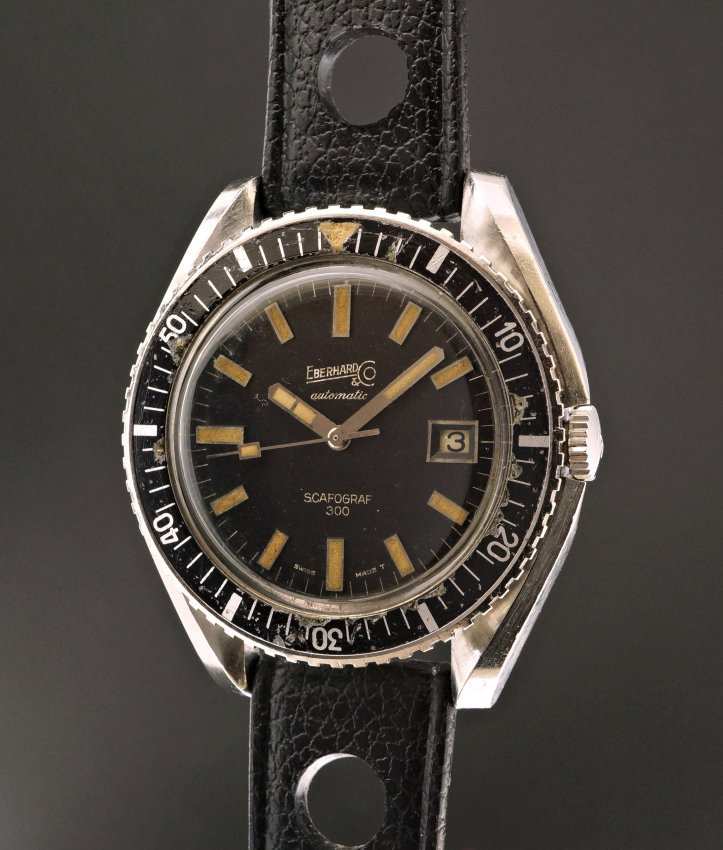
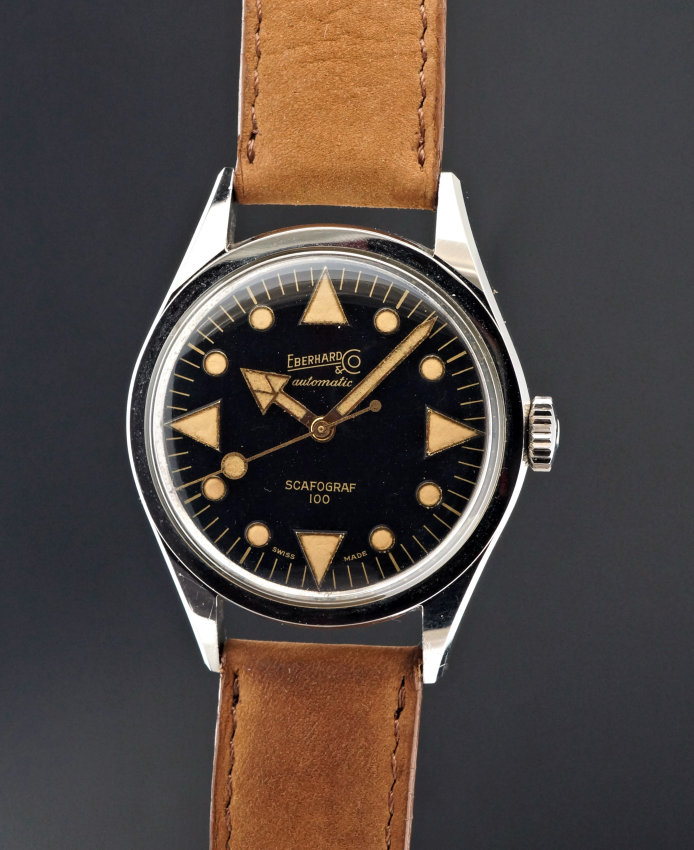
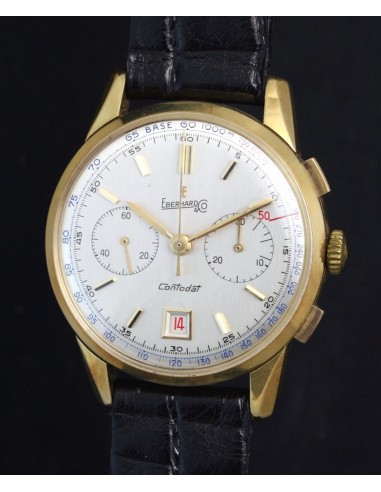
In 1955, Eberhard became a public limited company (SA), and André Montandon, Maurice Eberhard’s son-in-law, joined the board of directors [18]. Eberhard then launched a series of remarkable models: the Contodat chronograph, the first chronograph with a date window, in 1957, followed by the Contograf, a diving chronograph, and the Scafograf 300 diving watch in 1965.

But a tragic event occurred in 1962: André Montandon and his wife died in a car accident. And Pierre-Auguste Leuba, who had been called upon to lead the company, passed away in 1965.

Eberhard then went through a difficult period. The company joined the CHP (Communauté Horlogère de Précision) to develop a high-frequency caliber (36,000 vph), which was launched in 1968, and then introduced its first quartz watches using the Beta 21 caliber in 1970; however, Maurice Eberhard decided to sell his company, which he did in 1972 [19].

2. Charles Brandt

It was Charles Brandt who took over Eberhard in 1972 and became its sole director upon the death of Maurice Eberhard in 1976 [20].

Charles Brandt was already involved in the watchmaking industry: he ran two companies in Biel—E. Brandt & Fils, founded in 1958 with his mother Erica Brandt-Bottinelli, and Fabrique d’horlogerie Dux SA, whose origins date back to 1948.

Eberhard & Co. was, in fact, relocated to Biel in 1978.

Charles Brandt first revitalized the Italian market—the brand’s most important market—by establishing Eberhard Italia SpA in Milan, led by Palmiro Monti, who would play a major role [21].

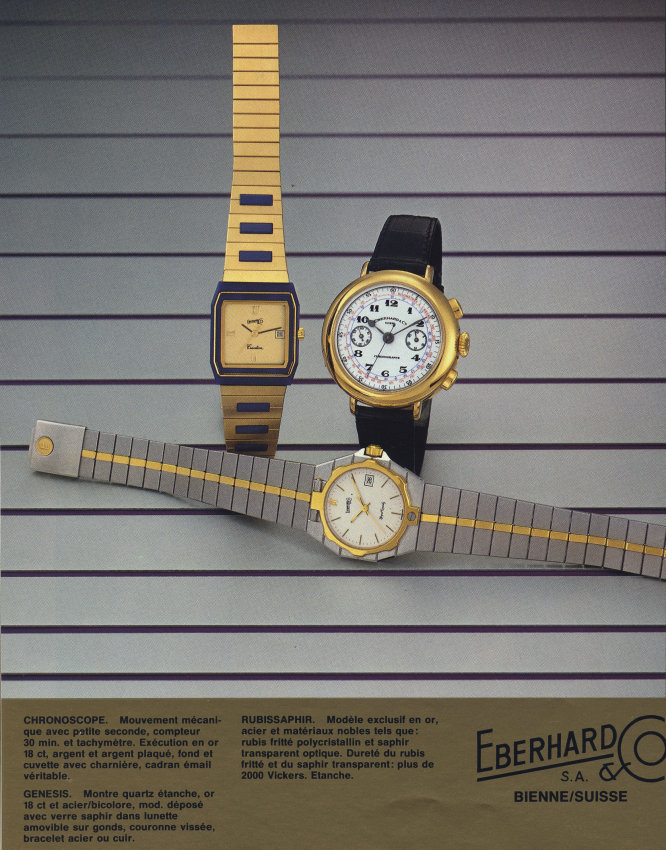
A line of quartz watches was launched, and Eberhard was one of the first Swiss companies to pioneer the “neo-vintage” trend with “Replica” chronographs featuring cases reminiscent of the 1930s and equipped with vintage movements.

1983

1987

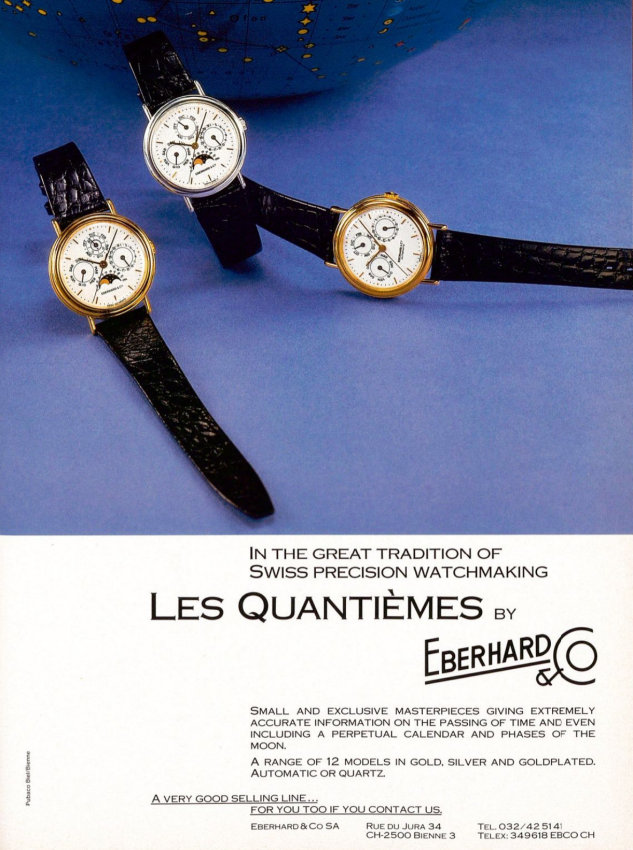
Gradually, the focus shifted to mechanical watches: a titanium regatta chronograph with a regatta start mechanism in 1983, a titanium chronograph based on the Valjoux 7750 in 1984, calendar watches based on the Dubois Dépraz in 1986, and so on.
1986

1992

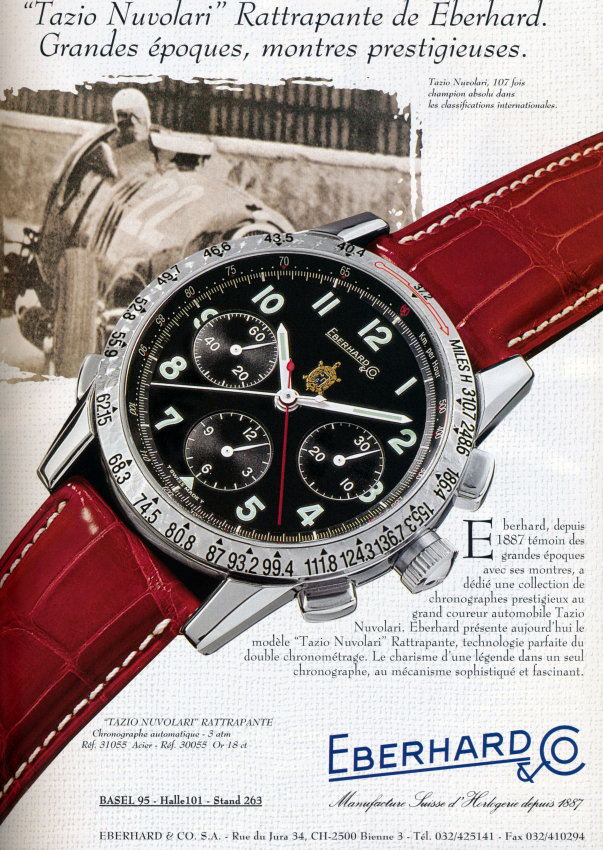
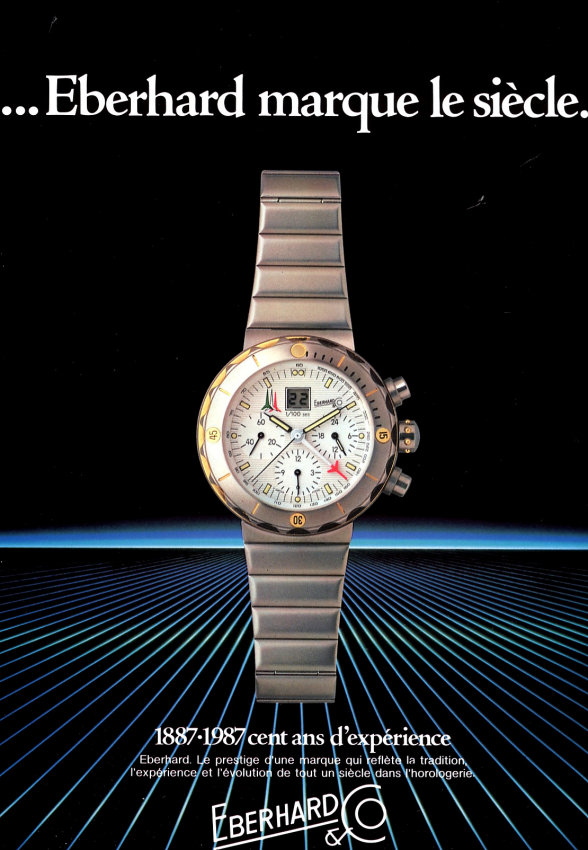
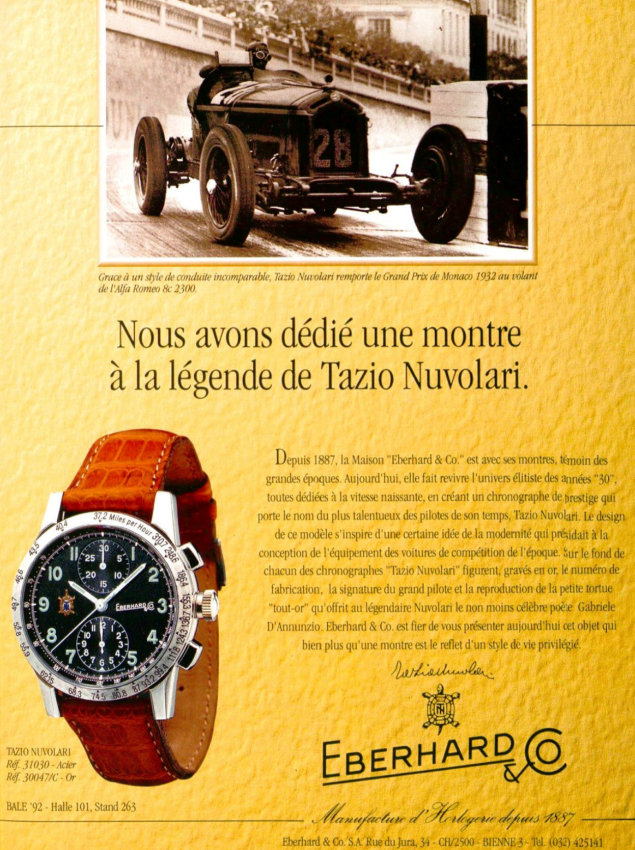
Although the company is based in Biel, it is clearly in Milan that its strategy takes shape: the Frecce Tricolori chronograph in 1987 for pilots of the Italian Air Force, a chronograph honoring Italian racing driver Tazio Nuvolari in 1992, the Quadrangolo automatic watch that same year, the Traversetolo manual-winding watch in 1996, and so on.
1995

2001

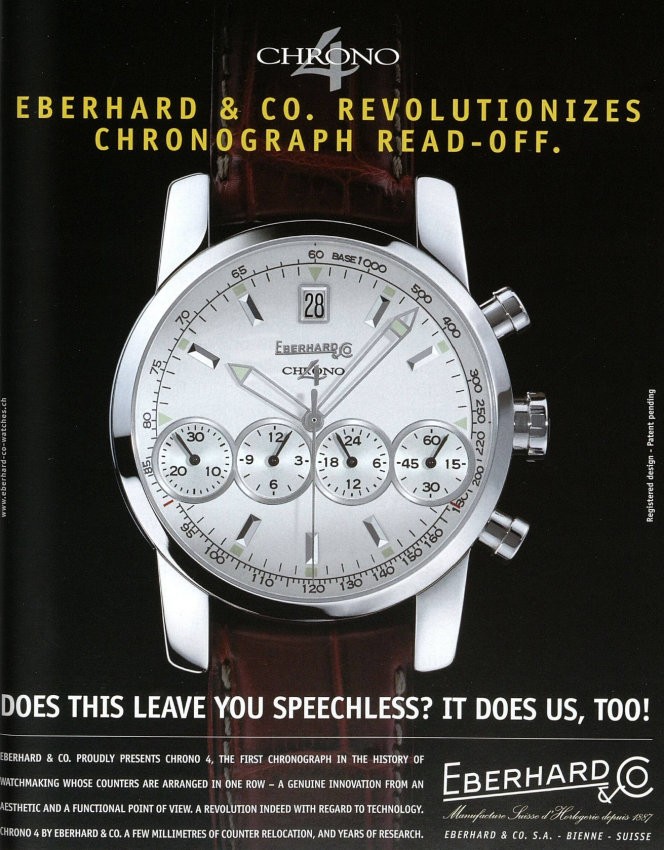
In 2001, Eberhard launched a highly original chronograph: the Chrono 4, featuring four counters arranged in a row. The model was registered in the United States by Charles Brandt in 2002 [22], but the transition was already underway: in 2003, Palmiro Monti became president of the company [23], and today the Monti family is at the helm of the company.

Eberhard’s current website: https://www.eberhard-co-watches.ch/en/

[1] FOSC 1887

{2] FOSC 1892

[3] FOSC 1899

[4] FOSC 1906

[5] Patents CH 31 613 et 33 814

[6] FOSC 1907

[7] FOSC 1914

[8] Journal Suisse d’Horlogerie, 1915, 11, p. 356

[9] FOSC 1918

[10] FOSC 1919

[11] https://www.eberhard-co-watches.ch/fr/la-maison/ accessed in April 2026

[12] FOSC 1925

[13] Revue Internationale d’Horlogerie, 1933, 18, p. 225

[14] La Fédération Horlogère, 1947, 13, p. 245

[15] Coming soon

[15-2] https://segnatempo.it/storia-delle-maison/storia-della-maison-eberhard-co/

[16] Dubois Dépraz, 90 années d’horlogerie compliquée, édité par Dubois Dépraz, 1991, pp. 52-53

[17] Journal Suisse d’Horlogerie, 1951, 7-8, p. 246

[18] FOSC 1955

[19] FOSC 1972

[20] FOSC 1920

[21] La Suisse Horlogère, 1982, 3, p. 37

[22] Modèle US D457,817

The FOSC (Swiss Official Gazette of Commerce) is available at E-periodica

Notes:

About Time To Tell: Time To Tell has one of the largest private digitized databases on the history of Swiss watchmaking, with over 2.5 TB of data on more than 1,000 Swiss watch manufacturers. This database has been built up over a period of around 30 years and continues to be updated with around 50 to 100 GB of data each year. The database consists of historical documents, mainly Swiss trade journals, dating from the late 19th century to the late 20th century. Most of these documents are not available on the Internet. The historical articles published on the time2tell.com website always cite the sources used.

Time To Tell is a private company, independent of any watch manufacturer.

©Time To Tell, 2026

Reproduction without permission is prohibited.

Any use of this article by artificial intelligence is strictly prohibited and will be considered a violation of copyright.

Product Details

Product added to wishlist

Nous utilisons des cookies afin de fournir une expérience utilisateur conviviale. En naviguant sur ce site, vous acceptez la politique d'utilisation des cookies.