The main Ernest Borel watch models

The main Ernest Borel watch models

Ernest Borel

Many Ernest Borel watches of the 1930s and 1940s have an original design, but the company didn't name some of its models until 1946.

Description

Joël Pynson

October 2024

Update : November 2024, August 2025

- Rendez-vous

This extremely rare watch dates back to 1946, and it's very surprising. It features a tact alarm: at the time set by the crown and displayed on a small dial at 9 o'clock, a small auxiliary crown at 9 o'clock starts to turn and warns the wearer. It appeared only once in the watchmaking press of the time, and was certainly only produced in very limited quantities.

The Rendez-vous name was later used by Ernest Borel for classic alarm watches equipped with Ébauches SA's Alertic movement.

- Cocktail


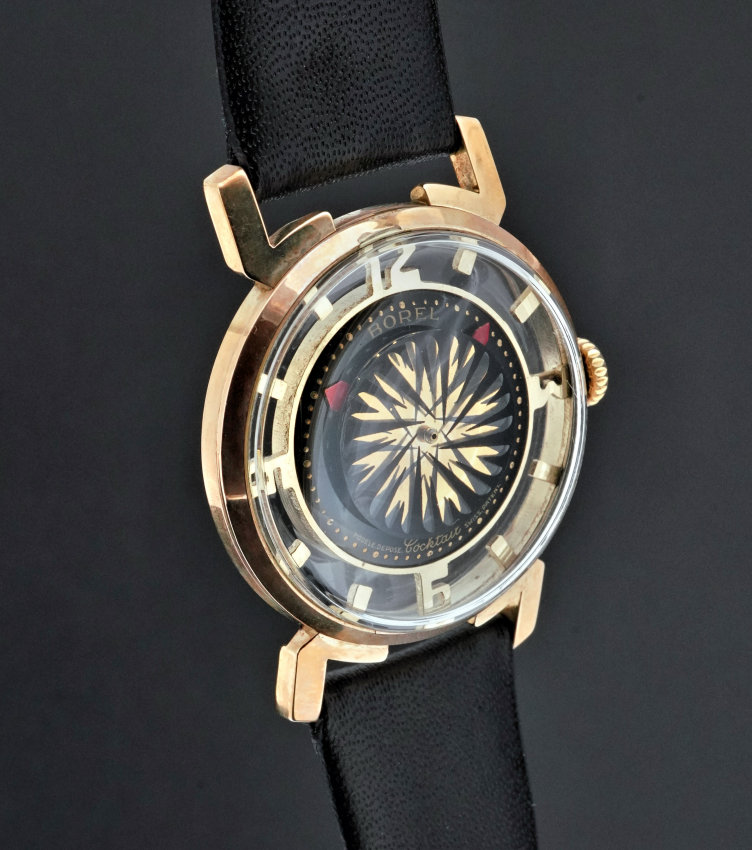
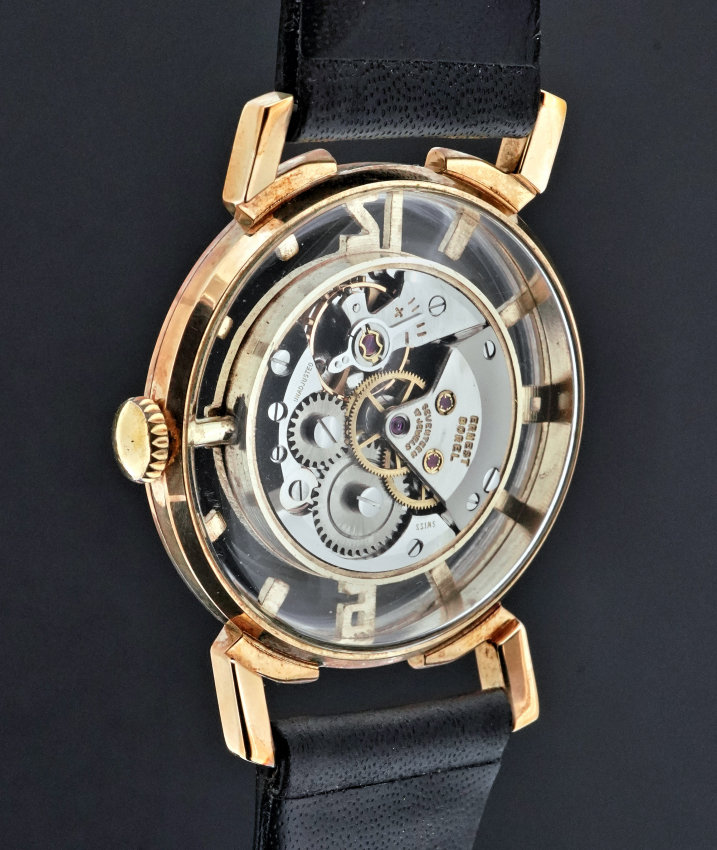
This is Ernest Borel's best-known model. Launched in 1953, its success was immediate. The watch is equipped with a small 8.75-line movement with center seconds. The minute and seconds hands are replaced by transparent colored discs which, as they rotate, create attractive kaleidoscopic patterns. From the outset, there were numerous models for both men and women with a variety of motifs. Remarkably, the back of the watch is transparent to reveal the movement.

In 1954, the Cocktail model was the subject of a 3D advertising campaign: green/red glasses were supplied with the magazines so that the advertising could be admired in 3D!


1954

The Cocktail model was produced throughout the 20th century, and is still in the brand's catalog today.


1954

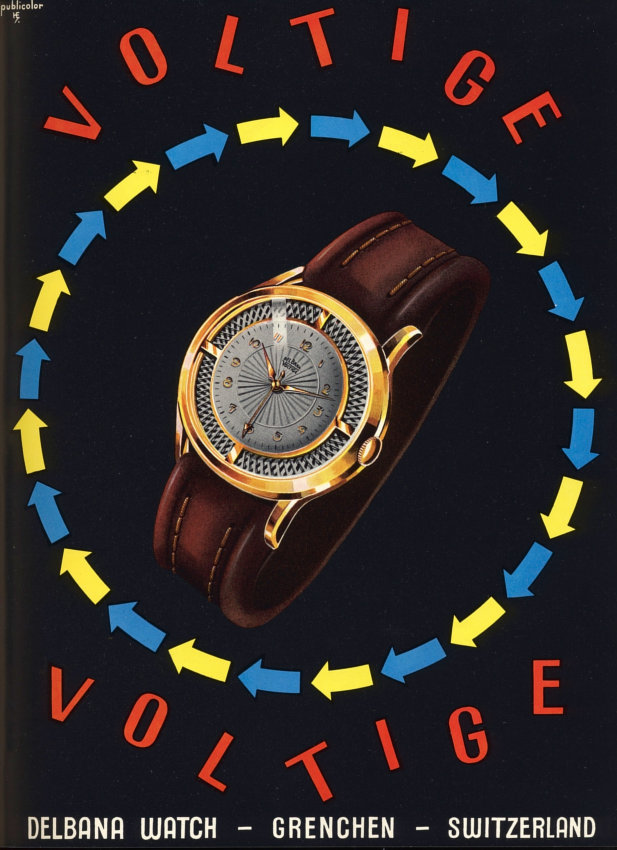
Following this success, other manufacturers launched watches with moving dials. These included Delbana with its Voltige model launched in 1954, and Invicta with its Graphomatic model from 1955. Ernest Borel's patents were disputed, in particular because of an earlier patent dating from 1950, which Ernest Borel and Delabana eventually licensed [22]. 

- Datoptic

On a wristwatch, reading the date is not always easy due to the small size of the numerals in their aperture. Rolex was well aware of this, and in 1952 patented its famous "Cyclops" magnifier glued to the crystal [23]. In 1954, Henry Du Pasquier patented a magnifying glass set directly onto the dial aperture [24]. The Datoptic model was born in 1955, and has been available in steel, plated and gold.


1955

However, the laws of optics are clear: the magnification effect also depends on the distance between the magnifying glass and the object. Being very close to the date disc, Ernest Borel's magnifier is not as effective as Rolex's, and the Datoptic model had a relatively short career.

- Society


This elegant automatic watch in steel or plated, launched in 1956, has the distinctive feature of having a "drowned" crown, i.e. integrated into the case or bezel. The dial also has a mirror effect. The movement is equipped with the Incastar setting device.

- Flash

Curious wristwatches appeared at the end of the 1950s: they were equipped with a small lamp that could be switched on at will! The first was launched in 1956 by Ad. Allemann Fils, under the name Tourist Everlight. The watch featured a small bulb above the 12 o'clock index, which could be switched on by a push-button located on the side of the case at 2 o'clock [25].


1956

In 1958, the famous Fabrique Ernest Borel launched its own Flash model, based on its own patents and a slightly different principle [26]. The bulb was placed under the dial in a plastic housing running all the way around the periphery of the dial. When the push-button at 2 o'clock was pressed, the entire dial was illuminated. The battery could be recharged with a single cell, providing 6 months to a year's operation. The watch was available in steel or plated.

- Monaco


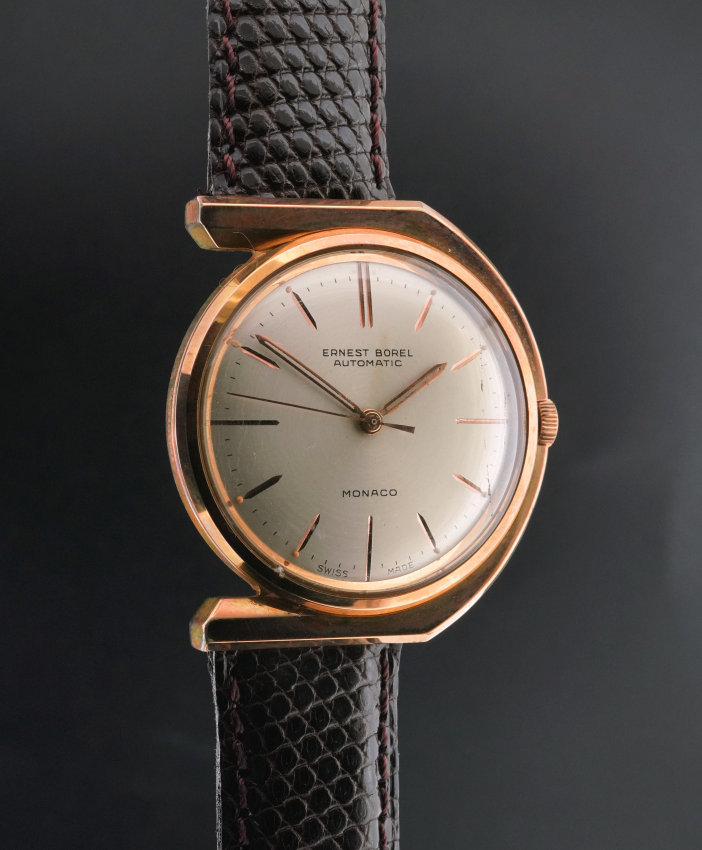
For the company's centenary in 1959, Ernest Borel launched several models, one of which, the Monaco, was quite original, with its asymmetrical case and drowned crown. It was an automatic model with a gold-plated case. Ernest Borel also presented other asymmetrical models in 1960.

- Space Gem


This is the last notable model from Ernest Borel's golden age. It's an automatic watch with date, featuring a case water-resistant to 200m, in steel or plated. There are high-frequency chronometer versions (36,000 vph) of this model.

See also: Aubry Frères-Ciny (coming soon) and the current Ernest Borel website

[22] Patent CH 284 141 from 1950, patent CH 296061 from Henry DuPasquier from 1952 and Delbana patent CH 311 299 from 1953.

[23] Patent CH 298953

[24] Patent CH 306108

[25] Journal Suisse d’Horlogerie, 1957, 3, p. 132

[26] Revue internationale d’Horlogerie, 1958, 4, p. 7 

Notes :

About Time To Tell: Time To Tell has one of the largest private digitized databases on the history of Swiss watchmaking, with over 2.3 TB of data on more than 1,000 Swiss watch manufacturers. This database has been built up over a period of some thirty years, and continues to be fed with around 50 to 100 GB of data every year. The database is made up of old documents, mainly Swiss trade journals, dating from the late 19th to the late 20th century. Most of these documents are not available on the Internet. Historical articles published on the time2tell.com website always cite the sources used.

Time To Tell is a private company, independent of any watch manufacturer.

© Time To Tell, 2025

Reproduction forbidden without authorization. Any use of this article by artificial intelligence is strictly forbidden and will be considered an infringement of copyright. 

Product Details

Product added to wishlist

Nous utilisons des cookies afin de fournir une expérience utilisateur conviviale. En naviguant sur ce site, vous acceptez la politique d'utilisation des cookies.