The true story of Camy watches

The true story of Camy watches

Camy

Forgotten today, the Camy watch factory was one of Switzerland's largest in the late 1960s, and millions of watches around the world bear the trademark of the dove of peace.
Description

Joel Pynson

January 2025 


1. The Stroun dynasty

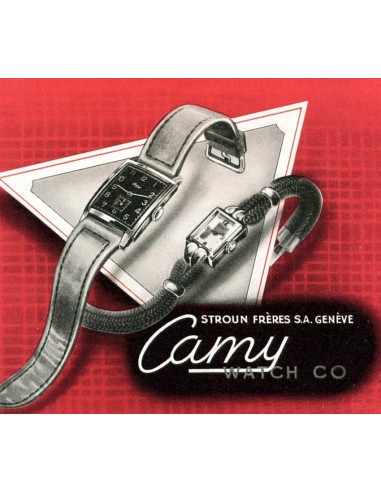
The brothers Maurice, Samuel and Naum (or Nachum) Stroun, originally from Polotzk, formerly in Russia and now in Belarus, set up a watchmaking factory in Grenchen in 1917 [1].

1918

The Camy trademark was registered in 1923.

In 1924, Samuel and Naum join the board of directors of Manufacture d'Horlogerie Etna, a company founded in Geneva in 1918 by another Russian citizen, Adolphe Neumann [2], with a branch in the United States.

In 1934, Naum left Stroun Frères and moved to Geneva to continue managing Etna, and he went on to set up a number of watchmaking factories, either alone or in association with Adolphe Neumann: Dione Watch, Tower Watch, Empire Watch and Geneva Watch Co. !

In 1943, Samuel and Maurice also decided to move to Geneva and rename their company Camy Watch [3].

1945

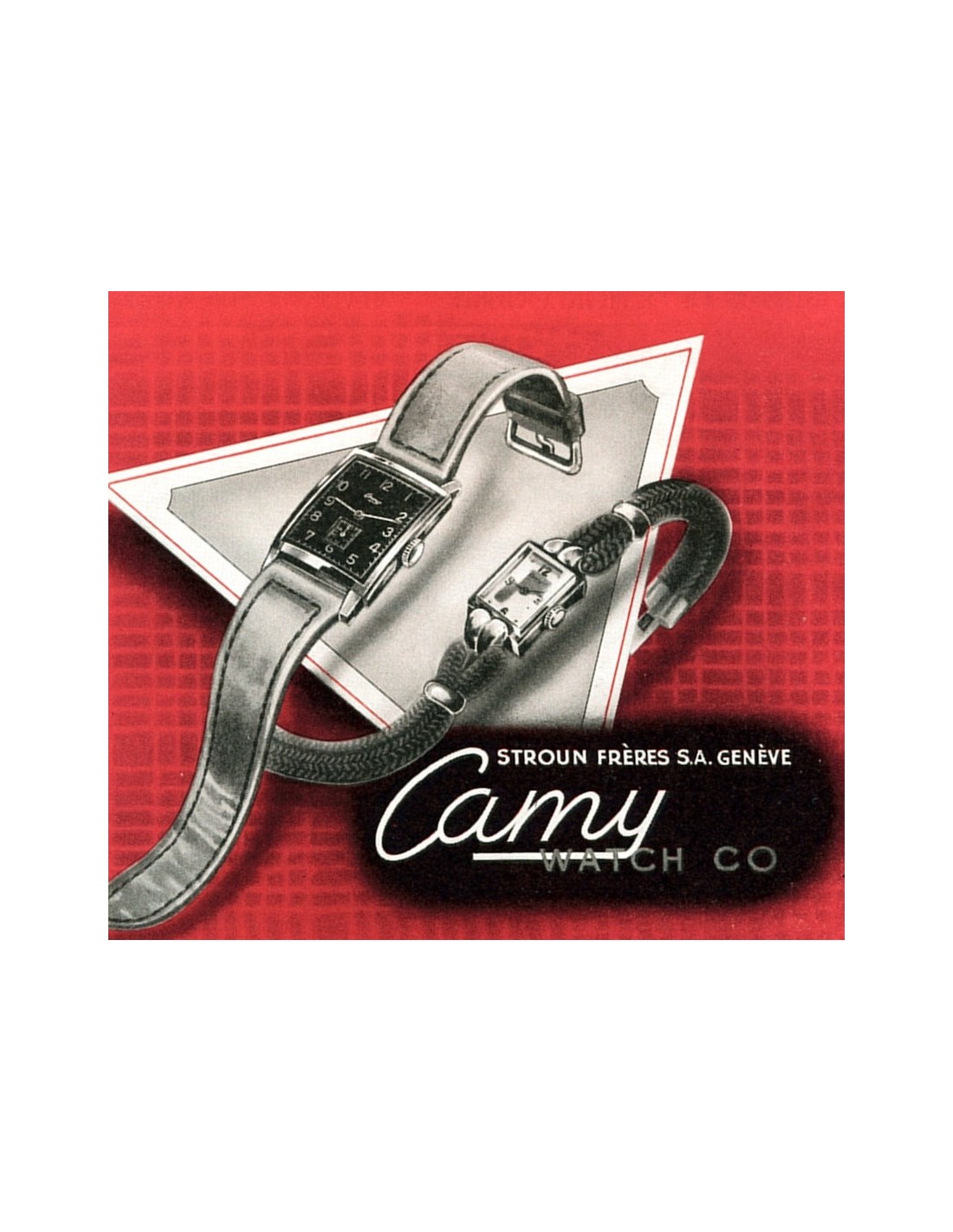
Camy watches are very classic, affordable anchor watches. As an "etablisseur", Camy takes advantage of the innovations offered by Ébauches SA, such as automatic watches from the early 1950s.


1954

1959

In 1954, an important event occurred in the company: Raymond Weil joined the Board of Directors [4]. Having joined the company in 1949, he was to accompany the company in its strong growth, linked to international expansion and the development of a profusion of new models.

The number of models multiplied: automatic watches, alarm watches, key-holders with watches, and numerous ladies' watches.

Jewels and more jewels [5]!

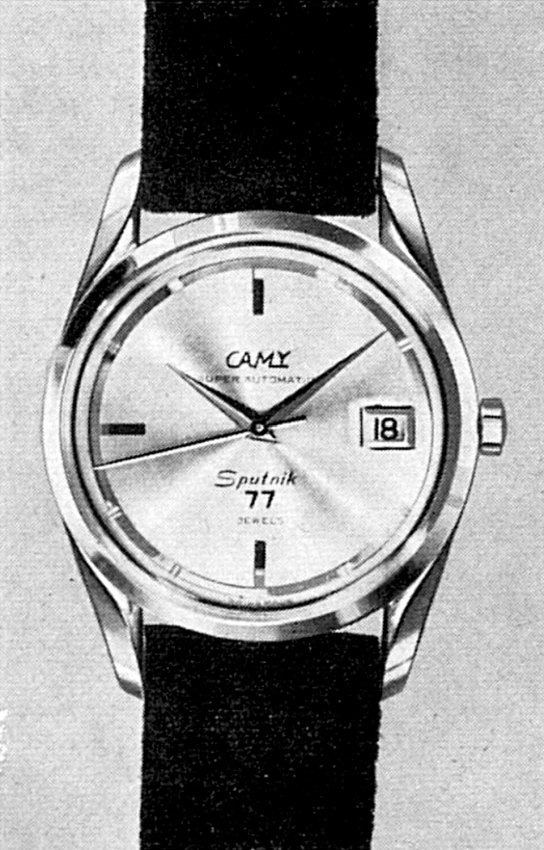
From 1959 onwards, Camy joined other Swiss watchmakers in a curious bidding war over the number of jewels in the movement. Some 1959 models featured 41 jewels on the dial, while others had no fewer than 77 jewels in 1960!


By replacing the steel balls of automatic movements with rubies, it is possible to increase the number of rubies without improving the quality of the movement. Manufacturers using A.Schild automatic calibers displayed 41 jewels on their dials: this was the case, for example, with Choisi, Candino, Damas, Invicta, Tradition, Wega, Rotary, Precimax or Dogma. A modification to the ETA automatic calibers (2450 or 2375) made it possible to announce 57, 60 or 77 jewels. And with the FHF 65 caliber, with its ball-bearing-mounted peripheral rotor, it was possible to replace the steel balls with ruby balls and increase the total to 51, 60 or even more. These consequent figures were claimed for the Selza Datamatic, Octo Missilemaster, Camy Sputnik, and also by Royce and Candino. Finally, the height of extravagance was reached by Cauny, who in 1962 offered models with a choice of 57, 81 or 110 rubies!

This overbidding was enough to leave the potential buyer rather perplexed. In 1962, a London court condemned the practice of "up-jewelling" as contrary to the Merchandise Marks Act - in other words, misleading advertising. In any case, the English decision had the effect of putting a stop to ostentatious advertising for the number of jewels, even if the production of certain movements of this type continued until the end of the sixties.

A few model names appeared on dials in the 1960s, such as Royal or Jetking, but these were actually range names, not model names.


1964

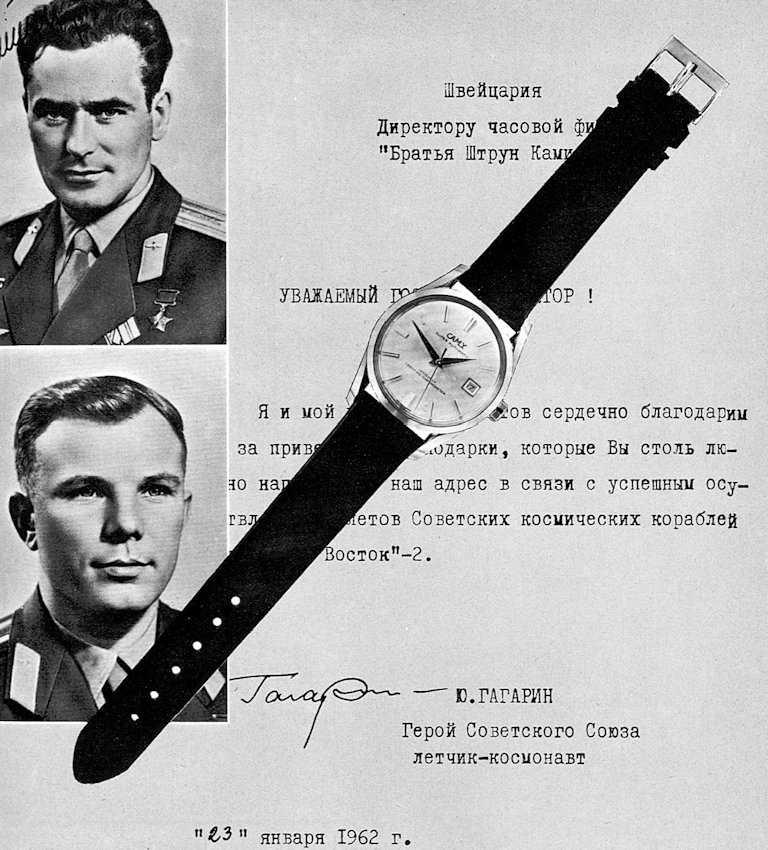
One of these ranges is now the subject of debate: the Sputnik models. In 1964, Camy claimed that two Russian cosmonauts, Titov and Gagarin, wore Camy chronometers [6]. This fact does not seem to have been confirmed by other sources.

1962

In 1961, Camy launched, along with other Swiss watchmakers, an electric watch, thanks to the provision by Ébauches SA of the Landeron 4750 caliber, whose spiral balance is maintained by a battery-powered electric system [7].

Poorly accepted by watchmakers and offering no increase in precision, this caliber was a commercial flop.

1962

1966

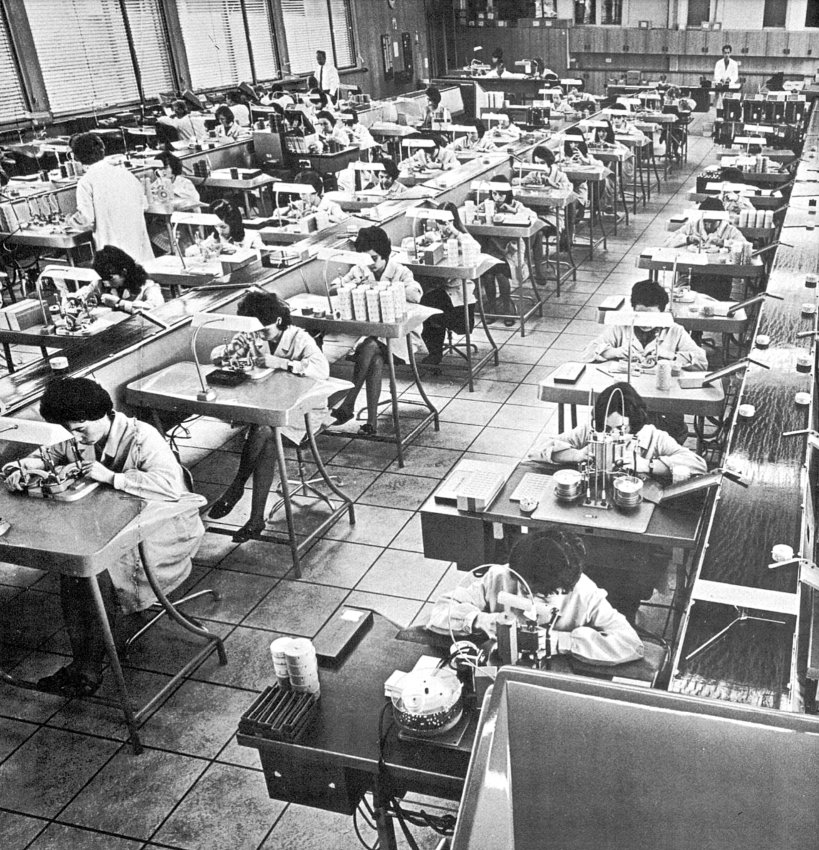
In 1962, to increase its production capacity, Camy inaugurated a new factory in Losone in the canton of Ticino. By 1966, the plant had 6 production lines and produced 1.5 million watches a year [8]. To market some of the watches made in Losone, Samuel Stroun and his son Jean set up the Stroun Frères company, Borea Watch, in the same town [9].

In the early 1960s, Camy launched a number of diving watches, some with Piquerez Supercompressor cases.

For the Swiss watchmaking industry, the 1960s were a time of consolidation to face up to competition. In 1967, Camy joined SAGITER, a production platform created by a dozen manufacturers including Invicta, Eska, Rado and Sandoz. [10]

In 1969, Camy inaugurated a new factory in Geneva. It was a remarkable building for its time, made of a block 50 meters long and 12 wide, resting on 4 concrete pillars. The workshops are high above the offices, and there are no partitions. Designed by architects Francis and André Gaillard, the building is now listed in the inventory of the Canton of Geneva [11].

1969

In the field of design, Camy's creativity continues unabated: new chronographs, new diver's watches, Seven Seas and Sea Club ranges, etc. By 1970, Camy boasted over 400 watch models!

Samuel Stroun died in 1971, and Jean took his place. Jean Stroun also took on responsibilities with the Fédération Horlogère, becoming Vice-President in 1974 [12].

1971

1973

1973

In 1972, Borea Watch was renamed Cronel Watch. This brand was dedicated to economical watches. In 1973, Camy launched electronic watches (tuning fork), but quartz watches arrived late, in 1974. The high price of the first quartz watches was undoubtedly not compatible with the company's tight pricing policy.

2. The electronic age

In 1975, Raymond Weil left the company to set up his own company with Simone Bédat, who had also worked at Camy [13].

The number of new models continued unabated. Automatic movements now rub shoulders with quartz movements. All display modes are available: analog, LED and LCD.

1976

1977

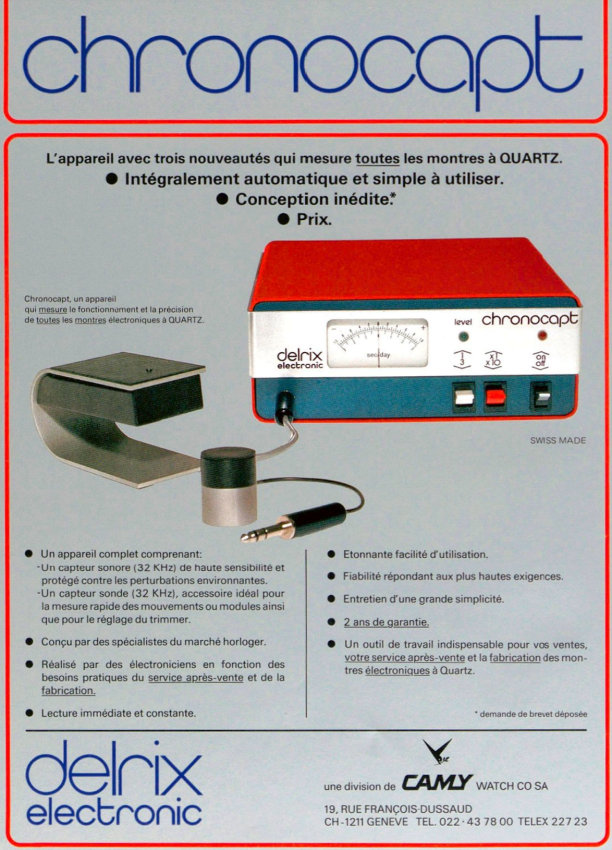
In 1977, Camy diversified into electronic components with the creation of Delrix Electronic. A device designed to control quartz watches, the Chronocapt, is offered to watchmakers [14].

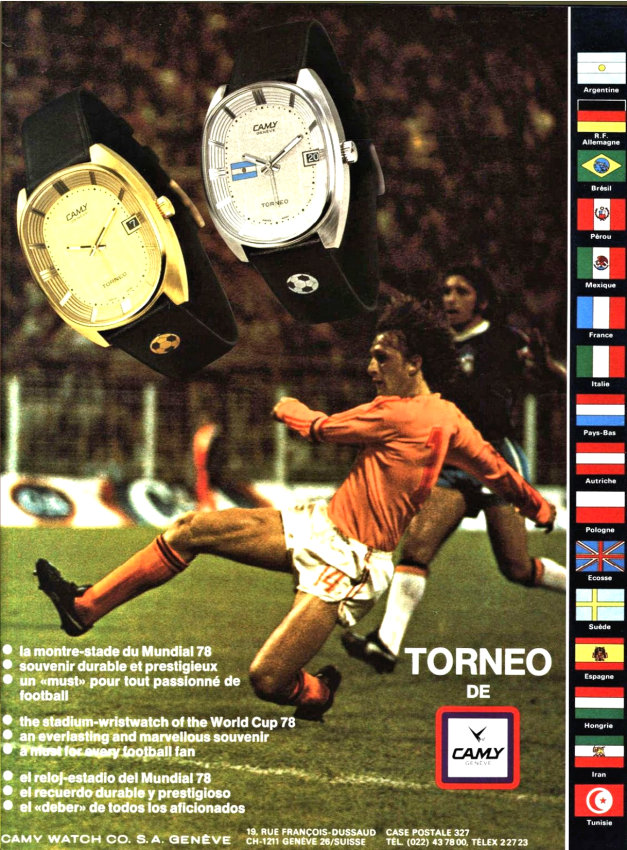
In 1978, Camy produced the Torneo model for the Football World Cup held in Argentina. It's an original model with the dial representing a miniature soccer stadium and the flags of the participating countries.

1978

But like so many other Swiss manufacturers, Camy was to suffer the "quartz crisis" of the 1970s and 1980s. Low-cost watches made in Losone faced direct competition from cheaper quartz watches now produced in Asia. Enzo Watch was reduced from 350 to 50 employees in 1985, and in 1987 Camy was radically reorganized: Cronel became Cronotec SA, Camy Watch became Camotec SA and Camy SA became a trading company [15].

Cronotec and Camotec went bankrupt shortly afterwards.

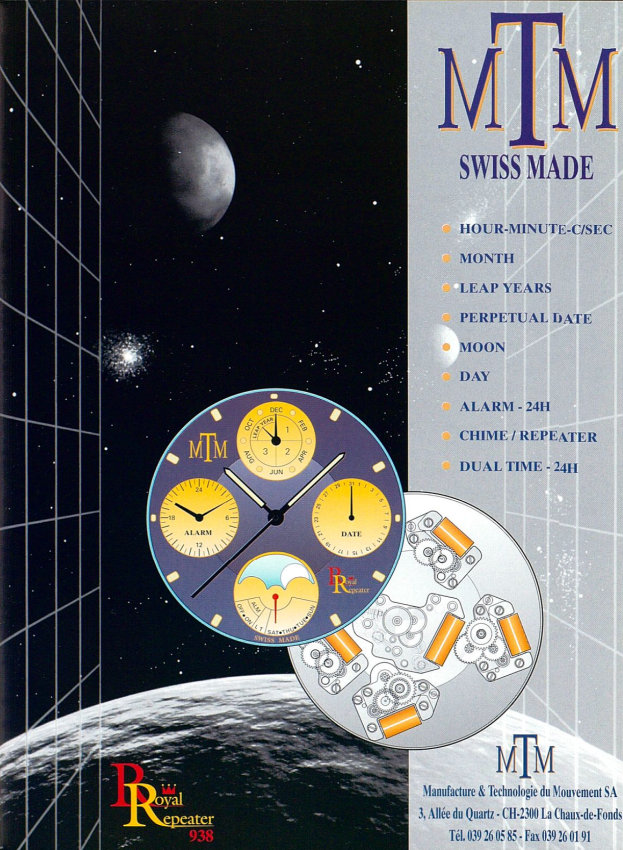
In 1991, Camy was taken over by the Chinese group National Electronics, which decided to produce quartz modules in Switzerland [16]. To this end, a new company, Manufacture et Technologie du Mouvement SA (MTM), was created in La Chaux-de-Fonds [17].

1993

1995

But producing quartz calibers in Switzerland at a reasonable price is very difficult, especially when launching unnatural experiments such as the production of a quartz tourbillon caliber!

MTM went bankrupt in 1998 and the Camy brand disappeared [18].

[1] FOSC 1917

[2] FOSC 1924

[3] FOSC 1943

[4] FOSC 1954

[5] For more information on this subject, see our book La montre-bracelet Suisse, p. 274-275.

[6] Europa Star Asia, 1964, 84, 5/6, p. 39

[7] La Suisse Horlogère, 1961, 3, p. 32

[8] Europa Star, 1966, 41, 5/6, pp. 77-83

[9] FOSC 1966

[10] Europa Star, 1970, 64, 4/6, p. 68

[11] https://ge.ch/geodata/SIPATRIMOINE/SI-EVI-OPS/EVI/edition/fiches/RAC-PAV/RAC-PAV_2004-2734_21146.htm

[12] Europa Star, 1974, 84, 6/6, p. 1

[13] FOSC 1975

[14] La Suisse Horlogère, 1977, 3, p. 49

[15] FOSC 1987

[16] Europa Star, 1992, 191, 1/6, pp. 112-116

[17] FOSC 1991

[18] FOSC 1998 

The archives of Fédération Horlogère, Davoine and l'Impartial are available online at www.doc.rero.ch

The archives of Journal Suisse d'Horlogerie, Europa Star, Revue Internationale d'Horlogerie and Suisse Horlogère are available on The Watch Library

The FOSC (Feuille Officielle Suisse du Commerce) is available on E-periodica

Notes :

About Time To Tell: Time To Tell has one of the largest private digitized databases on the history of Swiss watchmaking, with over 2.3 TB of data on more than 1,000 Swiss watch manufacturers. This database has been built up over a period of some thirty years, and continues to be fed with around 50 to 100 GB of data every year. The database is made up of old documents, mainly Swiss trade journals, dating from the late 19th to the late 20th century. Most of these documents are not available on the Internet. Historical articles published on the time2tell.com website always cite the sources used.

Time To Tell is a private company, independent of any watch manufacturer.

Time To Tell, 2025

Reproduction forbidden without authorization. Any use of this article by artificial intelligence is strictly forbidden and will be considered an infringement of copyright. 

Product Details

Product added to wishlist

Nous utilisons des cookies afin de fournir une expérience utilisateur conviviale. En naviguant sur ce site, vous acceptez la politique d'utilisation des cookies.