The true story of Invicta watches

The true story of Invicta watches

Invicta

A major company of the 20th century, Invicta and its subsidiary Invicta-Seeland have created remarkable models that are much sought-after today.

Description

Joël Pynson

February 2025

1. The Picard and Blum dynasties

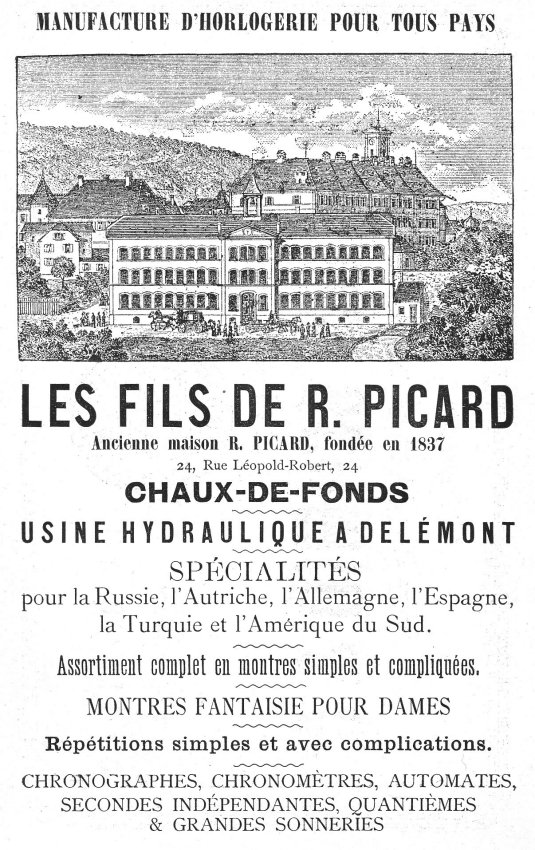
From Alsace, Raphaël Picard settled in Ste-Croix in 1837 [1].

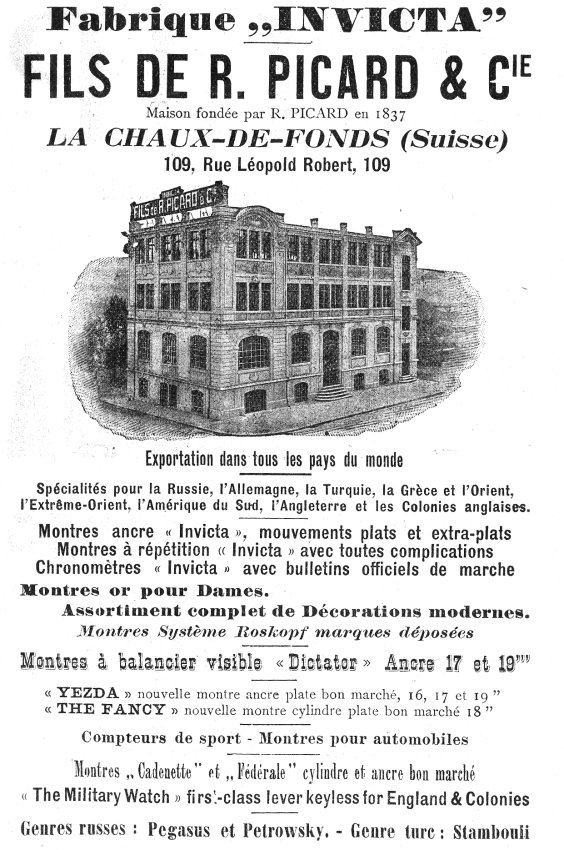
His sons Edmond, Gabriel and Armand took over, and in 1892 named their watchmaking factory in La Chaux-de-Fonds Les Fils de R. Picard [2].

The company grew rapidly, producing all kinds of watches, including chronographs, repeater and automaton watches. In 1895, the Picard sons joined forces with Jules Weber and James Ruedin to create Weber, Ruedin & Cie in Delémont [3]. This was an ébauches factory designed in particular for watches made by R. Picard's sons.

1893

1895

The Invicta trademark is registered in 1896. In the same year, R. Picard's sons presented repeater watches with and without chronographs, calendar watches, chronometers, etc. at the Swiss National Exhibition in Geneva.

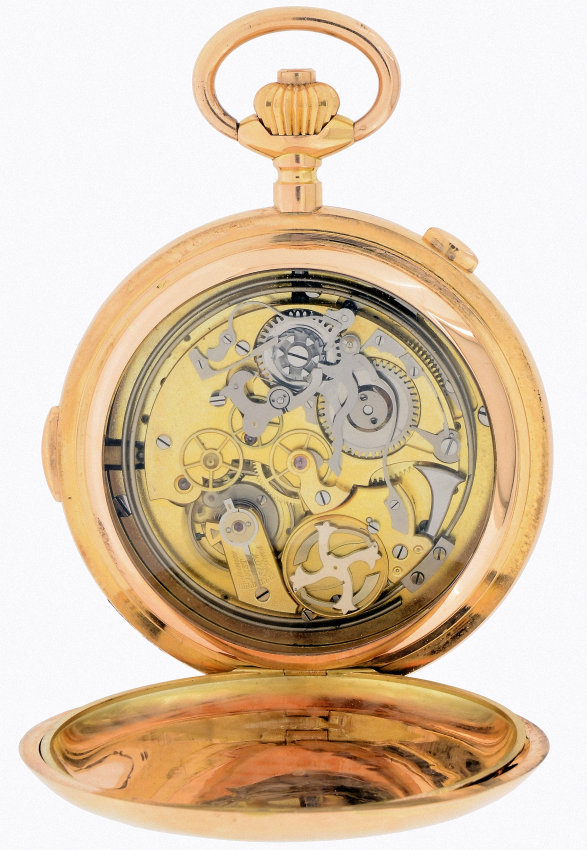
Usually, manufacturers in the Montagnes Neuchâteloises used ébauches from the Vallée de Joux for their complicated watches. But in Invicta's case, the ébauches came from the region's leading manufacturer of repeater watches: C. Barbezat-Baillot. This Le Locle factory had patented a silent gear that made it easier to hear the chimes, and had begun industrial production of repeater watches with a choice of chronograph, calendar and automaton movements. Barbezat-Baillot, which later became Fabrique Le Phare, supplied its movements to a large number of companies.

Barbezat-Baillot repeating chronograph

Invicta repeater chronograph

1900

In 1904, the company underwent a major overhaul. It welcomed 3 new members to its Board of Directors: Charles-Sylvain Blum, Henri-Robert and Edmond Dreyfuss. It also changed its name to Fils de R. Picard & Cie [4]. In 1909, it added Fabrique Invicta to its corporate name.

From then on, the company became increasingly independent. It developed its own repeater systems [5], its own chronographs [6], marketed exclusively Couleru-Meuri sports counters [7], and developed an astonishing date counter in 1912. But it remained dependent on Barbezat-Baillot for its complicated calibers.

1908

1910

Around 1912, Invicta launched its first wristwatches.

Several important events take place at Invicta during the First World War.

Edouard Picard died in 1915 and Charles Blum in 1916. Paul-Maurice Blum and Georges Raphaël Blum successively joined the company. In 1915, Georges Raphaël Blum had taken over the Seeland Watch Co. in Biel [8]. Seeland thus became a watch brand managed by Invicta, but the two companies remained independent.

1916

In 1916, the Délémont blank factory was taken over by Jämes Ruedin and became independent [9].

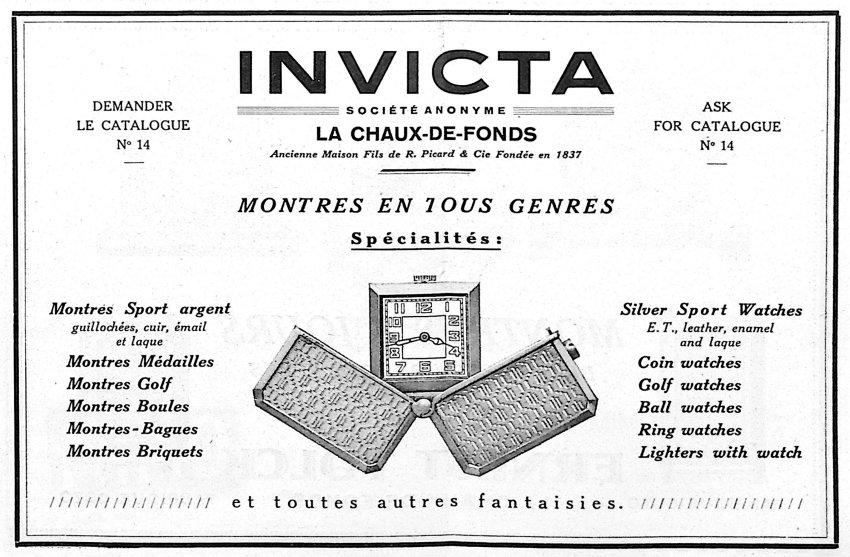
The company remained unchanged during the crisis years of 1920-1930. In 1928 it was transformed into a public limited company under the name Invicta SA, and Gabriel Picard joined the company [10].

2. Invicta's golden age

Between 1930 and 1960, Invicta enjoyed a veritable golden age. The company demonstrated remarkable creativity:

- sports watches ( Ermeto type), jumping-hour watches and calendar watches in 1931,

- wrist chronographs, including the famous Chrono-Sport rectangular chronograph in 1932,

- automatic watches and 8-day watches in 1933,

- waterproof watches with shock protection in 1939

- Time Log and Secontrol chronographs in 1940

- water-resistant automatic watches in 1942

- and new calendar watches from 1951.

1931

1931

1931

1932

By the 1930s, the company was also producing watches for the railroads and airplanes!

With the death of Gabriel Picard in 1935, and Henri Dreyfus in 1943, the company is now managed by the Blum family. Invicta-Seeland's success in the USA also contributed to the company's success.

1948

1952

To increase its production capacity, in 1960 Invicta took over the Prexa factory, founded in 1919 by the Perret family in Le Locle [11]. Prexa had inaugurated a new factory 3 years earlier.

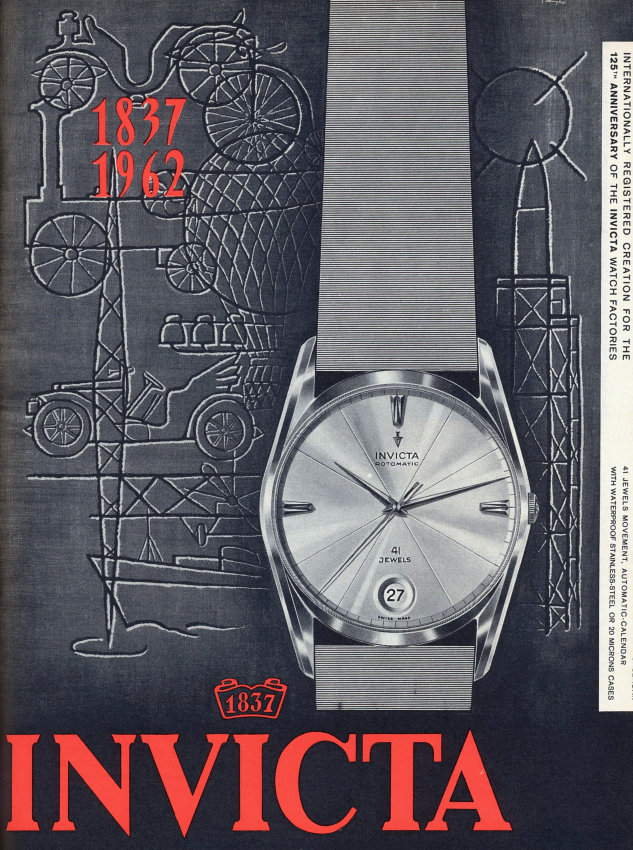
In 1962, for the company's 125th anniversary, Invicta launched an elegant model, available as a men's and ladies' watch.

1962

For the Swiss watchmaking industry, the 1960s were a time of consolidation to face up to the competition. In 1967, Invicta joined SAGITER, a production platform created by a dozen manufacturers including Camy, Eska, Rado and Sandoz. [12]

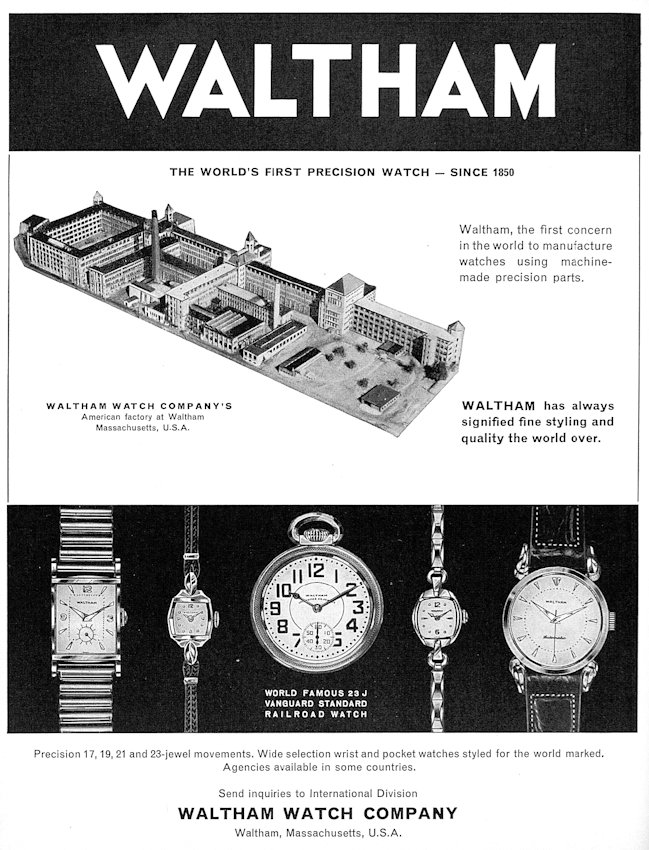
In 1968, Seeland, which had become Iseca SA [13], acquired the famous Waltham Watch Co. in the United States [14].

1955

Iseca was not the only company involved in this takeover: two other Swiss factories were also involved: Avia and H. Sandoz & Cie. The Fédération Horlogère and ASUAG probably facilitated this transaction, since Chronos Holding, a company set up by ASUAG to facilitate company mergers, provided financial backing [15].

However, a larger association soon became necessary, and Invicta joined the Société des Garde-Temps (SGT).

3. Invicta and the Société des Garde-Temps

Société des Garde-Temps SA (SGT) is a heavyweight in the Swiss watchmaking industry. Created in 1968, this holding company controls Degoumois ( Avia watches), Fleurier Watch ( Arcadia watches), Helvétia and Silvana, among others. In 1969, SGT took over Solvil & Titus, making it the largest concentration of Swiss watchmakers.

The watches produced by SGT's various players are quite similar, in the mid-range, but their markets are different, which explains the synergy.

1970

Invicta offered classic automatic watches with day and date, and followed the trend with electronic and quartz watches in 1976.

But with the price of quartz watches plummeting, sales of mid-range Swiss watches plummeted. In 1979, SGT attempted a vertical rationalization with Helvétia/Waltham at the high end, Sandoz/Invicta in the mid-range and Tell at the low end [16].

This attempt was unsuccessful and SGT went bankrupt in 1981 [17].

4. The owners' waltz

Invicta went through a troubled period that lasted well into the 21st century.

In 1983, the Invicta brand was taken over by the financial company Ondix [18], which relaunched it with a range of quartz watches. But Ondix went bankrupt in 1991 [19].

1983

Invicta then became a brand of the Italian Sector group, which was taken over in 2002 by the Opera holding company (Bulgari). The brand was then claimed by several entities, such as Invicta Montres SA in Switzerland, which went bankrupt in 2007 [19], and was finally taken over by an American company, Invicta Watch Group, which still owns it.

The main Invicta-Seeland watch models can be found here.


See also: Seeland


[1] http://www.judaisme-alsalor.fr/synagog/hautrhin/g-p/hegenh/horloge/tpicard.htm

[2] FOSC 1892

[3] FOSC 1895

[4] FOSC 1904

[5] Patent CH 44 390

[6] Patent CH 50 388

[7] Revue Internationale de l'Horlogerie, 1907, 18, pp. 967-968

[8] FOSC 1915

[9] FOSC 1916

[10] FOSC 1928-1929

[11] FOSC 1960

[12] Europa Star, 1970, 64, 4/6, p. 68

[13] FOSC 1967

[14] Chicago Tribune, Chicago, Illinois, Sun, Mar 31, 1968, p. 99 https://www.newspapers.com/article/chicago-tribune-invicta-watch-co-to-mak/103616824/

[15] Journal Suisse d'Horlogerie, 1969, 1, p. 6

[16] Europa Star, 1979, 116-2, p. 6

[17] FOSC 1983

[18] FOSC 1991

[19] FOSC 2007

The archives of Fédération Horlogère, Davoine and l'Impartial are available online at www.doc.rero.ch

The archives of Journal Suisse d'Horlogerie, Europa Star, Revue Internationale d'Horlogerie and Suisse Horlogère are available at The Watch Library

The FOSC (Feuille Officielle Suisse du Commerce) is available on E-periodica

Notes :

About Time To Tell: Time To Tell has one of the largest private digitized databases on the history of Swiss watchmaking, with over 2.3 TB of data on more than 1,000 Swiss watch manufacturers. This database has been built up over a period of some thirty years, and continues to be fed with around 50 to 100 GB of data every year. The database is made up of old documents, mainly Swiss trade journals, dating from the late 19th to the late 20th century. Most of these documents are not available on the Internet. Historical articles published on the time2tell.com website always cite the sources used.

Time To Tell is a private company, independent of any watch manufacturer.

©Time To Tell, 2025 

Reproduction forbidden without authorization. Any use of this article by artificial intelligence is strictly forbidden and will be considered an infringement of copyright.

 

Product Details

Product added to wishlist

Nous utilisons des cookies afin de fournir une expérience utilisateur conviviale. En naviguant sur ce site, vous acceptez la politique d'utilisation des cookies.