The true history of Breitling watches. Part One: from the origins to 1950

The true history of Breitling watches. Part One: from the origins to 1950

Breitling

Breitling is a major company in the history of the Swiss chronograph. It was behind such legendary models as the Chronomat and Navitimer, which are still in production today, and of which there have been many versions. The company's history is difficult to reconstruct, not because period sources are lacking, but because it has been repeatedly rewritten with marketing rather than historical objectives in mind. This series of articles will attempt to disregard the legend and reconstruct as far as possible the true story of the watchmaking factory founded in St Imier by Léon Breitling.
Description

Joël Pynson

April 2025

1. From St Imier to La Chaux-de-Fonds

From Germany, many members of the Breitling family settled in the canton of Neuchâtel in the 19th century. As early as 1841, a Breitling-Laederich, watchmaker in La Chaux-de-Fonds [1], was mentioned.

Léon Breitling was born in 1860, probably in Les Ponts-de-Martel [2]. His parents moved to St Imier, and it was here that Léon Breitling set up his watchmaking business in 1884, although he did not officially register his company until 1890 [3].

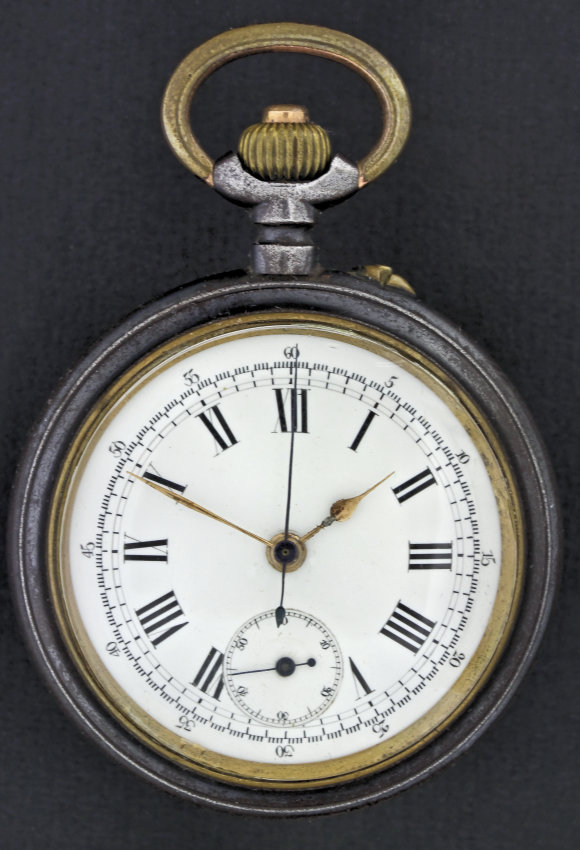
At that time, St Imier was the capital of the chronograph. A dozen or so factories produced this type of watch, which met with growing success all over the world. These included Schwab-Loeillet, Droz et Cie, Jules Frédéric Jeanneret, Albert Jeanneret & Frères, Ferdinand Bourquin, and of course Ernest Francillon and his Fabrique des Longines [4].

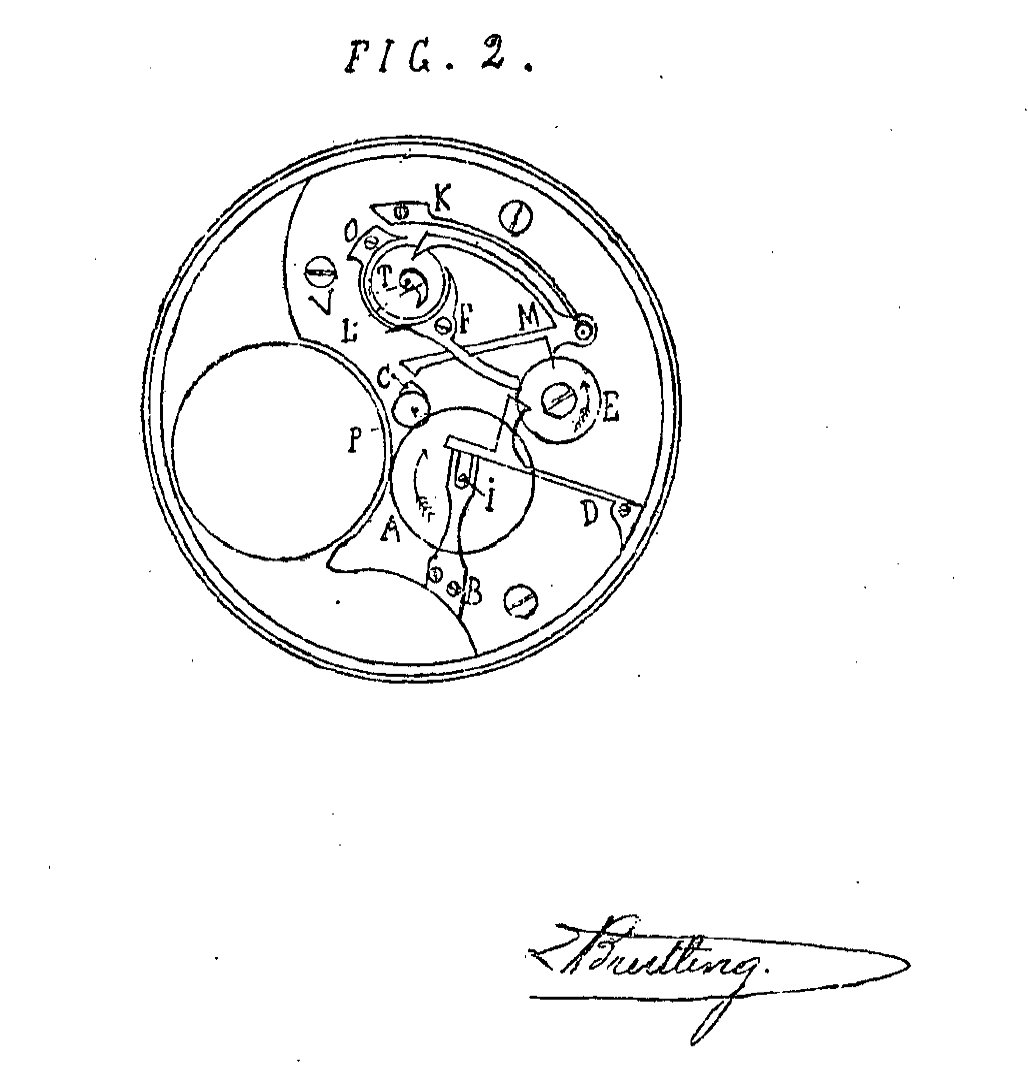
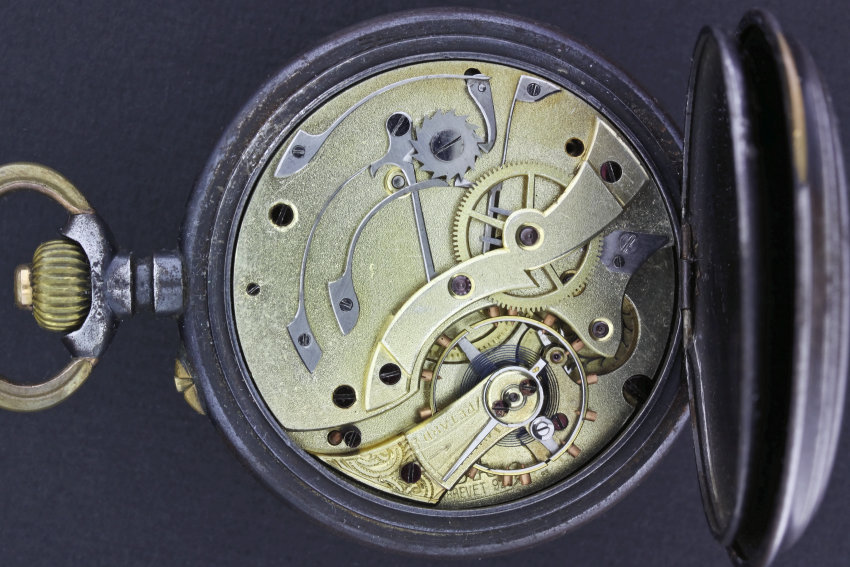
Léon Breitling was interested in chronographs, but he had an innovative spirit: in 1889, he patented a simplified mechanism with a vertical clutch, enabling him to make more economical chronographs.

Patent CH 927

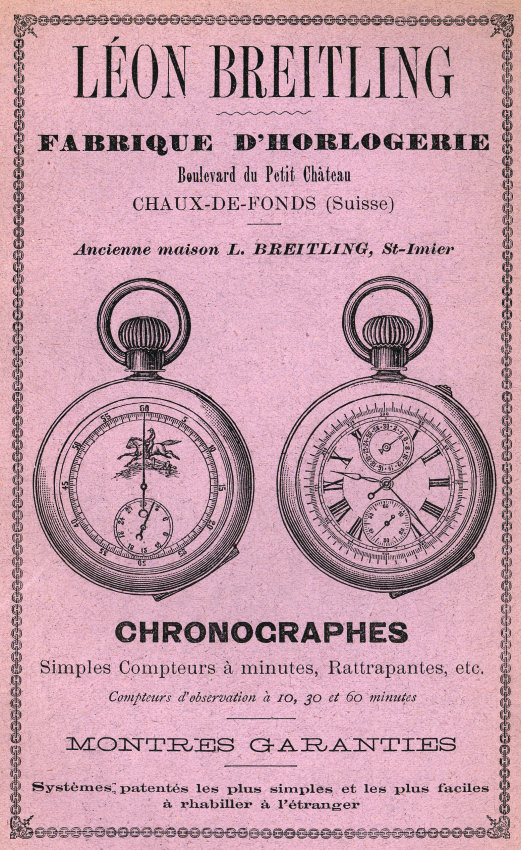
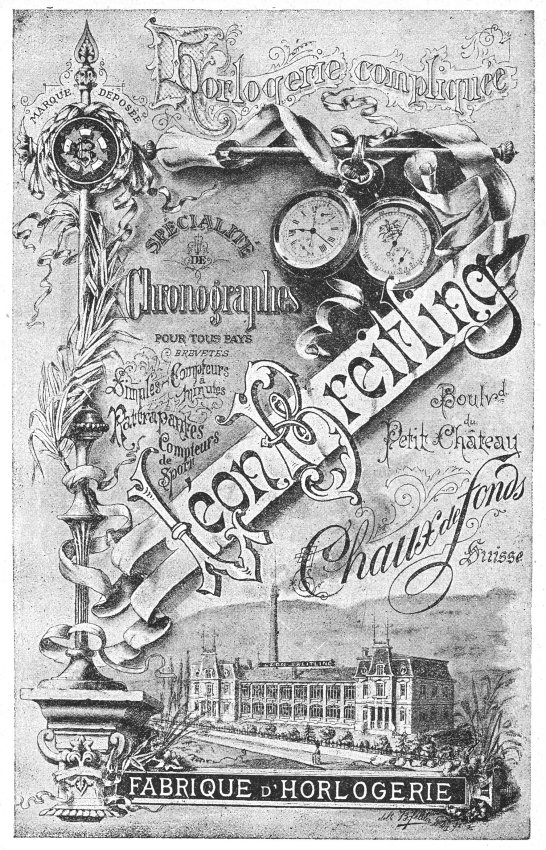
With his success, Léon Breitling decided in 1892 to move to the region's most active watchmaking metropolis: La Chaux-de-Fonds [5]. This move was facilitated by the fact that Léon Breitling was an établisseur, i.e. he assembled in his workshops parts made in other companies. It would have been difficult for a manufacturer, which makes its own movements and therefore has much more extensive tooling, to move.

Léon Breitling moved to La Chaux-de-Fonds, Boulevard du Petit Château, to continue his activities.

2. From Léon to Gaston-Léon Breitling

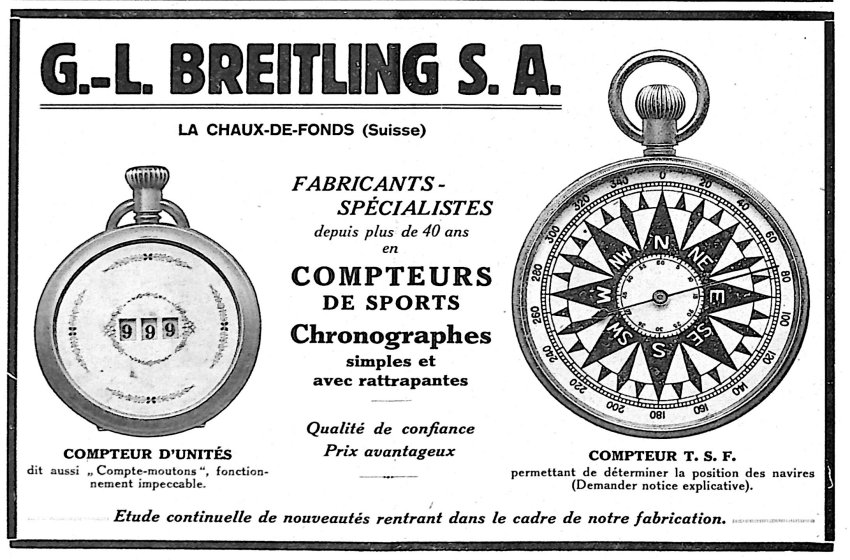
Demand for chronographs and counters is still very strong, and Breitling's models multiply: simple chronographs (without minute counters), chronograph-counters, split-seconds, sports counters with 10, 30 or 60-minute totalizers, etc.

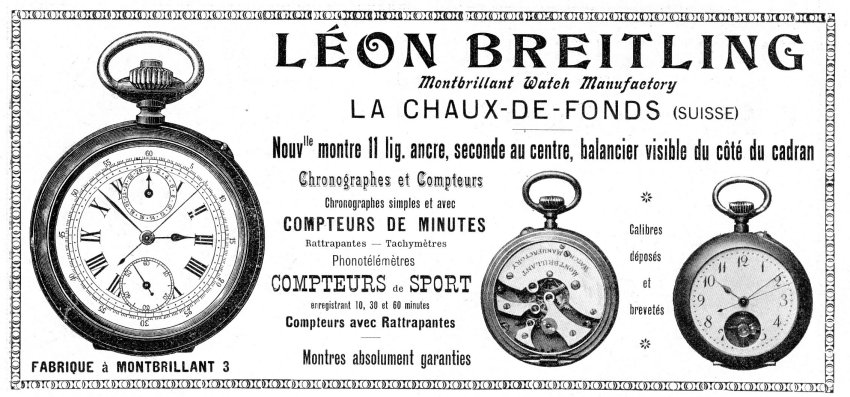
Although chronographs remained the company's specialty, a number of new watches appeared: an 8-day caliber for clocks in 1896, and a simple watch with the balance visible from the dial in 1902.

1892

1893

In 1899, boulevard du Petit Château was renamed Chemin de Montbrillant, and L. Breitling became L. Breitling, Montbrillant Watch Manufactory [6].

1903

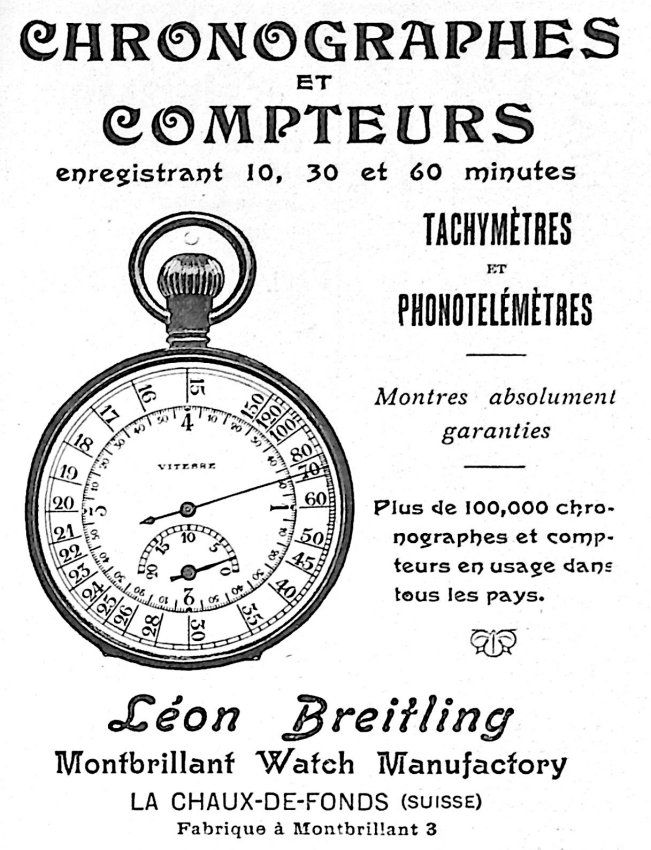
In 1905, Breitling launched a new speedometer called " Vitesse ", with a central hand that completes one revolution in 4 minutes, providing a tachometric scale indicating speeds of up to 15 km/h, consistent with vehicles of the time. Contrary to what has sometimes been written, this speedometer was not intended to be used by the police to penalize speeding. For that, the policeman would have had to be able to follow the car for a minute! According to Léon Breitling himself, this counter was intended for motorists, and the factory also supplied "a patented metal watch-holder, which by an ingenious combination fits onto the steering wheel of the automobile and thus enables the driver to have his tachometer constantly to hand [7]".

1906

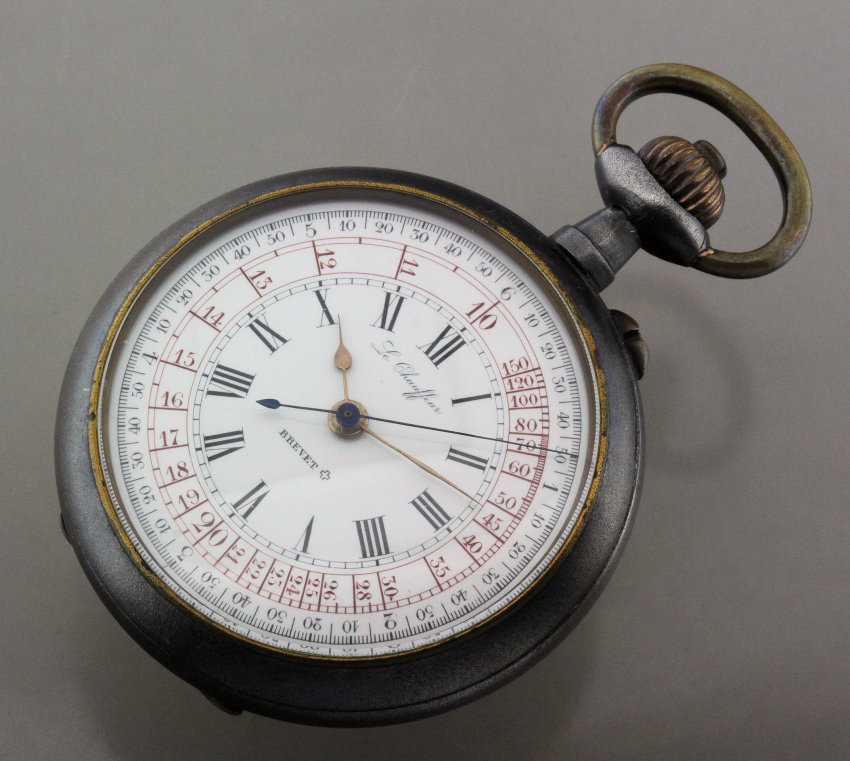
Léon Guinand "Le Chauffeur" chronograph with central hand making one revolution in 6 minutes

This counter, which also existed as a chronograph, was not the first of its kind. Léon Guinand, from Les Brenets, had patented "Le Chauffeur" chronographs in 1900, whose central hand made one revolution in 4, 5 or 6 minutes [8].

Léon Breitling died in 1914, and his son Gaston-Léon took over. The company thus became G. Léon Breitling, Montbrillant Watch Manufactory [9].

3. From Gaston-Léon to Willy Breitling

Gaston-Léon inherits a flourishing company, but a war is starting. However, the First World War was not a period of crisis for the Swiss watchmaking industry, which had to meet numerous demands for timepieces and... ammunition.

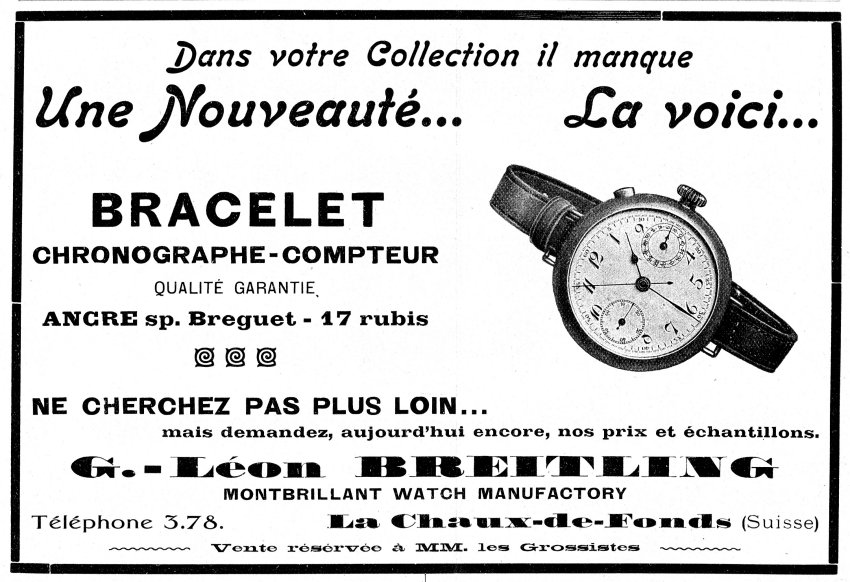
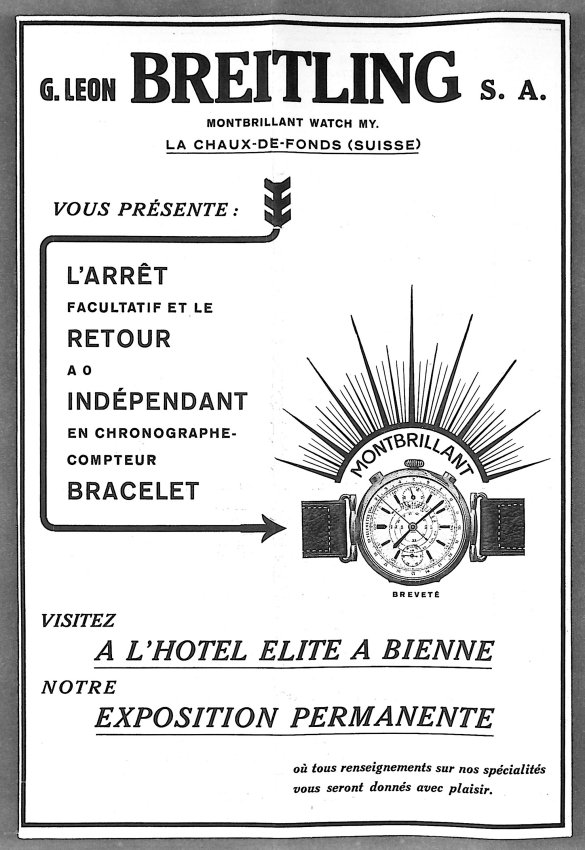
The military increasingly demanded wristwatches, and other manufacturers, such as Omega in Bienne and Nathan Weil in La Chaux-de-Fonds, now offered wrist chronographs. To remain a specialist in the field, Breitling innovated in 1915 by launching a wrist chronograph with a push-button at 2 o'clock. This was not the first wrist chronograph with a pusher independent of the crown, but its judicious positioning at 2 o'clock made it easier to use when the watch was on the wrist.

1915

After the war, the company continued to innovate and several patents were registered. But Gaston-Léon died in 1927, aged just 43, at a time when the Swiss watchmaking industry was going through a difficult crisis. His son, Willy, was only 13 and therefore too young to manage the company.

The company became a société anonyme with a board of directors made up of Berthe Breitling-Flajoulot, Gaston-Léon's widow, and Paul-Ulysse Huguenin, a watchmaker from Le Locle [10]. But in 1929 Paul-Ulysse Huguenin left the company. In 1933, he founded the Huga factory, which also specialized in chronographs and counters.

He was replaced by Louis Hêche, director of the famous Le Phare factory in Le Locle, which was in great difficulty at the time [11].

It was from this date onwards that the company became involved in sporting competitions to promote its chronographs and counters.

1930

1931

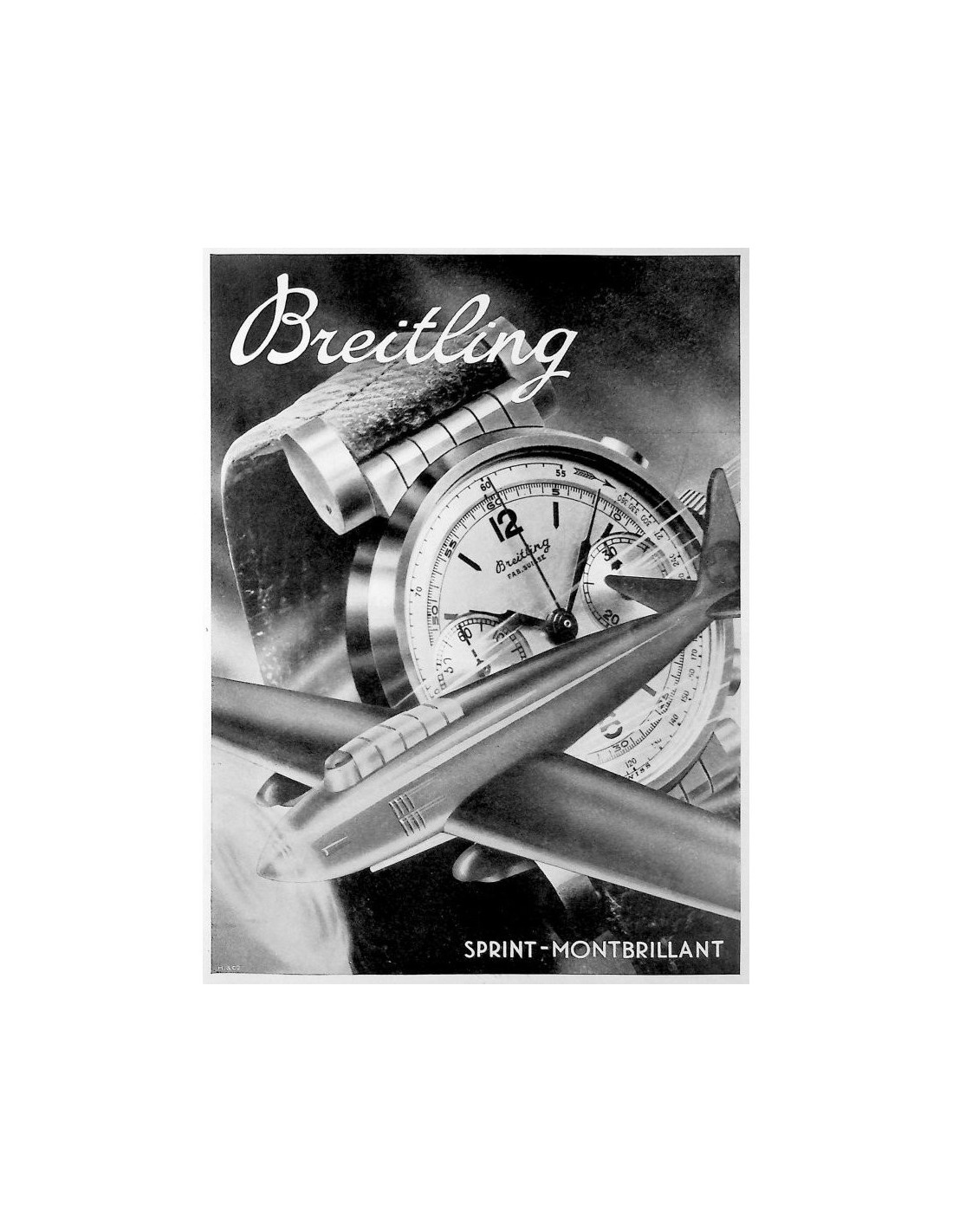
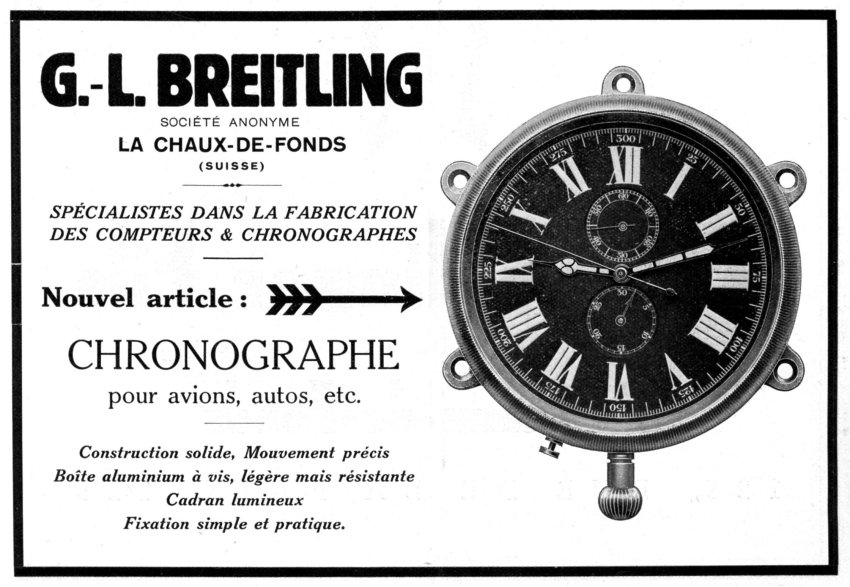
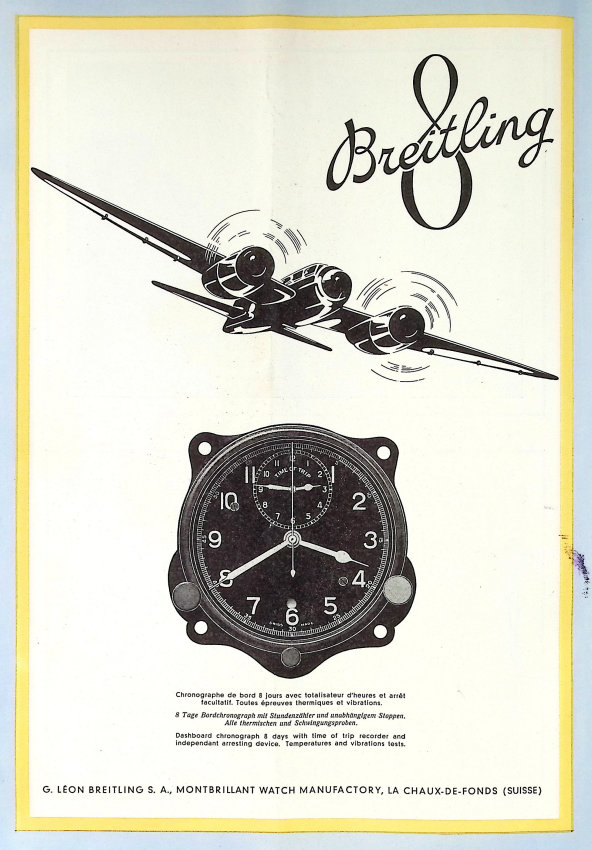
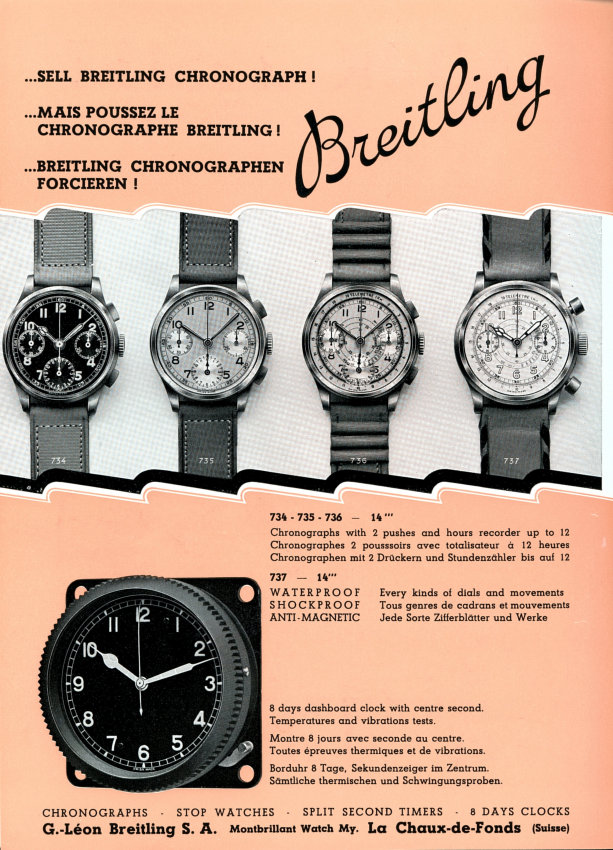
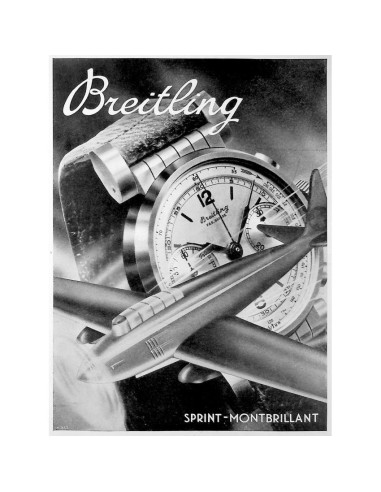
In 1931, the company launched a landmark new chronograph: a model for airplanes and cars that could be mounted on a dashboard. It was Breitling's first step into aviation.

1931

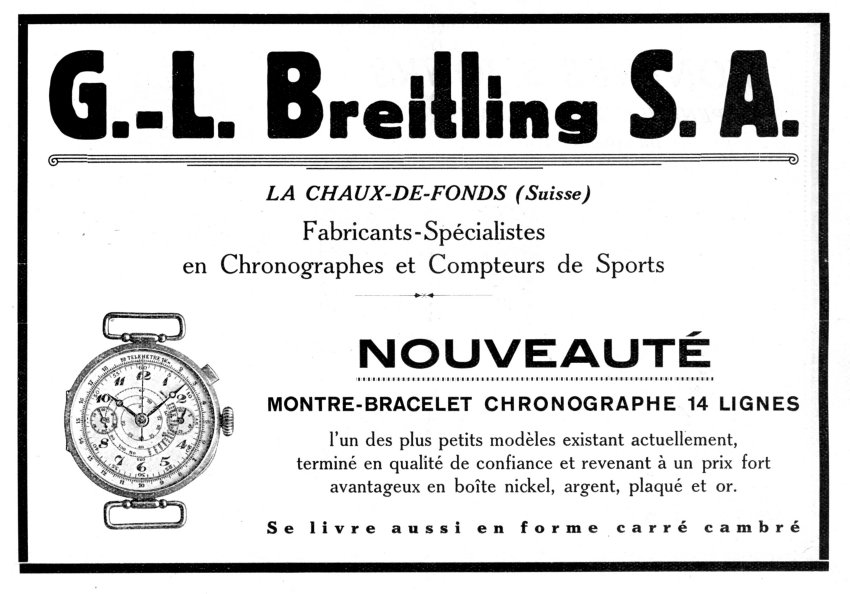
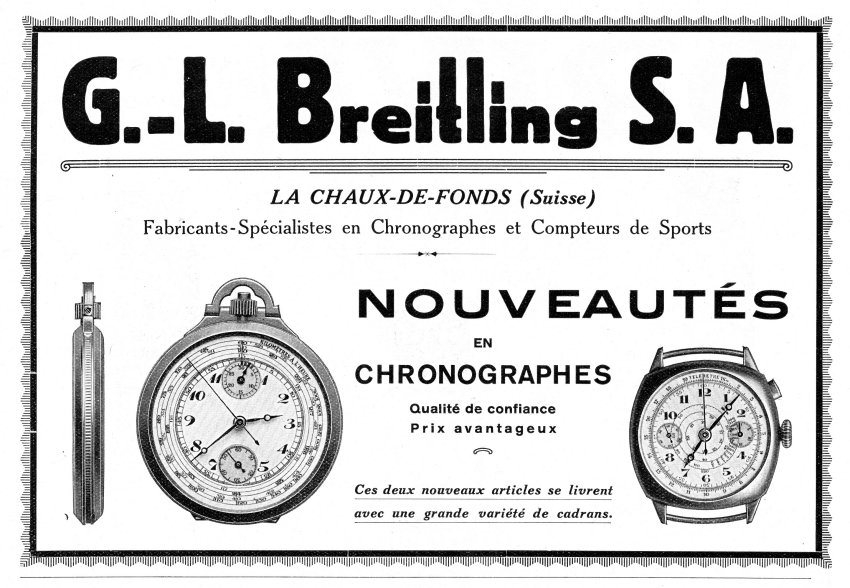
In the same year, Breitling introduces a new 14-line (31.5 mm) chronograph caliber, smaller than the first 16-line caliber of 1915. This enabled the launch of a range of wrist chronographs, including a rare version with jumping hour in 1932.

1931

1932

In 1933, a dynamic young man took over the company: Willy Breitling, representing the 3rd generation of the family [12].

4. From La Chaux-de-Fonds to Geneva

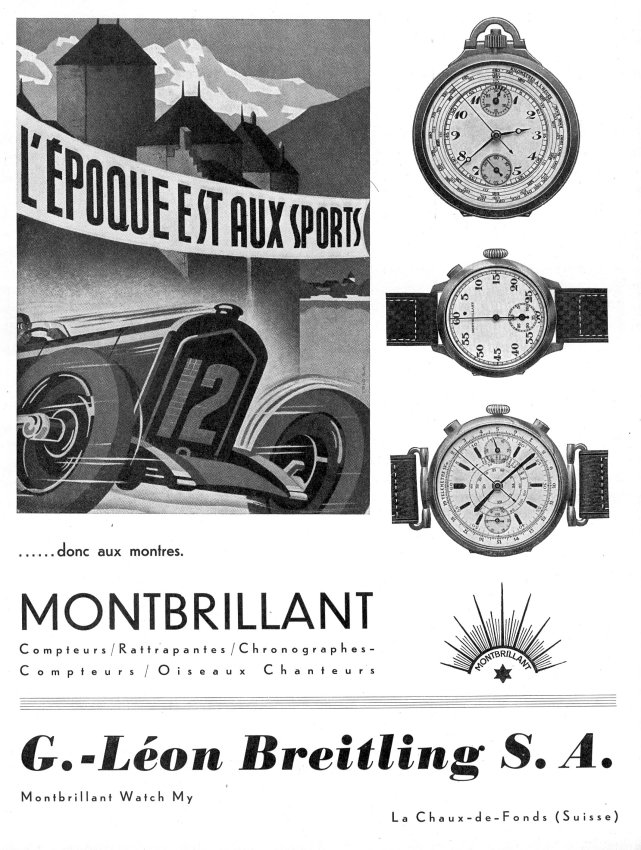
Willy Breitling understands that "this is a time for sports" and strengthens his chronograph and counter ranges, with increasingly complete wrist chronograph ranges.

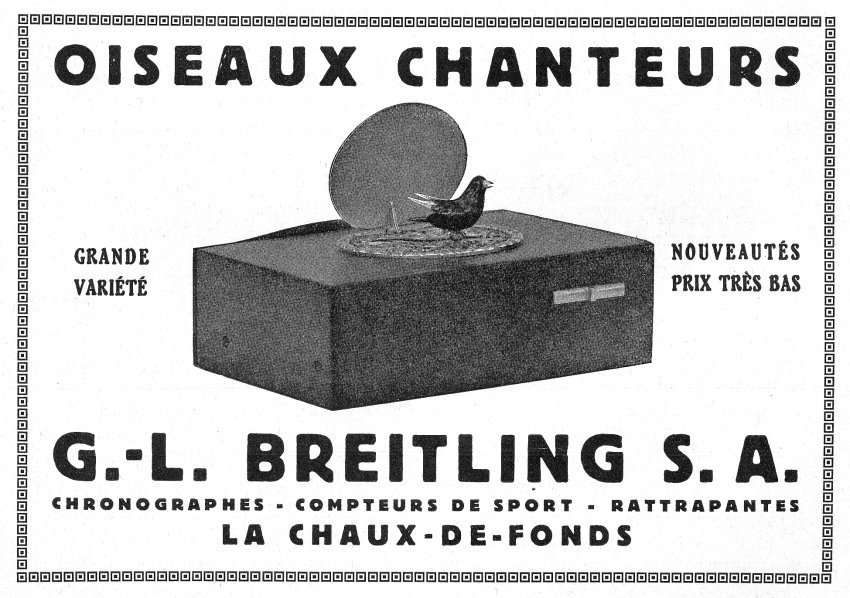
The economic situation was not yet flourishing, and in 1933 Breitling also offered some pretty singing bird boxes.

1933

In 1933, the company registered two patents [13] on a chronograph movement with two pushers enabling timing to be resumed after stopping.

This led to the launch in 1934 of a wrist chronograph presented as the first two-pusher wrist chronograph.

1934

1934

In fact, this was not the first time that interest had been shown in resuming timing after the chronograph hand had stopped, thanks to a second pusher. The Léonidas factory in St Imier had patented a system of this type as early as 1927 [14], and Longines is also said to have produced a double-pusher chronograph in 1929 [15].

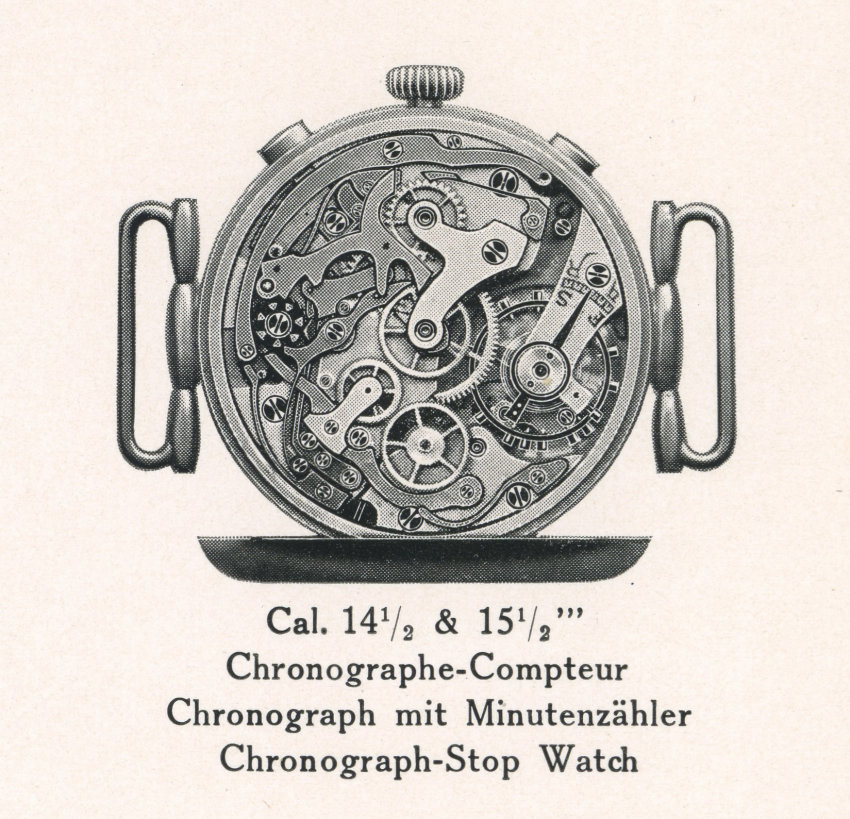
This no doubt explains why other chronograph manufacturers (Angélus, Universal) offered double pushers as early as 1935, including Ébauches SA, which in 1935 supplied Landeron double-pusher calibers with 14.5 and 15.5 lines [16].

Calibre Landeron, 1935

From 1935 onwards, the economic situation improved and Breitling redoubled its activities:

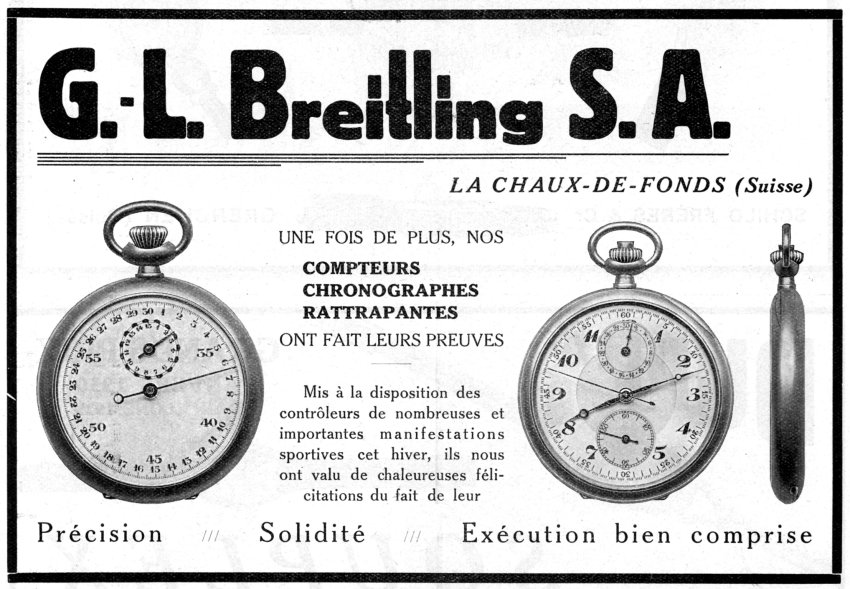
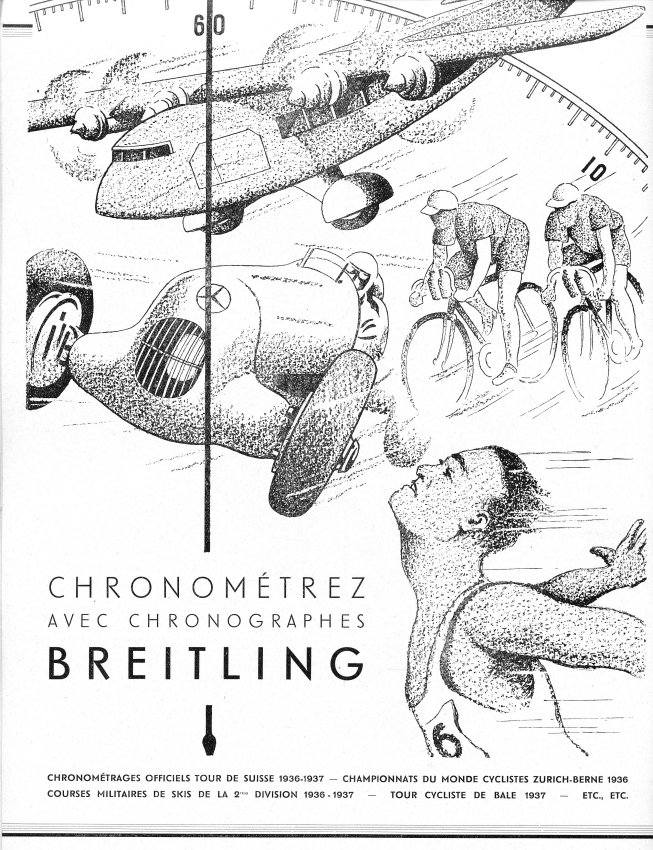
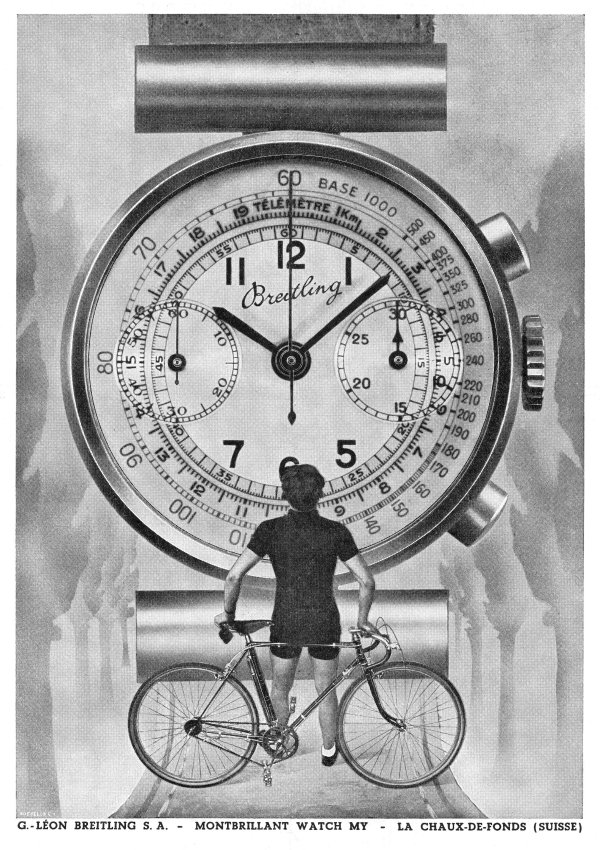
- firstly, by becoming a specialist in timing sporting events, with a predilection for cycling: World Cycling Championships and Tour de Suisse in 1936, for example. Sophisticated instruments were soon used for this type of timing: cinematographic film, photoelectric cells, etc.

1937

1938

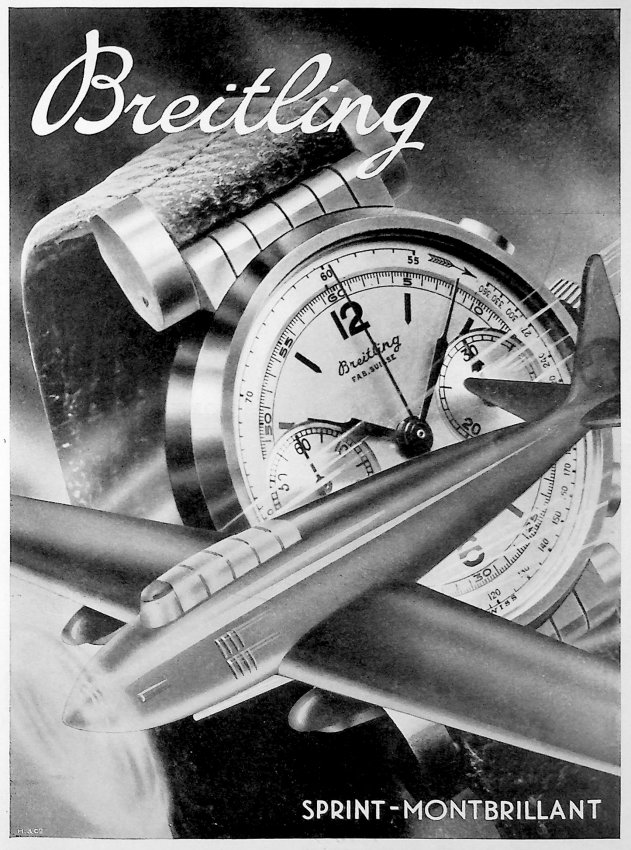
- then by developing the aviation watch division, which required sophisticated test instruments to test the operation and accuracy of instruments under extreme vibration and temperature conditions. This division became known as Breitling 8 Aviation at the start of the Second World War.

1937

1941

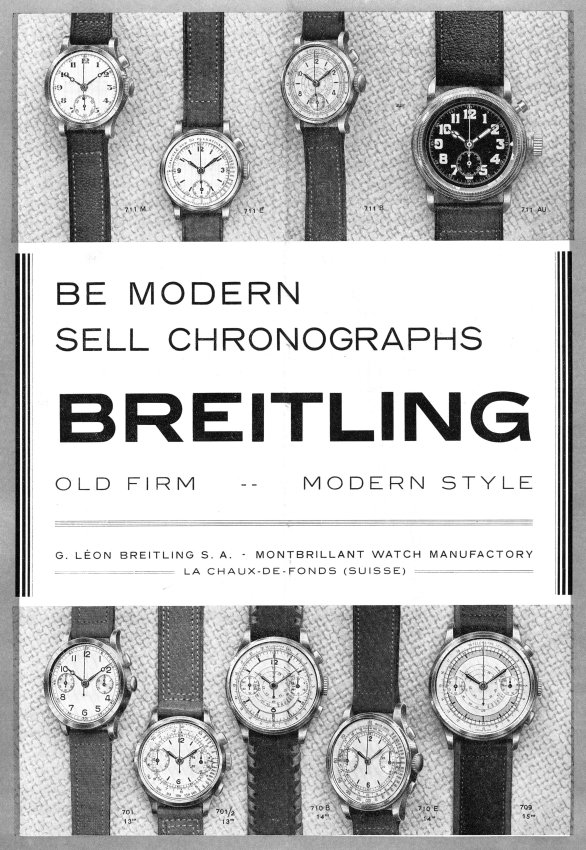
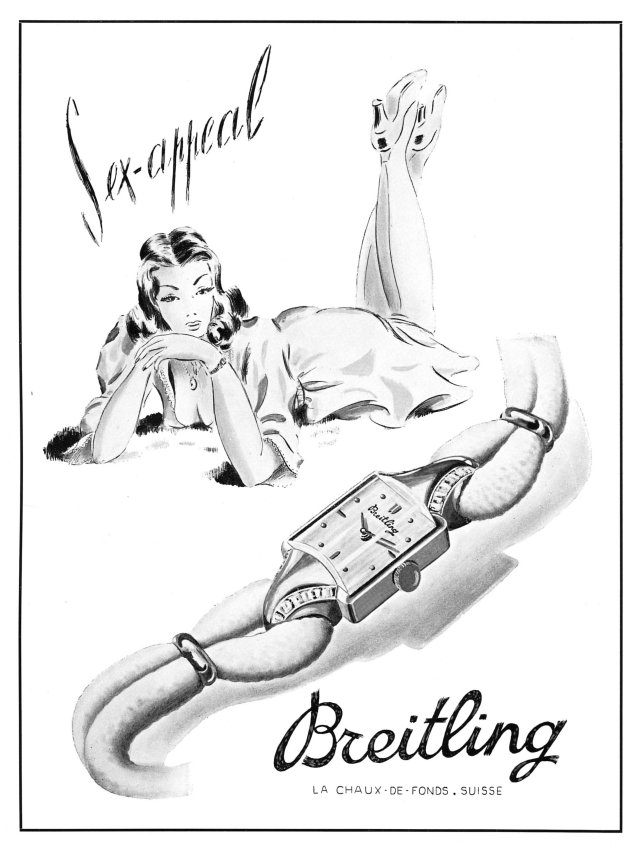
- Finally, by developing an impressive number of new chronograph models, in particular wrist chronographs: economy models without counters and an aviator model in 1936, ladies' models in 1937, water-resistant models and models with hour counters in 1939, square models in 1940, and so on.

1937

1939

The Second World War had little impact on the Swiss watchmaking industry, which had to respond to the strong demand for timepieces. For Breitling, it was a period of extraordinary activity:

- the range of aviation instruments expanded: 8-day watches, counters and on-board chronographs. Breitling became a supplier to several governments, as did Léonidas in St Imier, and above all Thommen in Waldenburg, whose production went beyond hourly instruments to include altimeters, barometers and speed or altitude indicators.

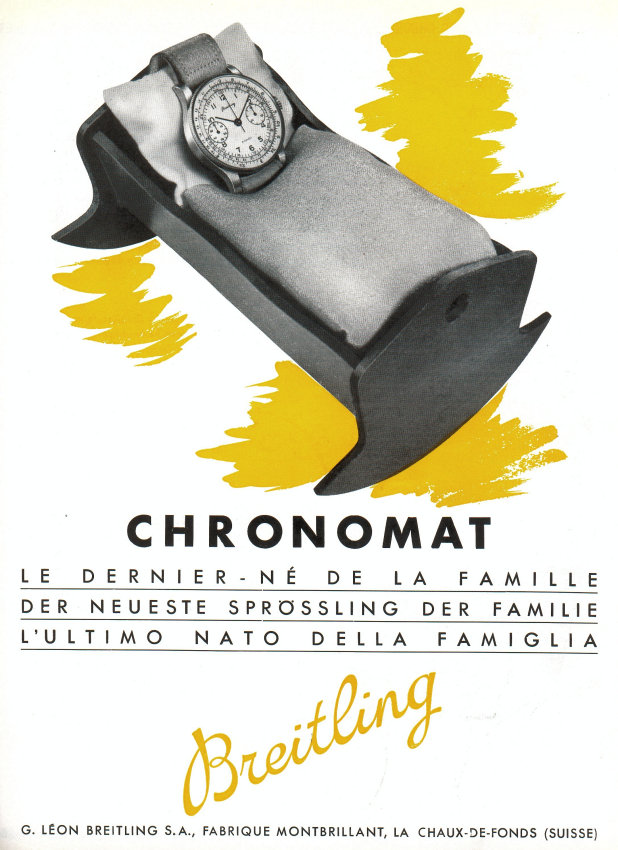
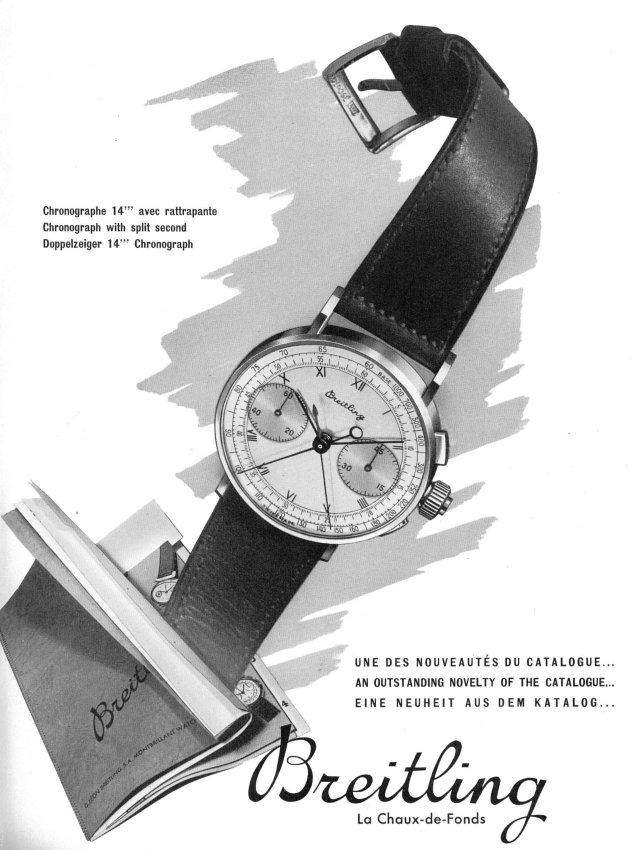
- The range of wrist chronographs reached new heights, with the launch in just a few years of extraordinary models that were to become milestones in Swiss watch history: the Chronomat slide rule chronograph and Duograph split-seconds chronograph in 1941, and the Datora calendar chronograph from 1944. These innovations were of course aided by Ébauches SA, which provided watchmakers with an impressive number of chronograph calibers.

1941

1941

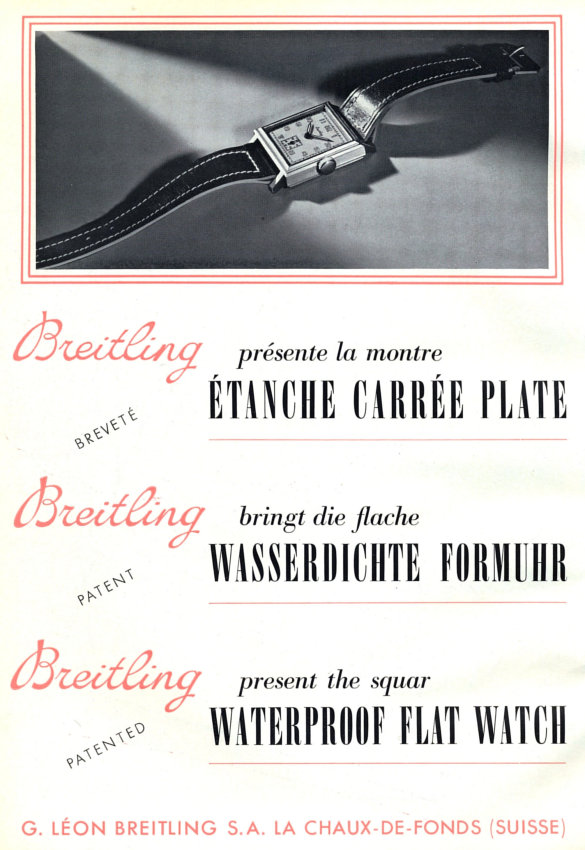
Willy Breitling probably sensed that the chronograph craze had its limits, especially as the competition was stiff: Angélus, Heuer, ARSA, Lémania, Doxa, Minerva, etc. also had fine wristwatch chronograph ranges. He therefore turned his attention to the "simple" watch, and in 1944 launched an elegant square water-resistant watch.

1944

1942

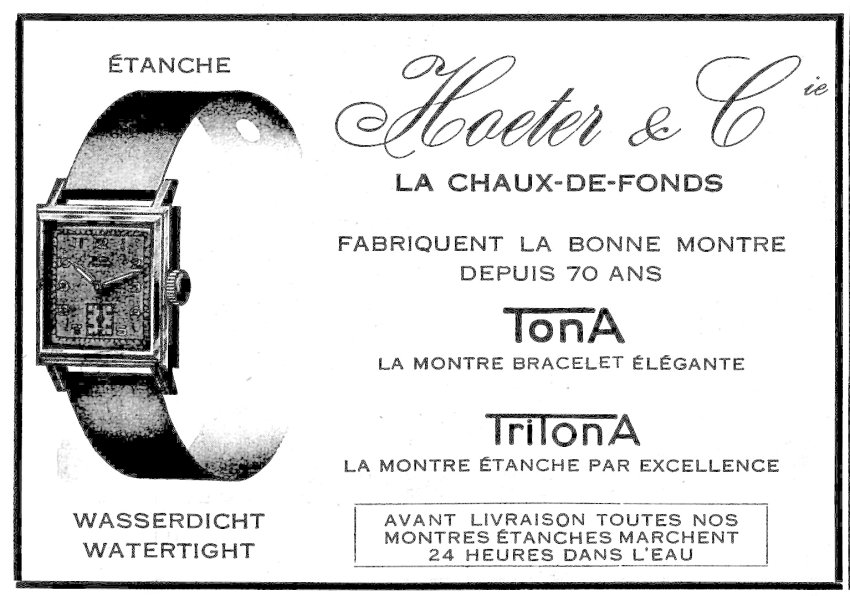
But water-resistance is not something you can improvise, especially on a square watch, and in this case it's best to contact a specialist in the field. The specialist that Breitling contacted was Hoeter & Cie in La Chaux-de-Fonds. This watch factory belonged to the Hoeter family, also from Germany. Max Hoeter was also an engineer who had worked on the water-resistance of watches, leading to the launch in 1933 of the Tritona water-resistant watches, and in 1939 of a water-resistant watch with a square case. It was this watch that interested Bretling. Willy Breitling went even further, taking control of Hoeter in 1944, when the company became Compagnie des Montres Brémon Hoeter SA [17].

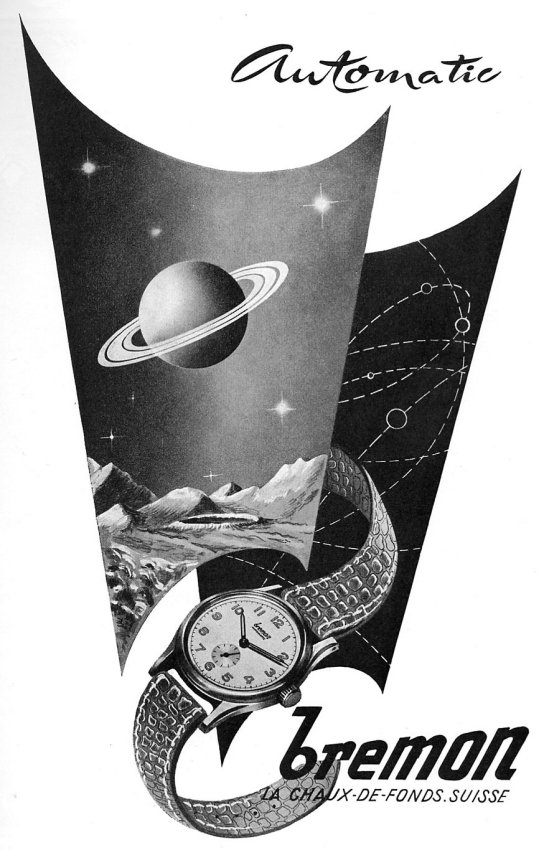
After the war, non-chronograph watches became commonplace: ladies' watches, calendar watches, and the first automatic watches. The Bremon brand is now used as Breitling's second brand.

1945

1945

It was also during this period that Breitling strengthened its presence in the United States by creating the Breitling Watch Corporation of America on 5th Avenue in New York.

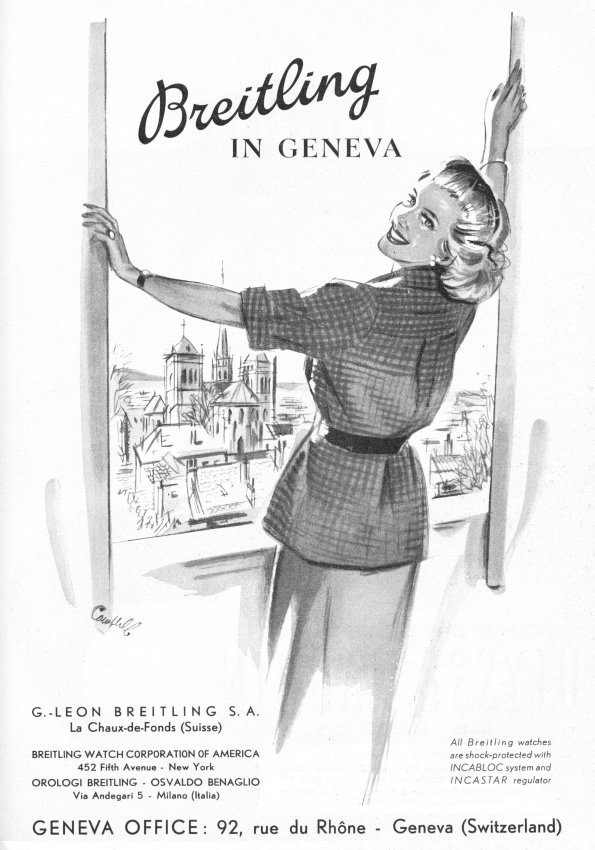
Finally, in 1949, Breitling decided to move to Geneva. This decision was of course linked to the prestige of the city and its international exhibition, but certainly also to the much more advantageous tax conditions [18]. To this end, Willy Breitling created the Société Anonyme pour la vente de montres et chronographes Breitling à Genève. The company is located on rue du Rhône, where a new chapter in the Breitling saga begins.

1949

To be continued...


[1] Almanach de commerce des montagnes, 1841, Convert et Heinzely éditeur, p. 21

[2] Some sources say he was born in La Chaux-de-Fonds: Breitling The Book, 2009, published by Breitling SA, p. 14.

[3] FOSC 1890

[4] Indicateur Davoine, 1890-1891, Canton Bern, pp. 30-32

[5] FOSC 1892

[6] FOSC 1899

[7] Revue Internationale de l'Horlogerie, 1909, 8, p. 423

[8] Patent CH 21 709

[9] FOSC 1914

[10] FOSC 1927

[11] FOSC 1929

[12] FOSC 1933

[13] Patents CH 172 129 and CH 175 564

[14] Patent CH 127 821

[15] https://watchesbysjx.com/2020/09/longines-13-33z-first-flyback-chronograph.html

[16] https://www.time2tell.com/en/swiss-calibres/80-landeron-145-155.html

[17] FOSC 1944. Willy Breitling became Chairman of the Board in 1946.

[18] Feuille d'Avis de Neuchâtel, October 30 1951, p. 8

Notes :

About Time To Tell: Time To Tell has one of the largest private digitized databases on the history of Swiss watchmaking, with over 2.3 TB of data on more than 1,000 Swiss watch manufacturers. This database has been built up over a period of some thirty years, and continues to be fed with around 50 to 100 GB of data every year. The database is made up of old documents, mainly Swiss trade journals, dating from the late 19th to the late 20th century. Most of these documents are not available on the Internet. Historical articles published on the time2tell.com website always cite the sources used.

Time To Tell is a private company, independent of any watch manufacturer.

©Time To Tell, 2025 

Reproduction forbidden without authorization.

Any use of this article by artificial intelligence is strictly forbidden and will be considered an infringement of copyright.

Product Details

Product added to wishlist

Nous utilisons des cookies afin de fournir une expérience utilisateur conviviale. En naviguant sur ce site, vous acceptez la politique d'utilisation des cookies.