The true story of Buren watches

The true story of Buren watches

Buren

Like Rolex or Britix, Buren (or Büren) has English origins. It was an important manufacturer in Switzerland, and its history is marked by remarkable models, particularly in the field of automatic watches and micro-rotors. It disappeared after its takeover by the American company Hamilton.

Description

Joël Pynson

December 2024

1. From London to Büren

H. Williamson Limited was a major London wholesaler in the late 19th century, which also manufactured clocks in Coventry [1]. Watches were imported from Switzerland, and in 1899 the company decided to manufacture them itself. To this end, H. Williamson took over F. Suter & Co. in Büren sur Aar [2], a family business founded by Fritz Suter in 1873 [3], whose production was already destined for England.

Fritz Suter Jr. took over the management of the new H. Williamson subsidiary. The company grew rapidly under his leadership, with the creation of a whole range of in-house calibers, from 18 to 20 lines, with anchor or cylinder escapements. By 1904, H. Williamson was producing 500 watches a day in Büren.

1904

Fritz Suter left the H. Williamson company in 1914, to found the Manufacture d'Horlogerie Hafis [4] in Biel with his father two years later. The management of the subsidiary was entrusted to Samuel Tripet [5].

In 1916, H. Williamson added Buren Watch Co. to his corporate name, which later became the company's sole name.

1921

Production of wristwatches, which began just before the First World War, increased during the war years.

Around 1918, Buren Watch developed a technical improvement for setting rubies, which were now set in "bouchons rectifiés". This simplification was quickly adopted in Switzerland.

The Grand Prix at the 1929 Barcelona International Exhibition

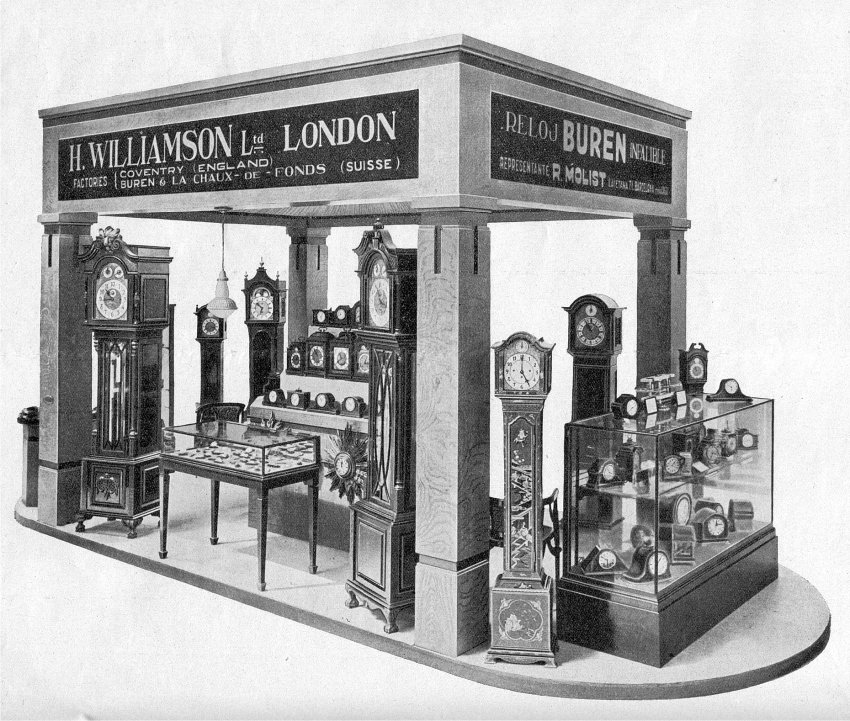
Like all the major World's Fairs of the early 20th century, the Barcelona Exhibition in 1929 had a major impact. Switzerland was present, but it was with England that Buren Watch took part, under the banner of H. Williamson [6].

Spain being an important market for Buren, the exhibition of watches and clocks was carefully prepared. A strong magnifying glass enabled visitors to admire the different calibers of Swiss-made watches. All the watches, for men and women, were engraved or enamelled in precious metals. Two gold Lépine watches were decorated with extraordinary enamel backgrounds: one depicted the Alhembra of Granada, the other the Black Madonna of Montserrat, so dear to the Catalans.

Equally remarkable were the table and floor clocks, some with Japanese lacquered decor, others with chimes playing several tunes, and a reproduction of an 18th-century hall clock, identical to the one owned by the Queen of England.

The King of Spain paid a long visit to the Williamson stand and purchased several pieces, including the Queen's.

Understandably, the Grand Prix could not escape the attention of the Anglo-Swiss company [7]...

1930

During the severe economic crisis of the early 1930s, several satellite companies were created for different brands such as Rival, Vanburen, Sphynx and Ready. Some of these brands were used, particularly Rival.

But H. Williamson - Buren was in difficulty, and the company separated from its English parent company to become simply Buren Watch Co in 1932 [8]. It was at this point that the brothers Jean and Hans Kocher, who had recently joined the company, reorganized the business.

2. Buren Watch Co and the Kocher dynasty

After the 2nd World War, Buren Watch changed stature and became a major manufacturer. Some thirty calibers were now available, enabling the production of a wide variety of ladies', men's and pocket watches. No complications at Buren: the watches are classic and tasteful, with the small seconds hand at 6 o'clock. Central seconds were not introduced until 1944.

1943

Buren also produces a number of chronometers, tested at the official testing office in Biel.

In 1950, the first complications appeared on watches: automatic watches, with an original oscillating weight system, and calendar watches with day, month and moon phases.

1950

In 1951, Hans Kocher's two sons, Robert and Hans, joined the company, with Hans Jr playing a leading role.

Hans Kocher Jr. was a brilliant engineer and watchmaker [9]. He cut his teeth at Cortébert, where he was in charge of caliber design and production. At Buren, he became technical director in 1952, and was involved in the design of new automatic calibers.

1954

In 1953, Buren presented the Rotowind, an automatic watch then considered " the world's smallest watch with power reserve [10]". The Rotowind caliber was available with or without power reserve, with or without a center seconds hand, and its small size made it suitable for both men's and ladies' watches.

In 1954, Buren presented a dead-seconds watch at the Basel Fair [11], but it does not appear to have been commercialized.

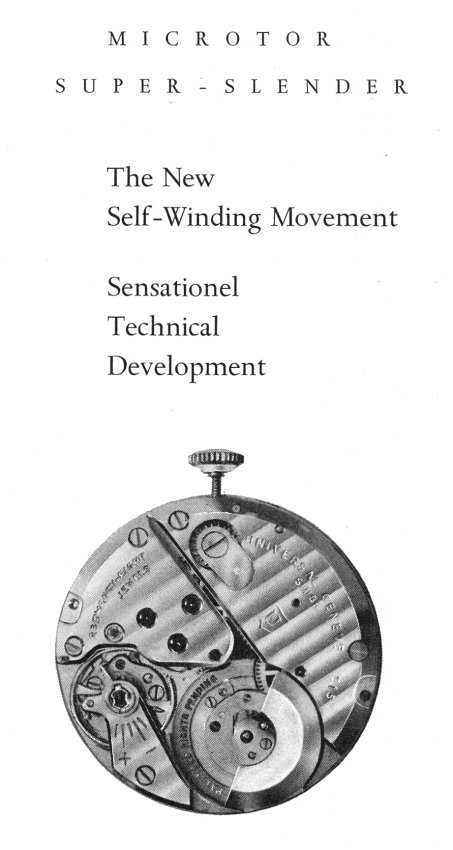
Hans Kocher continued his study of the automatic watch on an experimental level. He notes that "the winding speed of automatic watches has remained an unsolved mystery for a very long time (...) Italians speak with their hands and therefore wind their watches fifty times more than Americans, who never move their left arm when eating, for example [12]". This work enabled him to determine two types of impulse for the oscillating mass: change of position (the quiet wearer) and acceleration (the active wearer). By optimizing these two types of force, he developed a revolutionary concept: placing a small rotor within the movement rather than above it, to make watches as slim as possible.

The patent [13] for this microrotor, or planetary rotor, was registered on June 21, 1954, and enabled Buren to launch the thinnest automatic watches ever made in 1958: the Buren Super Slender movement was just 4.2 mm thick.

The Manufacture des montres Universal, unaware of Buren's work, also patented a micro rotor. Since Buren had the prior art, Universal agreed to pay a license fee of 4 Swiss francs per watch.

1958

In 1965, Buren designed an even thinner automatic movement, the Intra Matic with micro-rotor, with a thickness of just 2.85 mm [14] (3.15 mm for the version with center seconds), a new record for thinness.

1965

The early 1960s saw the end of the statut horloger in Switzerland, which protected watch manufacturers. It became possible for foreign companies to buy Swiss manufacturers. This is what will happen with the Buren Watch.

3. Takeover by Hamilton and the end of the Buren Watch

A major producer of clock mechanisms for the US army during the Second World War, Hamilton then refocused on watchmaking, developing the first electric wristwatch in 1957, and pursued an expansionist policy [15].

In 1959, Hamilton bought the Swiss manufacturer Huguenin in Bienne, in 1961 Standard Time Corp, and in 1966 Buren Watch. This gave Hamilton access to remarkable calibers, in particular the micro-rotor automatic calibers that would equip some Hamilton watches.

Bulova, another American company, used some Buren calibers, and decided to acquire Universal, which also had micro-rotor calibers. Initially, both structures were to be maintained, and Buren watches were to continue to be marketed under their own names. In fact, the Buren brand was soon abandoned, and only the Hamilton brand was retained.

Technical developments continued at Hamilton-Buren, with the creation of Neosonic SA in collaboration with Certina, Rolex and Roamer for research into electronic calibers [16], and above all the collaboration with Dubois Dépraz for the development of the famous Chrono-Matic automatic chronograph caliber.

But Hamilton's economic situation deteriorated rapidly. In 1971, watch production ceased at Buren Watch and the premises were sold [17]. The head office was transferred to Biel in 1974, and the company was liquidated the same year [18].

An article on the main Buren watches can be found here.

[1] Revue Internationale d'Horlogerie, 1929, p. 313

[2] FOSC 1899

[3] FOSC 1883

[4] FOSC 1916

[5] FOSC 1914

[6] Revue Internationale d'Horlogerie, 1929, pp. 312-313

[7] Swiss watchmaking did not disappoint at this exhibition: 7 manufactures were awarded a Grand Prix: Zénith, Cortébert, Moeris, Recta, Vulcain, IWC, and Gay Frères bracelets.

[8] FOSC 1932

[9] Hans Kocher, A life marked by men and watches, 1998, edited by the author, pp. 13-15

[10] Journal Suisse d'Horlogerie, 1953,

[11] Revue Internationale de l'Horlogerie, 1954

[12] Hans Kocher, Une vie marquée par des hommes et des montres, edited by the author, 1998, p. 31 ff.

[13] Patent CH 329804

[14] Journal Suisse d'Horlogerie, 1966, 3, p.401

[15] Journal Suisse d'Horlogerie, 1968,

[16] Journal Suisse d'Horlogerie, 1969

[17] La Suisse Horlogère, weekly edition, 1971

[18] FOSC 1974

The archives of Fédération Horlogère, Davoine and l'Impartial are available online at www.doc.rero.ch

The archives of Journal Suisse d'Horlogerie, Europa Star, Revue Internationale d'Horlogerie and Suisse Horlogère are available on The Watch Library

The FOSC (Feuille Officielle Suisse du Commerce) is available on E-periodica

Notes :

About Time To Tell: Time To Tell has one of the largest private digitized databases on the history of Swiss watchmaking, with over 2.3 TB of data on more than 1,000 Swiss watch manufacturers. This database has been built up over a period of some thirty years, and continues to be fed with around 50 to 100 GB of data every year. The database is made up of old documents, mainly Swiss trade journals, dating from the late 19th to the late 20th century. Most of these documents are not available on the Internet. Historical articles published on the time2tell.com website always cite the sources used.

Time To Tell is a private company, independent of any watch manufacturer.

©Time To Tell, 2024-2025 

Reproduction forbidden without authorization.

Any use of this article by artificial intelligence is strictly forbidden and will be considered an infringement of copyright.

Product Details

Product added to wishlist

Nous utilisons des cookies afin de fournir une expérience utilisateur conviviale. En naviguant sur ce site, vous acceptez la politique d'utilisation des cookies.