The true story of Gallet watches

The true story of Gallet watches

Gallet

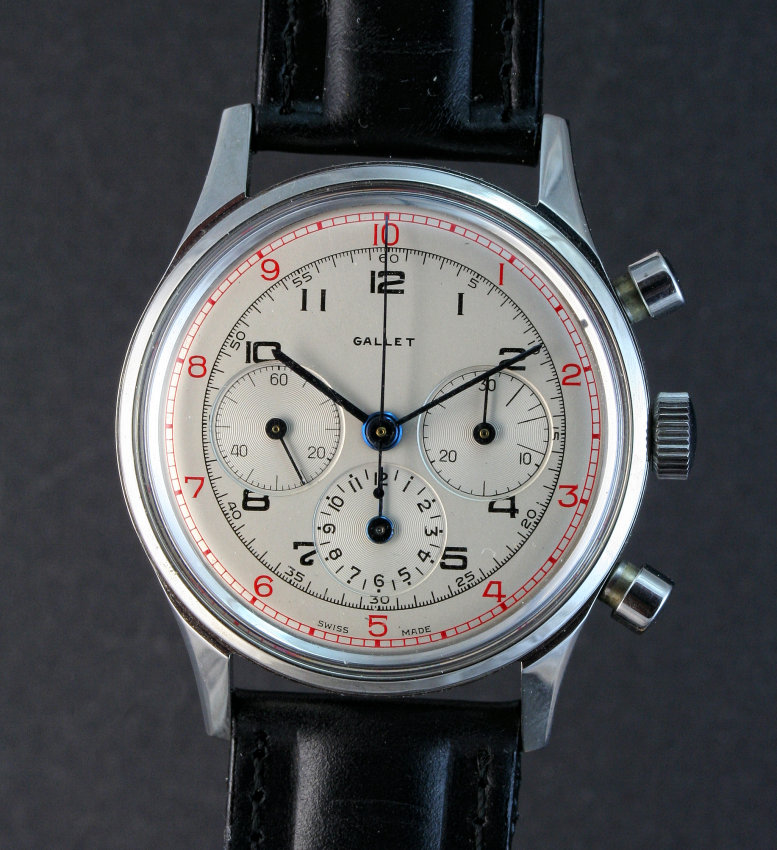
Gallet is a special case among Swiss watch manufacturers. It was essentially a trading company, buying watches from various manufacturers in the La Chaux-de-Fonds region and marketing them abroad. But the company also made a name for itself in the field of chronographs and counters, particularly in the USA.

Description

Joël Pynson

May 2025

1. The Gallet dynasty

Julien Gallet, originally from Geneva, settled in La Chaux-de-Fonds as a watch manufacturer around 1826 [1]. He then went into partnership with his sons Lucien-François and Léon-Louis under the name J. Gallet & Cie.

In 1864, Léon-Louis opened a branch in the United States, which quickly became the company's most important market.

Léon-Louis's eldest son, Julien-Louis, known as Julien Jr. joined the family business and in 1883 went into partnership with Jules Racine, under the name Julien Gallet & Cie [2]. Jules Racine was in fact Julien-Louis' uncle. He was based in New York and was also instrumental in the success of Gallet watches in the United States [3].

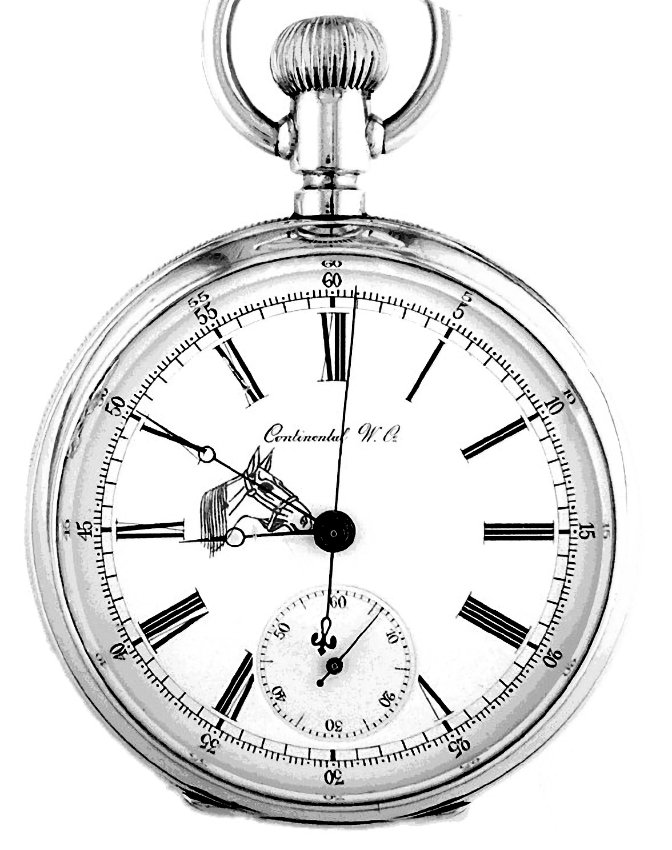
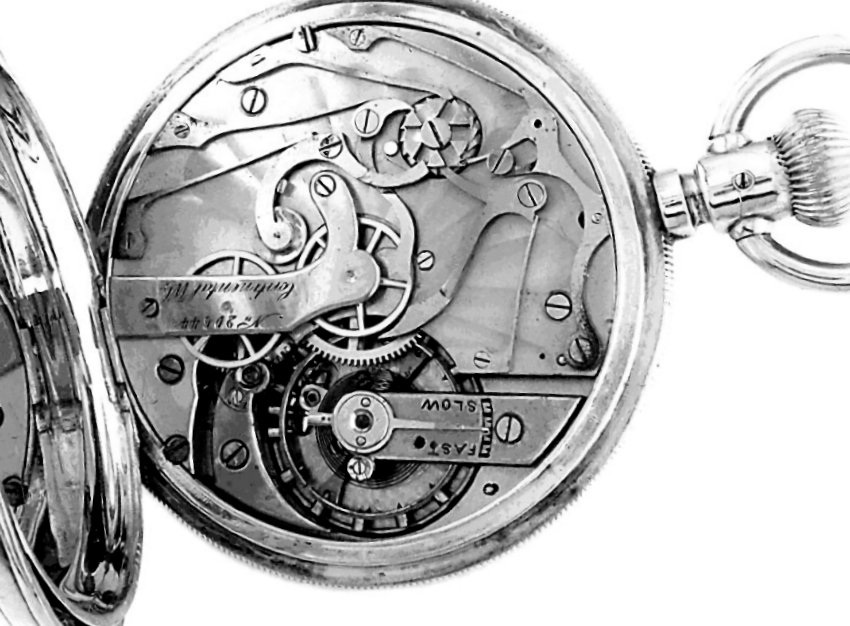
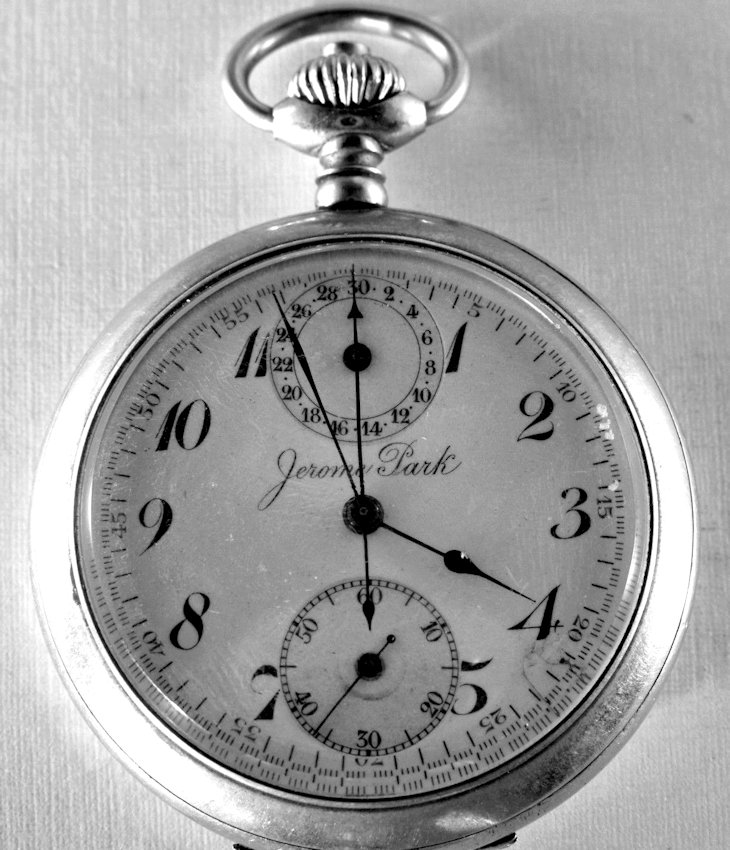
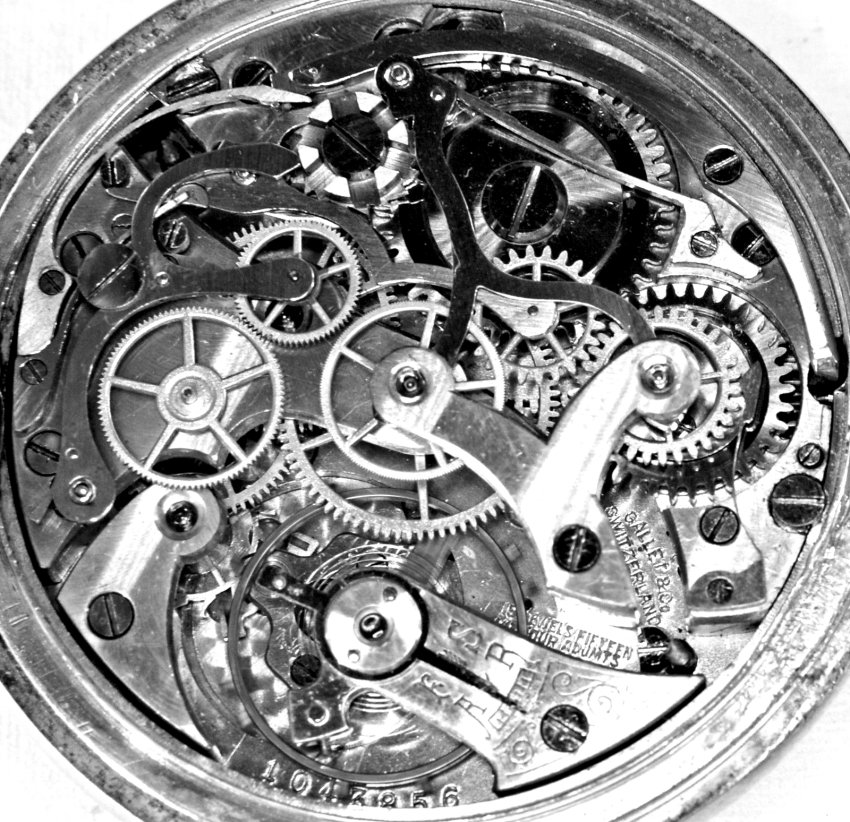
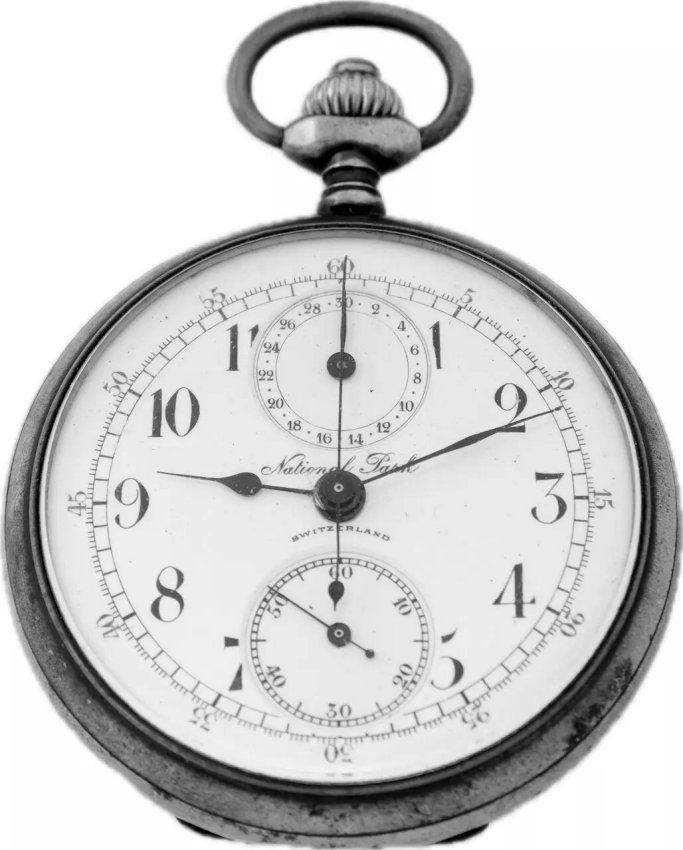
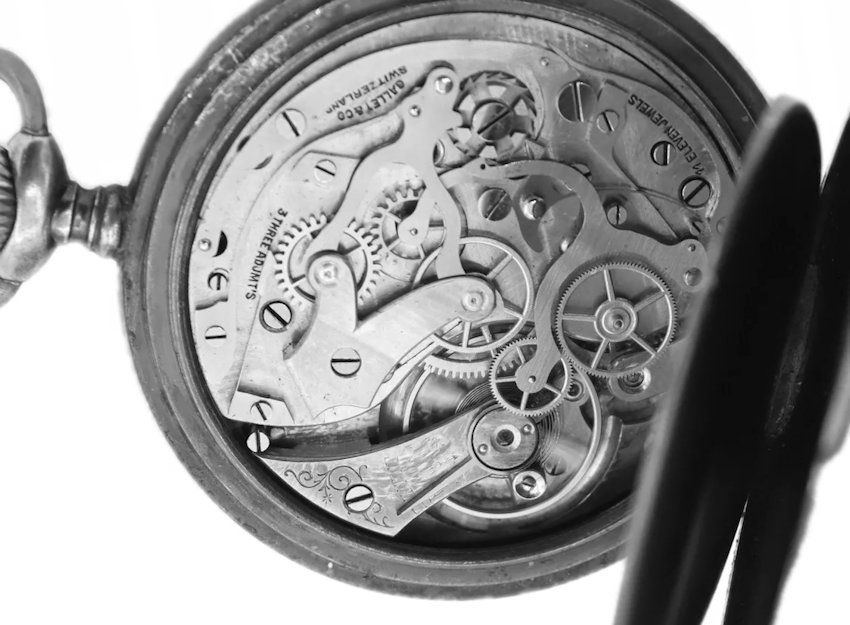
The number of trademarks registered by Julien Gallet & Cie is impressive: National Park, Jerôme Park, Continental, Lady Racine, Epsom Timer, etc. Examination of the calibers used in the watches of these brands that have come down to us shows that suppliers were very numerous, and that the chronograph was an important model, probably because it was so popular in the USA.

Continental Chronograph, Guinand calibre

Jerome Park Chronograph, Minerva calibre

National Park chronograph, Breitling calibre

This also explains why, in 1876, Lucien and Léon-Louis Gallet acquired a stake in the Société Suisse d'Horlogerie, a company created in La Chaux-de-Fonds to ensure the supply of watches by the Fabrique de Montilier [4].

In 1891, Julien Jr's younger brother Georges-Léon became a partner.

Léon-Louis Gallet died in 1898. He had acquired a considerable fortune, and bequeathed a large sum to the town of La Chaux-de-Fonds, part of which was used to create a watchmaking museum [1].

In 1900, Julien-Louis and Georges-Léon transformed the company into Gallet & Co[5].

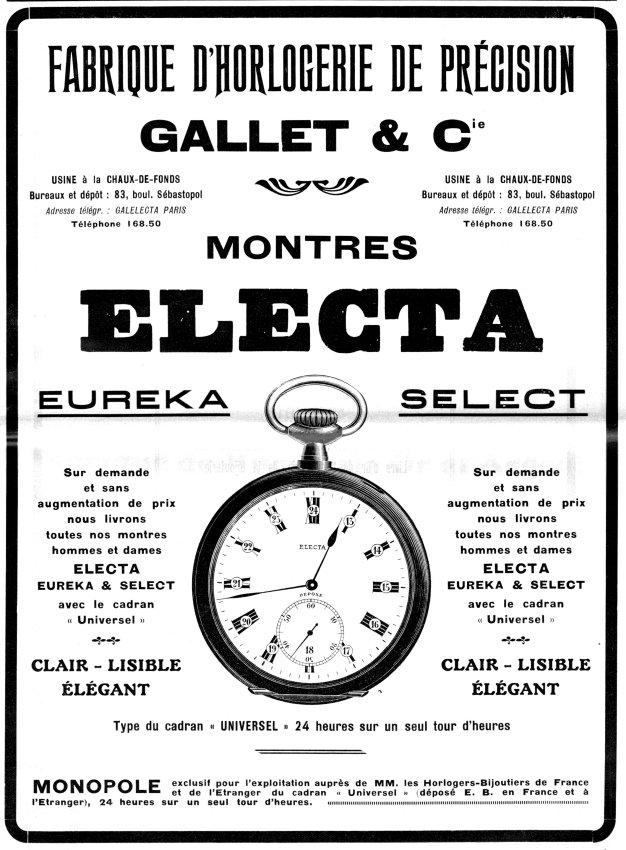
The Gallets certainly wanted to ensure the supply of high-quality watches. The opportunity arose in 1907 with the purchase of Société d'Horlogerie Electa.

2. Gallet & Co., Fabrique d’horlogerie Electa

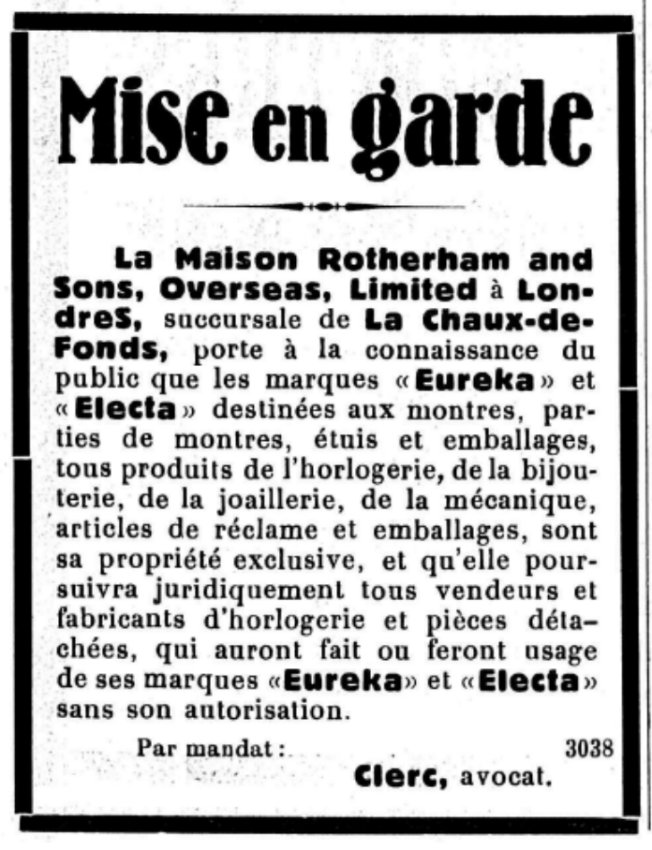
Electa had its origins in the Société d'Horlogerie de Genève, created by Prosper Nordmann to market chronographs and repeater watches of his own invention [6]. In 1902 the company was transferred to La Chaux-de-Fonds under the name Société d'Horlogerie Electa [7].

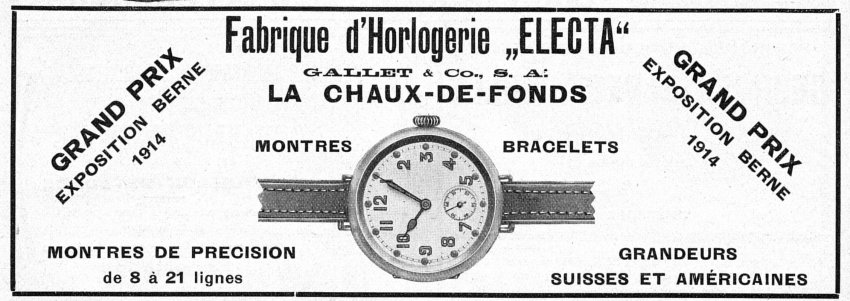
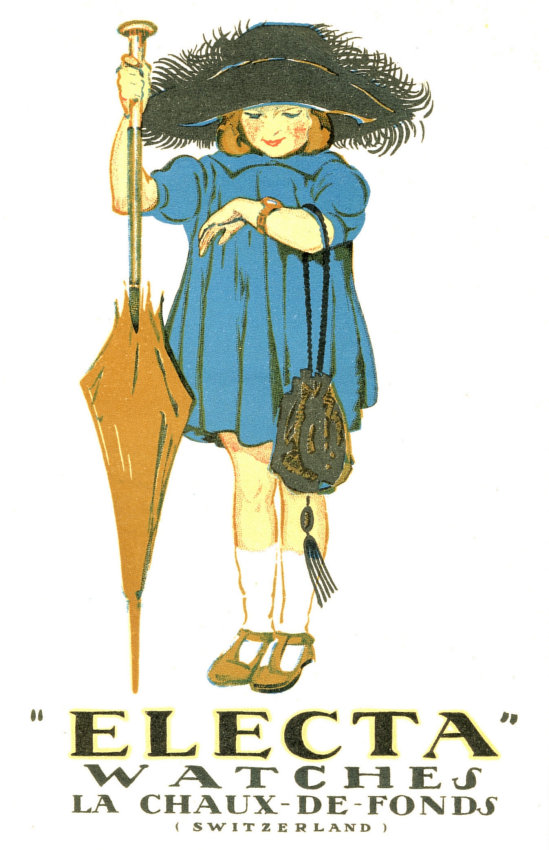
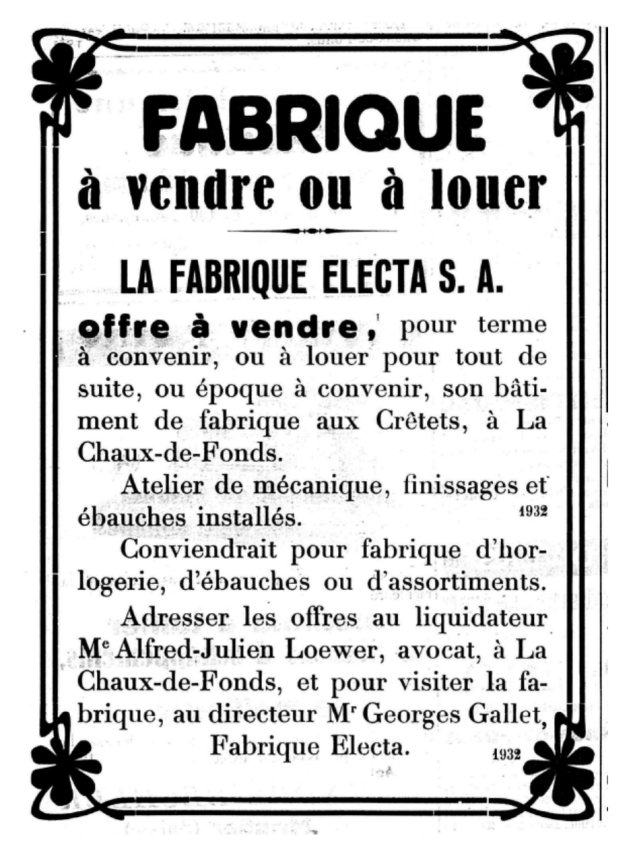
Probably due to financial difficulties, Société d'Horlogerie Electa was taken over by Gallet & Co. and renamed Gallet & Co. Fabrique d'Horlogerie Electa [8].

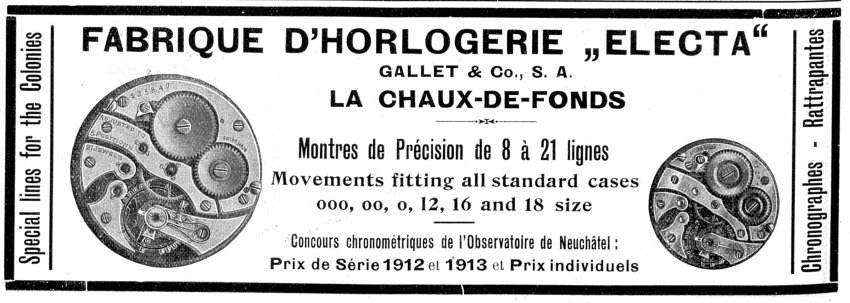
The Electa factory became Gallet's "manufacture". The number of calibers was increased, but production of "Nordmann type" chronographs was discontinued.

In 1912, the company became a société anonyme under the name Fabrique d'horlogerie Electa, Gallet & Co. SA [9].

1912

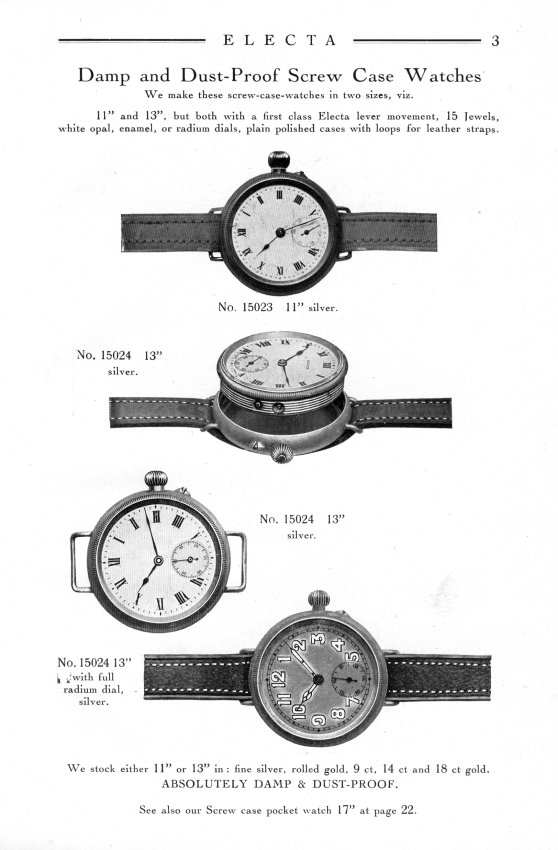
At the start of the 1st World War, Electa-Gallet begins production of wristwatches. The Galco trademark is registered in 1916.

1914

1915

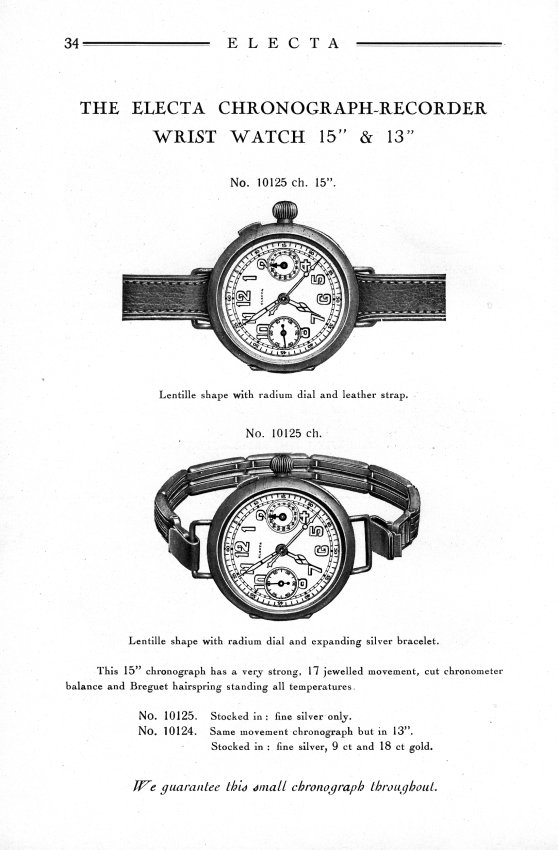
From then on, wristwatches became a company specialty, with an ever-growing range of watches for the military, including wrist chronographs.

1918

1920

But the post-war years were crisis years for the Swiss watchmaking industry, and Electa-Gallet was no exception.

In 1924, the company went into receivership, and the factory and all its machinery had to be put up for sale.

1924

1927

Fabrique d'Horlogerie Electa, Gallet & Co. SA disappeared in 1928 [10].

But the Gallet story was not over. In fact, the company will bounce back with flying colors.

3. Gallet et Co.

In 1924, Léon-Louis Gallet and Madeleine Montandon-Gallet set up a new company in La Chaux-de-Fonds, L. Gallet & Co., which became Gallet & Co. in 1928 [11].

The American market was growing steadily, especially as sporting activities became more widespread: demand for counters and chronographs exploded. It was at this time that Gallet & Co. established a very close relationship with Excelsior Park, which claimed to be the largest manufacturer of sports counters in Switzerland [12].

Gallet's suppliers were still numerous, but the counters were almost exclusively supplied by Excelsior Park. Likewise, chronograph calibers were supplied by Ébauches SA, in particular the Venus 140, which Gallet used extensively, but as soon as Excelsior Park's EP 12/13 caliber became available in 1938, it was used by Gallet.

1931

1936

1938

Calibre Vénus 140

Calibre Excelsior Park

Calibre Excelsior Park

The range of wrist chronographs exported to the USA is extremely varied. There were many models based on the Venus 140, as well as smaller models based on the Valjoux 69. Around 1938, some models are called Multichron. These were models initially fitted with a tachometric scale, then models with a double scale, tachometric and telemetric.

In 1940, Madelaine Montandon-Gallet died, and Paulette, wife of Léon-Louis, joined the company [13].

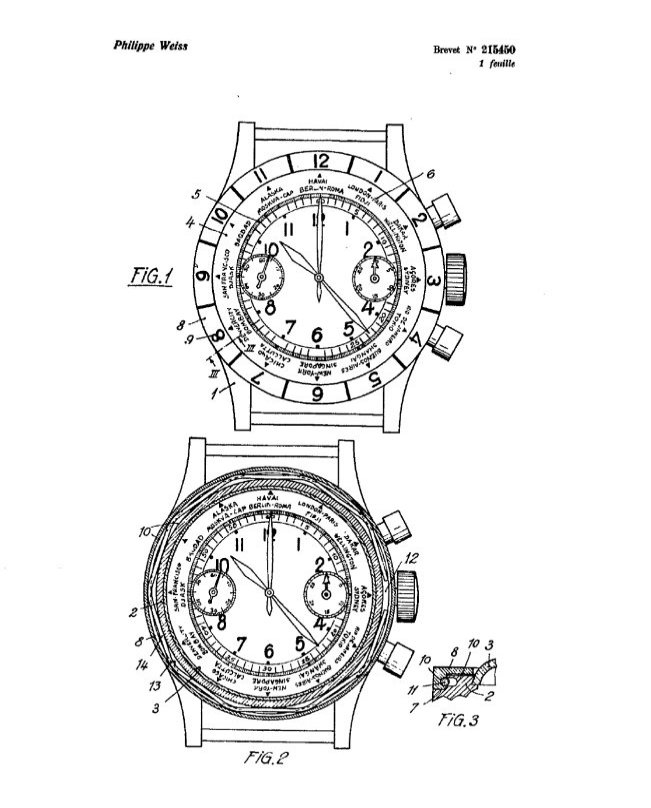
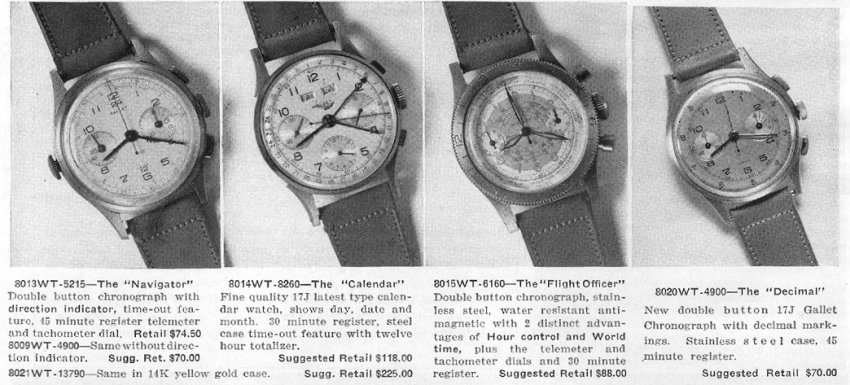
In 1941, Gallet launched its best-known model in the USA: the Flight Officer chronograph. It is a chronograph indicating the world's hours, with a water-resistant steel case. The patent [14] for this model belongs to Philippe Weiss, who runs the White Star factory in La Chaux-de-Fonds. It is possible that White Star supplied Gallet with this chronograph.

In 1944, Gallet et Co becomes a SA with Léon-Louis Gallet as president. The following year, Gallet launches a rare Navigator model, which is actually the Excelsior Park Parachutist model [15].

1950

In the 1950s, Bernard-Georges-Léon and Pierre-Auguste Gallet joined the family business.

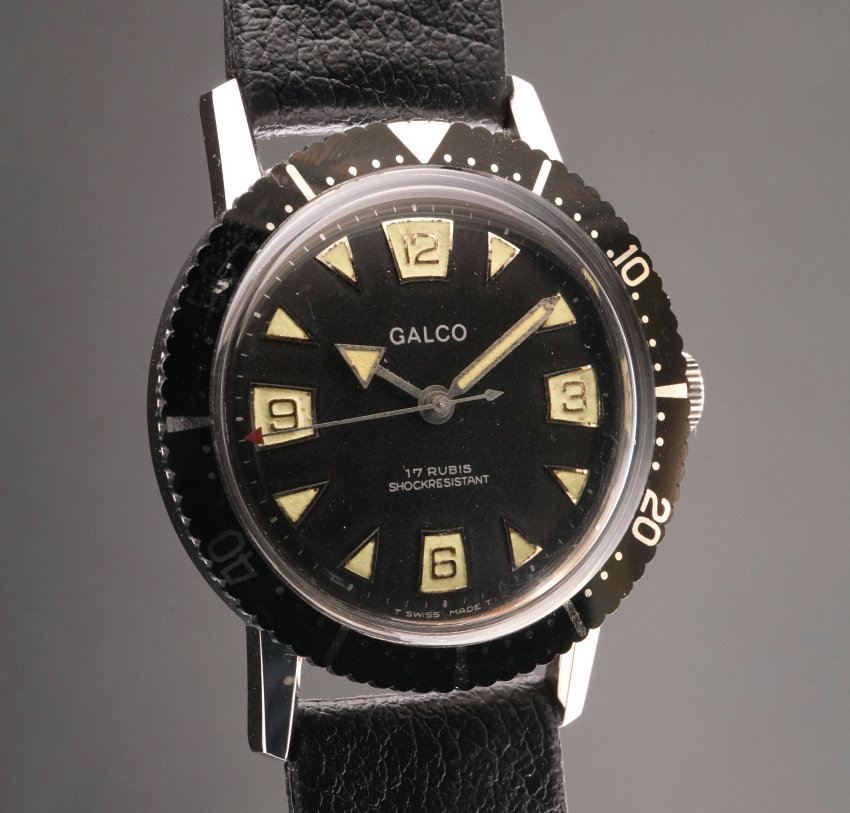
In the early 1960s, Gallet launched its first diving watches, under the Racine and Galco names.

1964

In the early 1970s, Gallet launched its version of the Excelsior Park Excel-O-Graph chronograph, but the company was not able to withstand the "quartz crisis" that began in 1975. The first difficulties began with the fall of the dollar, at a time when the American market was the most important. The market for counters then dried up, with strong competition from other manufacturers, Heuer in particular, and then came quartz counters, which put the company in jeopardy.

In 1977, Gallet et Co. was acquired by Guinand Watch Co [16].

4. From Gallet & Guinand to Gallet AG

The merger between Guinand and Gallet seemed logical: both companies sold chronographs and counters, and Guinand was also distributed in the USA.

The new company is called Gallet & Guinand and is headquartered in Les Brenets, near Le Locle. The president is Jean Guinand, but the board of directors includes Michel Guinand, and Hélène and Bernard Gallet.

However, the economic situation of the new company was not brilliant. In 1981, Bernard and Hélène Gallet decided to create Gallet SA in La Chaux-de-Fonds [17], taking over several brands, including Gallet and Galco. Michel Guinand also set up his own company under his own name in 1981 [18].

Gallet & Guinand went bankrupt in 1985 [19]. Gallet and Guinand went their separate ways.

Gallet SA found new partners in 1991. They were Michael and Jean-Claude Vrolixs, who ran New Trends of Switzerland in La Chaux-de-Fonds, whose best-known brand was Swiss Army [20].

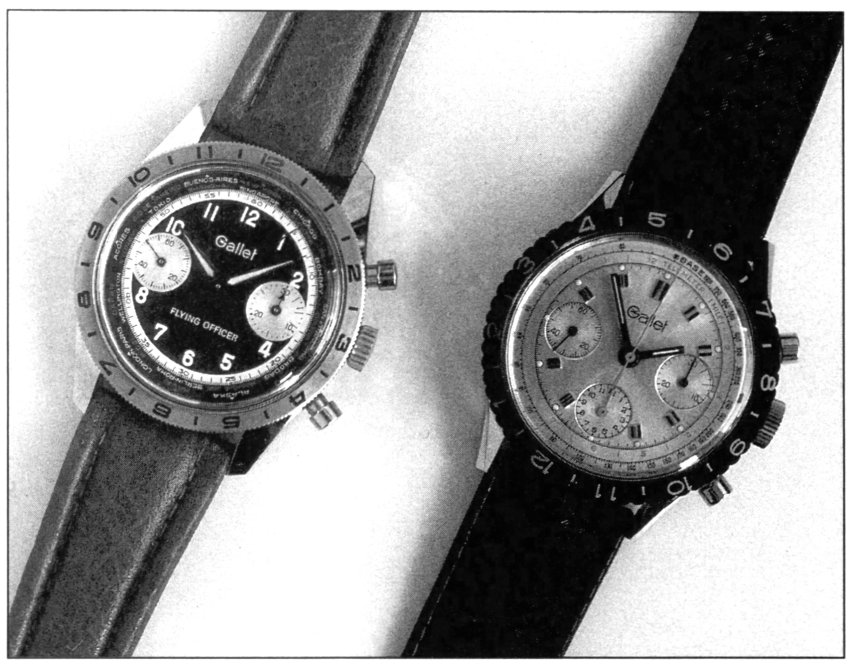
The brand is relaunched with ceramic watches and mechanical chronographs, including the Flight Officer model, renamed Flying Officer, but is not a great success.

1991

1992

Gallet SA went bankrupt in 1993 [21]. In 1996, the brand was taken over by the Neresheimer family, who founded Gallet AG in Zollikon, near Zurich [22]. But the brand was mothballed.

In April 2025, Breitling acquired the Gallet brand [23].

See also, Electa, White Star, Guinand, Excelsior Park


[1] Journal Suisse d'Horlogerie, 1899, 12, p. 424

[2] FOSC 1883

[3] Pierre-Yves Donzé, Les patrons horlogers de La-Chaux-de-Fonds, Editions Alphil, 2007, p.32

[4] FOSC 1883 and 1885

[5] FOSC 1900

[6] See Electa

[7] FOSC 1902

[8] FOSC 1907

[9] FOSC 1910

[10] FOSC 1928

[11] FOSC 1924 and 1928

[12] See Excelsior Park

[13] FOSC 1940

[14] Patent CH 215 450 filed in 1940. See also White Star.

[15] See the article on this chronograph here.

[16] FOSC 1977

[17] FOSC 1981

[18] See Guinand

[19] FOSC 1985

[20] Europa Star Europe, 1991, 2/6, p. 270

[21] FOSC 1993

[22] FOSC 1996

[23] https://www.fhs.swiss/fre/2025_04_03_02_Breitling.html

Notes :

About Time To Tell: Time To Tell has one of the largest private digitized databases on the history of Swiss watchmaking, with over 2.3 TB of data on more than 1,000 Swiss watch manufacturers. This database has been built up over a period of some thirty years, and continues to be fed with around 50 to 100 GB of data every year. The database is made up of old documents, mainly Swiss trade journals, dating from the late 19th to the late 20th century. Most of these documents are not available on the Internet. Historical articles published on the time2tell.com website always cite the sources used.

Time To Tell is a private company, independent of any watch manufacturer.

©Time To Tell, 2025 

Reproduction forbidden without authorization.

Any use of this article by artificial intelligence is strictly forbidden and will be considered an infringement of copyright.

Product Details

Product added to wishlist

Nous utilisons des cookies afin de fournir une expérience utilisateur conviviale. En naviguant sur ce site, vous acceptez la politique d'utilisation des cookies.