The true story of Alpina watches

The true story of Alpina watches

Alpina

Alpina occupies a special place in the history of Swiss watchmaking, as it was originally a grouping of retail watchmakers, first in Switzerland, then in several countries. This particular structure did not prevent Alpina from producing its own watches, before being transformed into a traditional company, the form it still has today.

Description

Joël Pynson

April 2025

1. The beginnings of the cooperative

"Under the name Schweizerische Uhrmacher-Genossenschaft (Swiss Watchmakers' Association), a watchmakers' cooperative was formed with the aim of providing its members with greater professional advantages by using the same sources of supply, i.e. enabling them to obtain good quality articles at as low a price as possible." And so, in 1886, Gottlieb Hauser, in association with Erhard Baur, Gottlieb Koblet, Christian Graf-Link and Carl Meyer, founded the cooperative that was to become Alpina [1] in Winterthur, in the canton of Zurich. The association must already have been in existence for some years, since the official founding date is 1883, 3 years before it was entered in the commercial register.

According to the articles of association, any Swiss watchmaker can become a member, after paying the registration fee. Foreign watchmakers can also join, but cannot take part in the cooperative's decision-making process.

In 1890, the cooperative relocated to Biel, a town more conducive to watchmaking [2].

Numerous watch manufacturers supplied the cooperative, which offered its members watches under the Alpina brand name.

At the 1900 Paris Exposition Universelle, the cooperative wins a bronze medal for the quality of its watches [3]. The cooperative offered a wide range of watches, from the good anchor watch to luxury ladies' watches, chronometers with control bulletin and chronographs.

In 1901, the cooperative became the Union Horlogère [4], and numerous subsidiaries were set up in Switzerland, Geneva, and abroad in Germany, Austria, France and Denmark.

1909

1909

In 1911, the Geneva branch was renamed Alpina Watch Co. with Gottlieb Hauser as president [5].

In the same year, another cooperative, not to be confused with the Union Horlogère, was founded in Biel: the Alliance Horlogère [5]. This new cooperative, whose president was Paul William Brack, used the Nomos brand.

1913

The First World War was a dramatic event with particular consequences for Union Horlogère, as subsidiaries were located in countries at war with one another.

As a result, the cooperative became a limited company in 1915 [6].

Also around 1915, Union Horlogère produced its first wristwatches.

1915

In 1923, the Geneva branch was closed.

In 1927, Louis Straub, a watch manufacturer from Biel, joined the Board of Directors of Union Horlogère [7]. This marked the beginning of a strategic decision to manufacture his own movements. This was to happen in two stages.

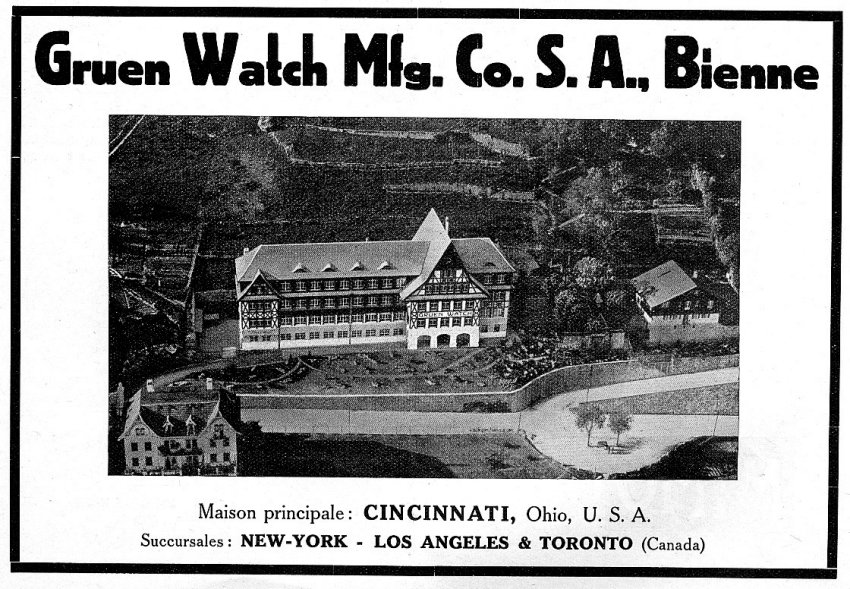
First, in 1928, Union Horlogère joined forces with the American manufacturer Gruen to create Alpina Gruen Guilde [8]. Gruen had been manufacturing its movements in Switzerland since 1904, with the support of the famous Aegler factory, which produced Rolex calibres. By 1925, Aegler had become Aegler SA, Fabrique des montres Rolex and Gruen Guild [9].

This gave Union Horlogère an excellent supplier of movements, and Gruen easier access to the European market.

1932

This partnership lasted until 1937.

But in 1930, Louis Straub changed his company name from Straub & Co. to Fabrique des montres Alpina [10]. And in 1938, the Alpina Gruen Guild became Alpina Union Horlogère with Gottlieb Fehlmann as president. This marked the end of the association with Gruen and the start of a new era for Alpina, now a manufacturer.

2. Alpina Union Horlogère

"The Alpina Union Horlogère manufactures and buys the merchandise required by its members, who are often shareholders.

The Alpine watchmaker (sic) remains in closer contact with his supplier than is generally the case in groups of this kind. At annual congresses, they have the opportunity to express their wishes and take an interest in the progress of the business. The contact that is thus established between the members of the association and the parent company, brings them closer together and gives them the feeling of being part of a big family of watchmakers.

This sense of community is further accentuated by the fact that Alpina sells its watches in medium-sized and small towns only on an exclusive basis, and that in large cities there is only one brand representative per neighborhood [10]."

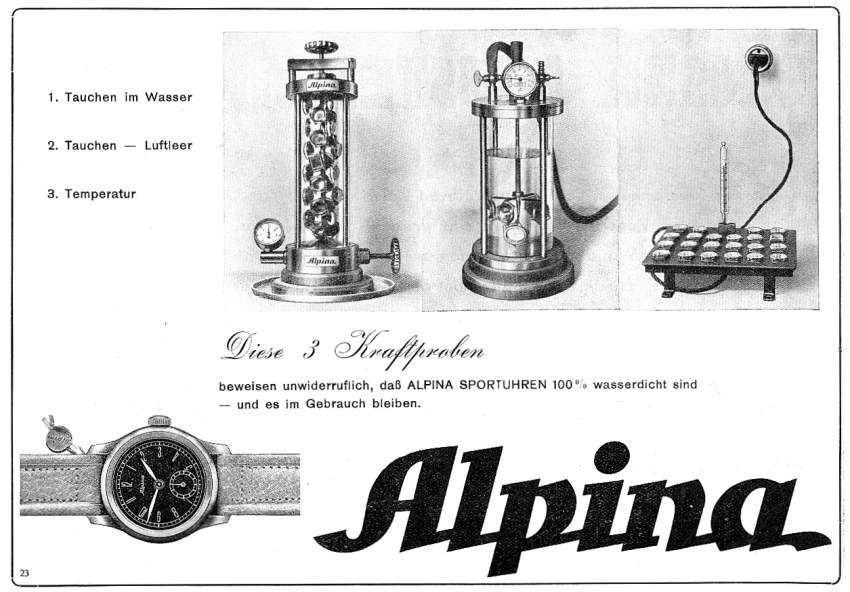
This is how Alpina presented itself in 1938. Having its own movements enabled Alpina to launch exclusive models, increasingly specializing in water-resistant watches.

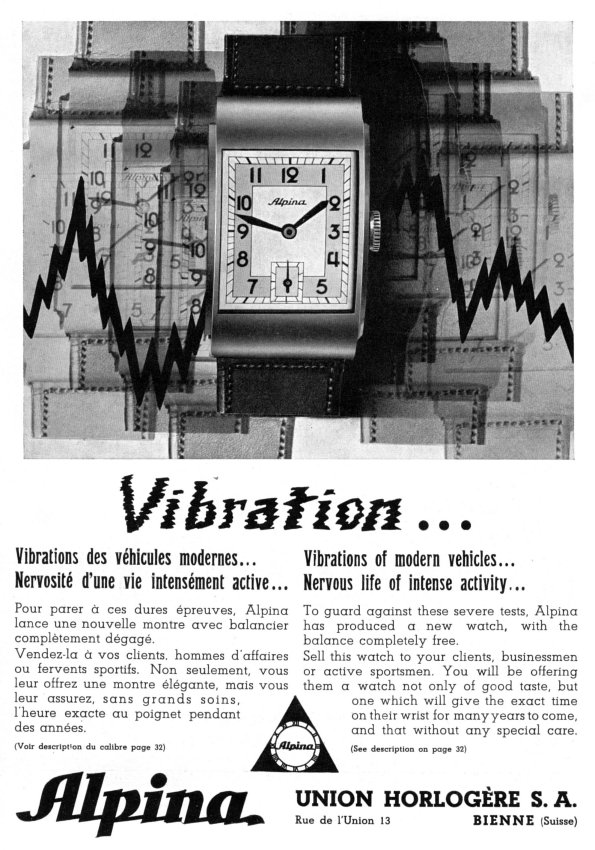
In 1938, Alpina launched a new rectangular caliber 490, with an eccentric balance to better protect it from shocks.

1938

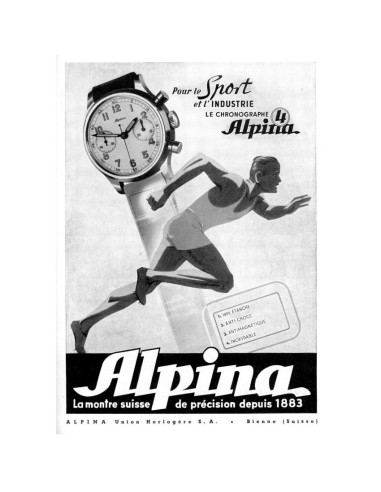
Also in 1938, Alpina launched the Alpina 4 model, for men and women. This is a round, water-resistant watch with a 10.5-line caliber for the men's version and 8.75 lines for the ladies' version.

The following year Alpina launched the Alpina 6, a rectangular water-resistant watch with a patented case, and around 1941 the Alpina 5, a rectangular water-resistant watch for ladies.

1941

1940

1941

At Alpina, water-resistance testing was taken very seriously: the cans were lightly heated to check for fogging, then tested in pressure and vacuum devices, and tested again for fogging [11].

1940

In 1947, Alpina launched its first automatic watch with an oscillating weight movement, caliber 582. The watches were of course water-resistant.

1948

1948

In the 1950s, Alpina experienced strong growth, as did the entire Swiss watchmaking industry. For example, at the 1953 annual congress, attended by over 200 participants representing 11 nations, more than 900 watch models were presented! [12]

In 1958, for the company's 75th anniversary, Alpina launched an economical manual-winding model, the Alpina Standard, and in 1962 a very slim model called the Miniplan.

1958

1962

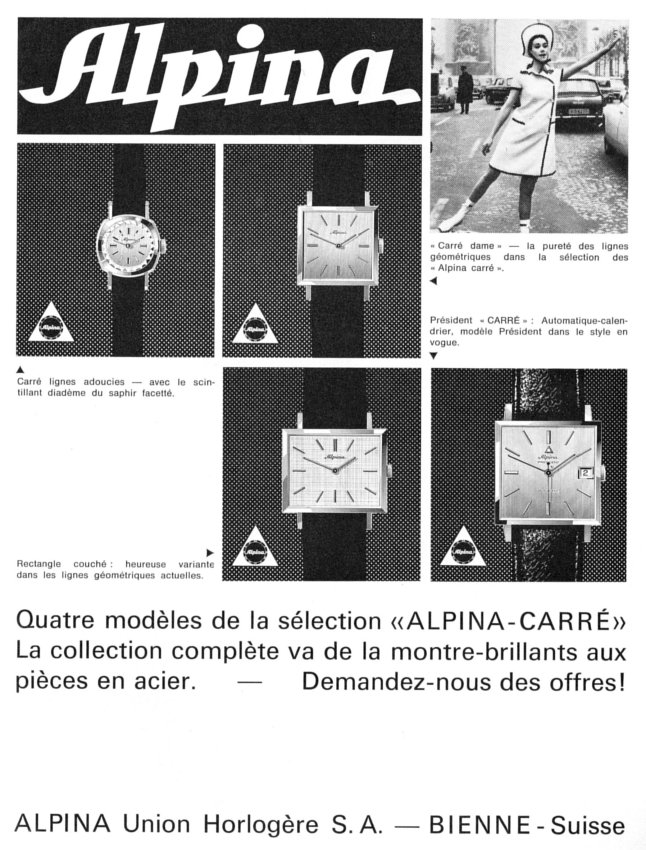
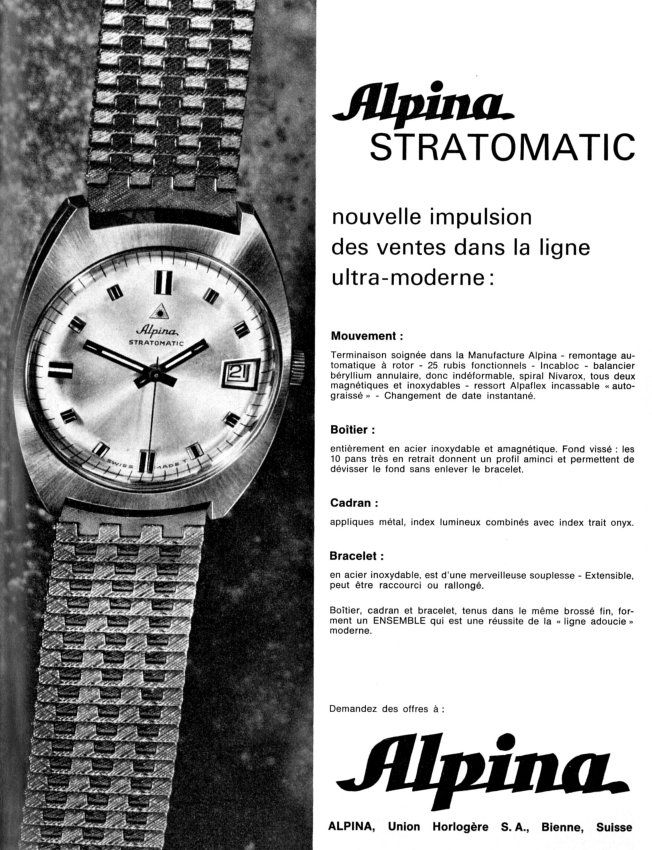
Other models were launched in the 1960s, such as the Alpina carré and the Stratomatic.

1966

1967

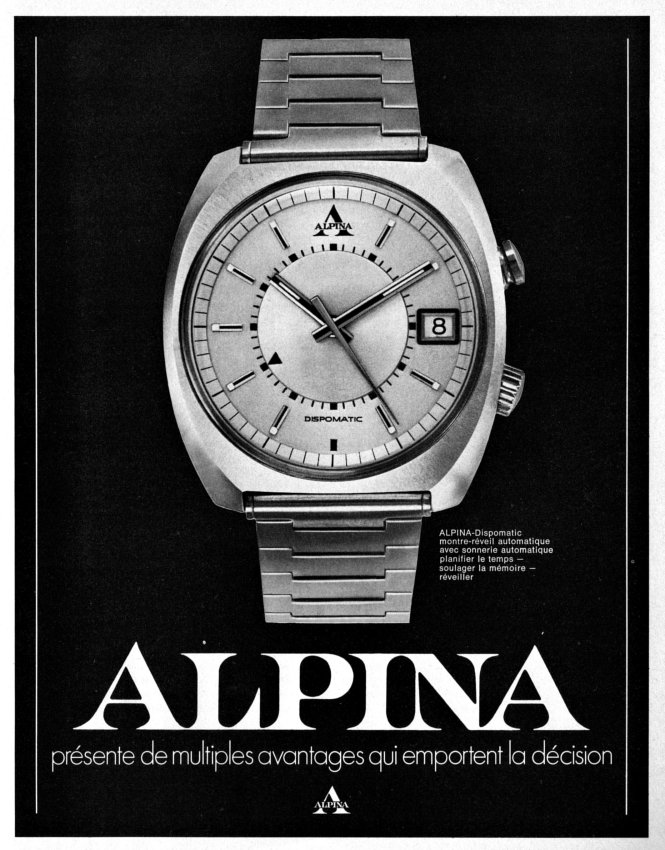
But Alpina's business model ran out of steam, perhaps due to strong competition on international markets and the difficulty of innovating in new technologies such as electronics and new materials.

In 1970, Straub & Co. ceased exclusive production of Alpina movements, and in 1971 Alpina ceased to be a cooperative and became a simple limited company under the name Alpina Watch SA [13].

3. From Alpina Watch International to the Citizen Group

In 1973, the company changed its name to Alpina Watch International [14].

The company is relaunched with very classic quartz and mechanical watches.

1974

1976

But the company did not survive the "quartz crisis" and ceased trading in the early 1980s.

The brand was acquired in 2002 by Frédérique Constant, who successfully relaunched it [15]. Frédérique Constant and Alpina are now part of the Citizen group.


Interesting models from Alpina's "manufacture" period can be found here.

The current Alpina website can be found here.


[1] FOSC 1886

[2] FOSC 1890

[3] La Fédération Horlogère, November 1, 1900, p. 544

[4] FOSC 1901

[5] FOSC 1911

[6] FOSC 1915

[7] FOSC 1927

[8] FOSC 1929

[9] FOSC 1925

[10] Journal Suisse d'Horlogerie, 1938, 7-8, pp. 134-135

[11] Journal Suisse d'Horlogerie, 1942, 1-2, pp. 37-38

[12] Journal Suisse d'Horlogerie, 1953, 7-8, p. 268

[13] FOSC 1971

[14] FOSC 1973

[15] Europa Star Europe, 2003, 260, 4/6, p. 28

Notes :

About Time To Tell: Time To Tell has one of the largest private digitized databases on the history of Swiss watchmaking, with over 2.3 TB of data on more than 1,000 Swiss watch manufacturers. This database has been built up over a period of some thirty years, and continues to be fed with around 50 to 100 GB of data every year. The database is made up of old documents, mainly Swiss trade journals, dating from the late 19th to the late 20th century. Most of these documents are not available on the Internet. Historical articles published on the time2tell.com website always cite the sources used.

Time To Tell is a private company, independent of any watch manufacturer.

©Time To Tell, 2025 

Reproduction forbidden without authorization.

Any use of this article by artificial intelligence is strictly forbidden and will be considered an infringement of copyright.

Product Details

Product added to wishlist

Nous utilisons des cookies afin de fournir une expérience utilisateur conviviale. En naviguant sur ce site, vous acceptez la politique d'utilisation des cookies.