The true story of Guinand chronographs

The true story of Guinand chronographs

Guinand

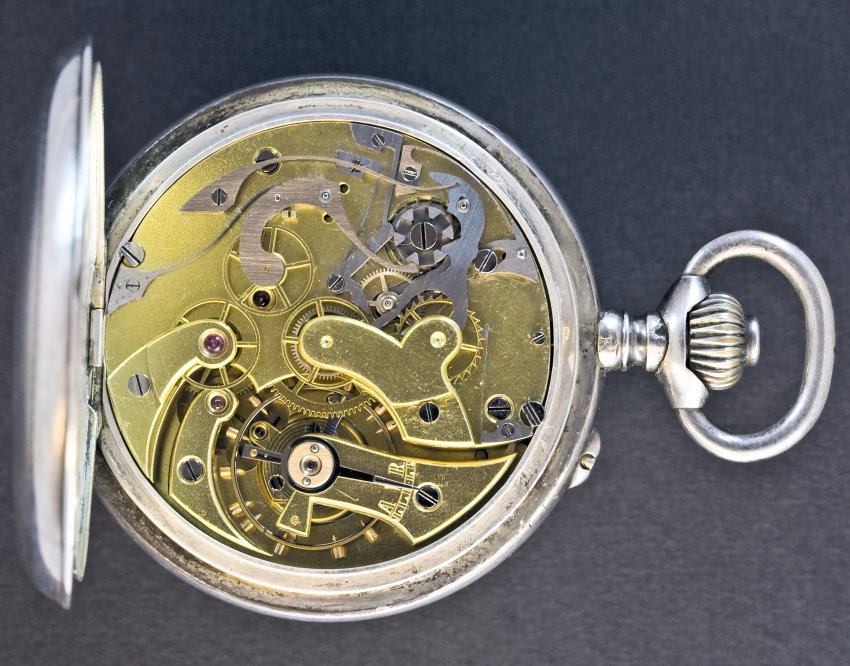
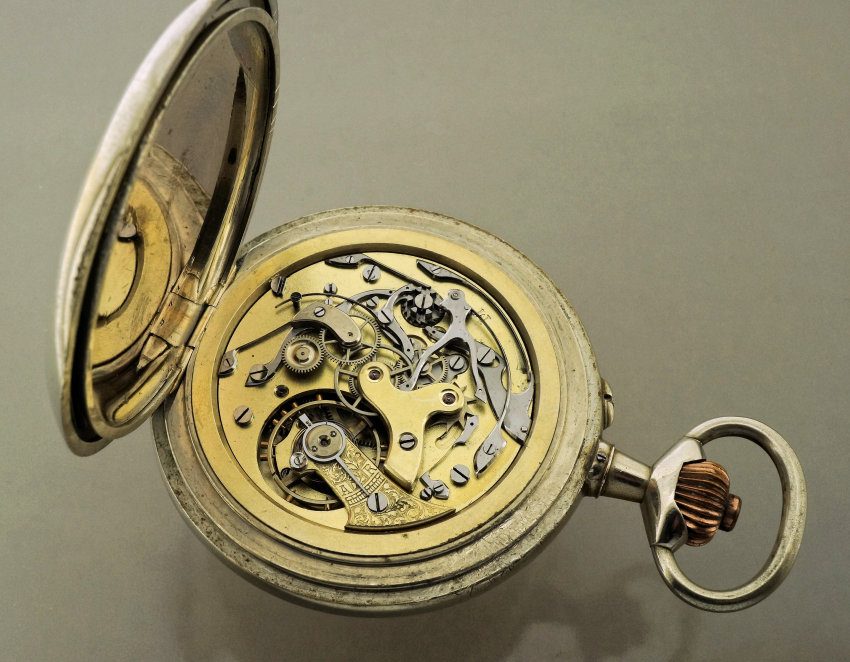
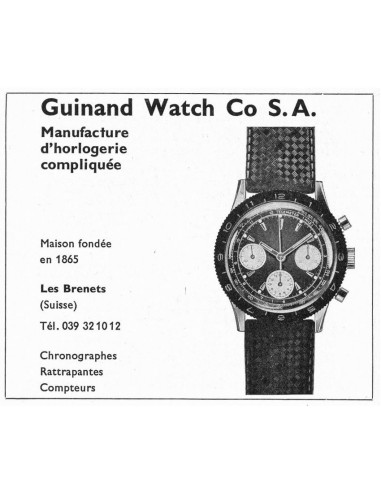
Guinand began as a manufacturer of high-quality counters and pocket chronographs. With the advent of wrist chronographs, Guinand used Ébauches SA calibers, but chronograph production has continued to the present day.
Description

Joël Pynson

May 2025

1. From Guinand frères to Guinand Watch

According to official history, the Guinand frères watch factory was founded in Le Brenets, near Le Locle, in 1865.

When he registered his company in the Feuille officielle suisse du commerce in 1883, Charles Léon Guinand was the sole proprietor [1].

Léon Guinand specialized in counters and chronographs, and patented a chronograph mechanism in 1891 [2]. The calibers are manufactured by the factory, which is a manufacture in the watchmaking sense of the term.

1890

In 1892, the company changed its name to simply Léon Guinand [3].

In 1900, Léon Guinand patented a chronograph whose seconds hand makes one revolution in 3 minutes or more, to facilitate measurement of low speeds [4]. These chronographs bear the name Le Chauffeur.

Manufacture chronographs are exported to the USA, where they can be found under the name C. Léon Guinand, but also National Park. This brand belonged to Gallet & Co. so it's likely that Léon Guinand was a supplier of chronographs to Gallet.

Léon Guinand died in 1908, and his widow, Olga Guinand, took over under the name Vve de Léon Guinand [5]. In 1912, Léon Guinand's son Georges-Henri took over, under the name Georges-Hri. Guinand [6].

Very fine chronograph models are registered in 1913.

In 1920, Guinand took over the National Park name and the company became Fabrique d'horlogerie National Park [7].

Production of chronographs and counters continued, and the Manufacture's chronographs were used for sports competitions by the Automobile Club de France, the Reale Automobile Club d'Italia, and various governments for their armies. By 1933, over 130,000 Guinand chronographs were in use worldwide [8].

c. 1930

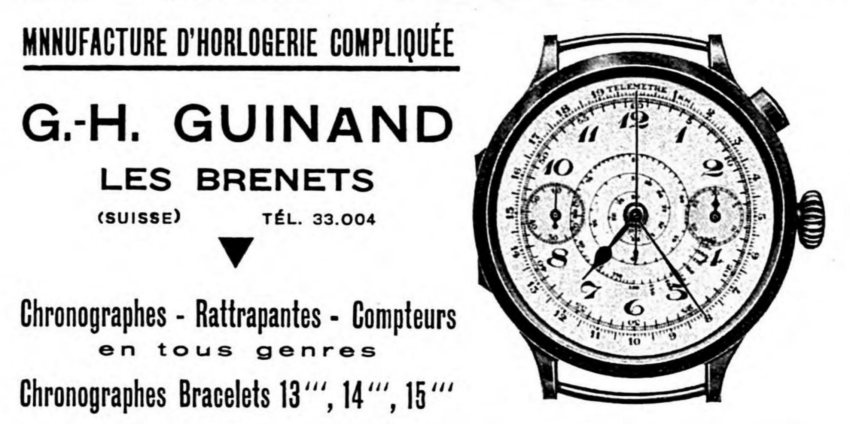
Production of wrist chronographs began in the early 1930s. These were no longer manufactured calibres, but Ébauches SA movements.

1938

1941

In 1945, the company became Guinand Watch SA. It is now run by 3 members of the Guinand family: Georges-Henri, Georges-Léon and John-Albin [9].

2. Guinand Watch

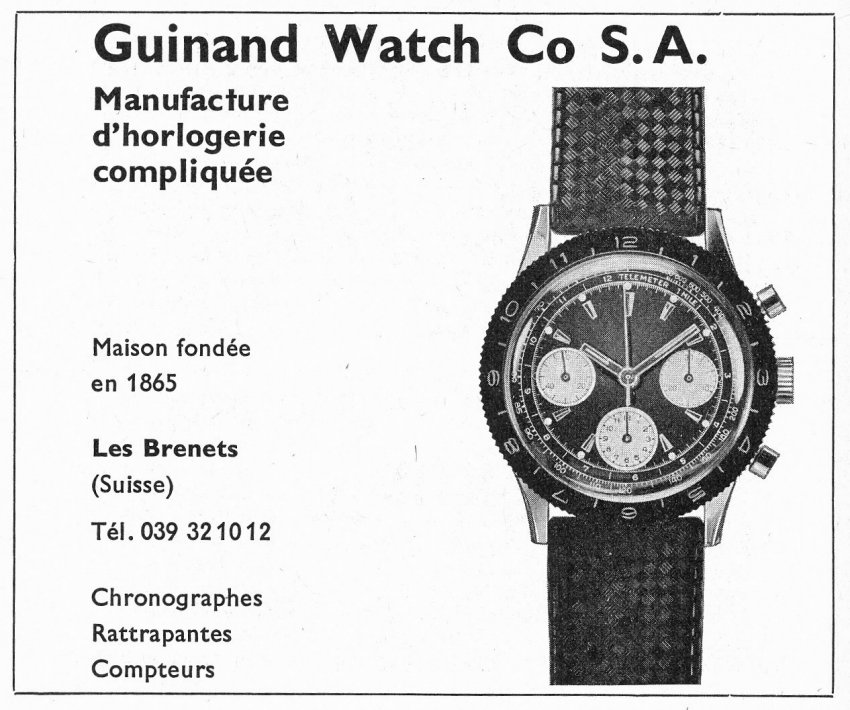
Georges-Henri dies in 1946. The company continues to manufacture wrist chronographs, simple, with hour counter, with calendar, etc.

1950

1957

Guinand supplies numerous companies, in particular Sinn in Germany.

In 1964, Michel Guinand joined the family business. In 1973, Georges-Léon, who had been mayor of Les Brenets and a member of the Neuchâtel Grand Council, passed away. Although demand for mechanical chronographs declined, the company continued to manufacture them, including fine chronographs for sports competitions.

1972

1976

In 1977, Guinand Watch Co. absorbed Gallet et Co. to become Gallet & Guinand SA, with Jean Guinand as Chairman, and Lucienne Gallet, Léon Gallet and Michel Guinand as shareholders [10].

In 1981, Michel Guinand set up his own company under his own name [11].

Gallet & Guinand went bankrupt in 1985 [12].

In 1995, Michel Guinand was taken over by Helmut Sinn Junior, a German manufacturer of chronographs, and the company became Montres Guinand SA [13].

In 1999, the company moved its headquarters to Lengnau.

The company still exists today, but is based in Germany: Guinand Uhren


See also Gallet

[1] FOSC 1883

[2] Patent CH 3 360

[3] FOSC 1892

[4] Patent CH 21 709

[5] FOSC 1908

[6] FOSC 1912

[7] FOSC 1920

[8] La Fédération Horlogère, 1933, 35, p. 299

[9] FOSC 1945

[10] FOSC 1977

[11] FOSC 1981

[12] FOSC 1985

[13] FOSC 1995

The FOSC (Feuille Officielle Suisse du Commerce) is available on E-periodica

Notes :

About Time To Tell:

Time To Tell has one of the largest private digitized databases on the history of Swiss watchmaking, with over 2.3 TB of data on more than 1,000 Swiss watch manufacturers. This database has been built up over a period of some thirty years, and continues to be fed with around 50 to 100 GB of data every year. The database is made up of old documents, mainly Swiss trade journals, dating from the late 19th to the late 20th century. Most of these documents are not available on the Internet. Historical articles published on the time2tell.com website always cite the sources used.

Time To Tell is a private company, independent of any watch manufacturer.

©Time To Tell, 2025 

Reproduction forbidden without authorization.

Any use of this article by artificial intelligence is strictly forbidden and will be considered an infringement of copyright.

Product Details

Product added to wishlist

Nous utilisons des cookies afin de fournir une expérience utilisateur conviviale. En naviguant sur ce site, vous acceptez la politique d'utilisation des cookies.