The true story of Aubry Frères, Ciny watches

The true story of Aubry Frères, Ciny watches

Ciny

A medium-sized watch manufacturer, Aubry Frères played an important role in the 1970s, crossing paths with companies such as West End, Dogma, Ernest Borel and Doxa.

Description

Joel Pynson

November 2024

1. Creation in the Franches Montagnes

1925

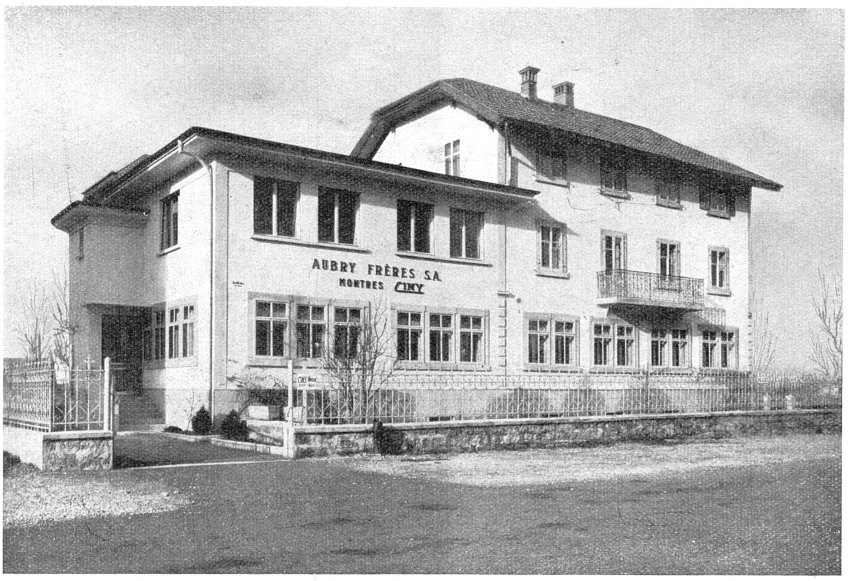
The brothers Marc and Henri Aubry founded their watchmaking factory in Le Noirmont, in the Franches Montagnes [1], in 1920 [2]. However, 1917 is ultimately considered to be the year the company was founded, as their father, Arnold, had actually started the business before them.

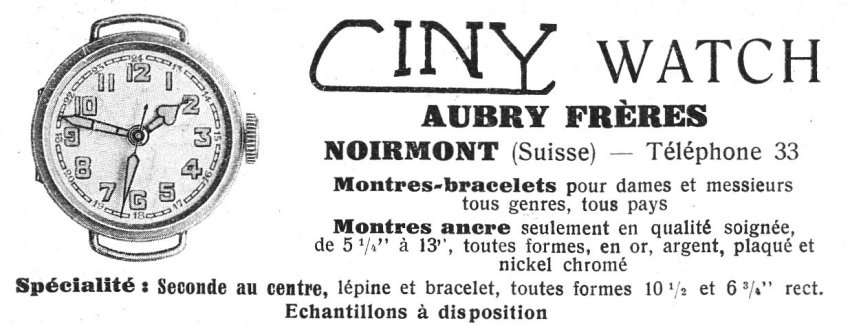
They started out as "finishers," assembling watches for other brands, but quickly became "manufacturers," producing watches under their own name. Gaston Aubry joined the company in 1926. They registered the Ciny trademark in 1928 [3], and the company became Aubry Frères, montres Ciny. The word Ciny comes from the last letter of each of the three brothers' first names, combined with the last letter of their surname: Marc, Henri, Gaston Aubry.

1931

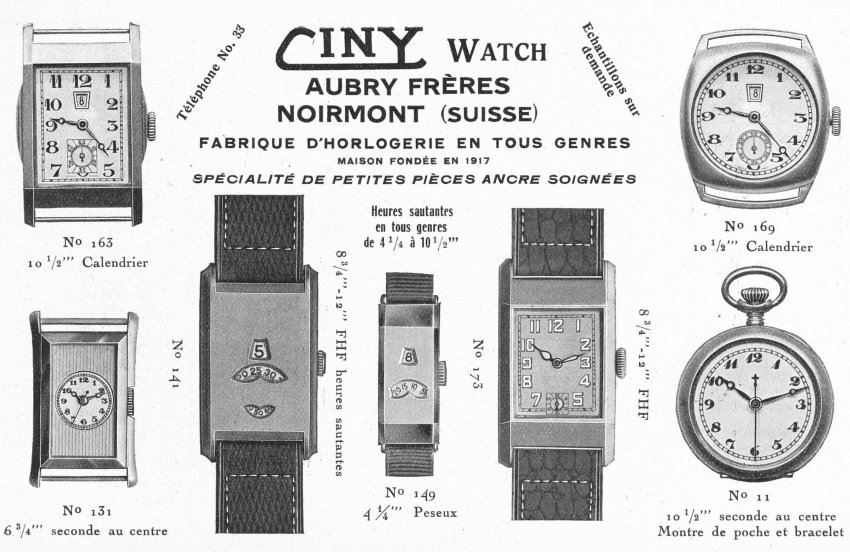
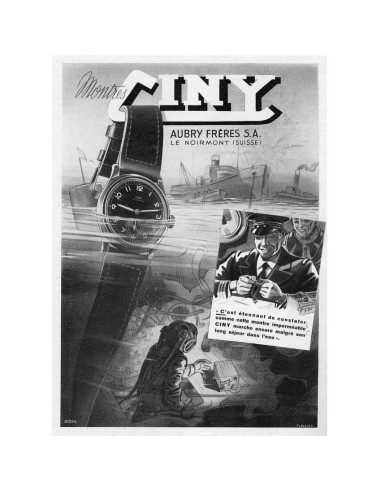
Ciny focused primarily on wristwatches and was quick to adopt technical innovations: watches with a clearly visible central seconds hand, designed for nurses, for example; jumping hour watches in 1930; watches with a window calendar, among the first produced in Switzerland, from 1933; and waterproof stainless steel watches in 1936.

1933

The 1930s were years of crisis for Swiss watchmaking, and Ciny managed to survive thanks to a Geneva-based company working in the Eastern and Far Eastern markets: West End Watch.

West End Watch was a company first established in St Imier in 1893 as a branch of the company Droz & Amstutz in Bombay, in what was then known as British India [5]. It moved to Geneva in 1916 [6]. In 1923, Ciny became the exclusive supplier to West End [7]. This collaboration enabled Ciny to survive the years of crisis.

1939

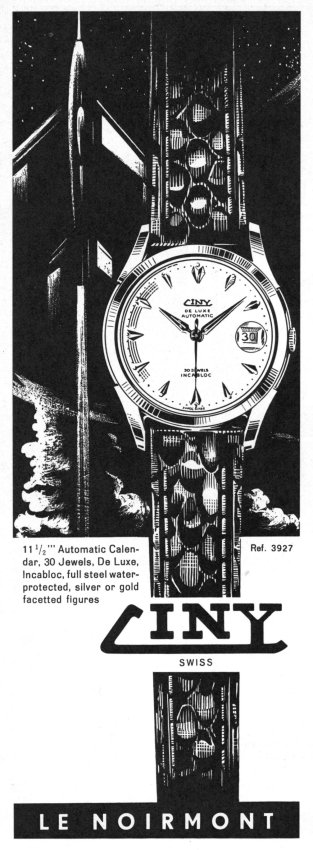
The first automatic watches appeared in 1939, and water resistance was regularly highlighted in advertisements, some of which were created by the famous illustrator René Bleuer.

1941

For the company's 50th anniversary in 1942, Ciny presented its first chronographs.

When Henri Aubry died in 1946, just as Ciny had begun to have some of its watches certified as chronometers, his son Marcel joined the board of directors [8]. He took over as CEO in 1961.

1959

In 1963, opening of an Espérus mechanical workshop in Sagnelégier.

By the end of the 1960s, Ciny had become a medium-sized factory, employing 180 people and producing around 1,000 watches per day [9]. But in the early 1970s, the company underwent a change in status.

2. Marcel Aubry's multiple companies

"There were three possible paths: the first was to sell the company, (...) the second was to create and develop a single international brand, (...) and the third was to buy strong brands in certain markets [10]."

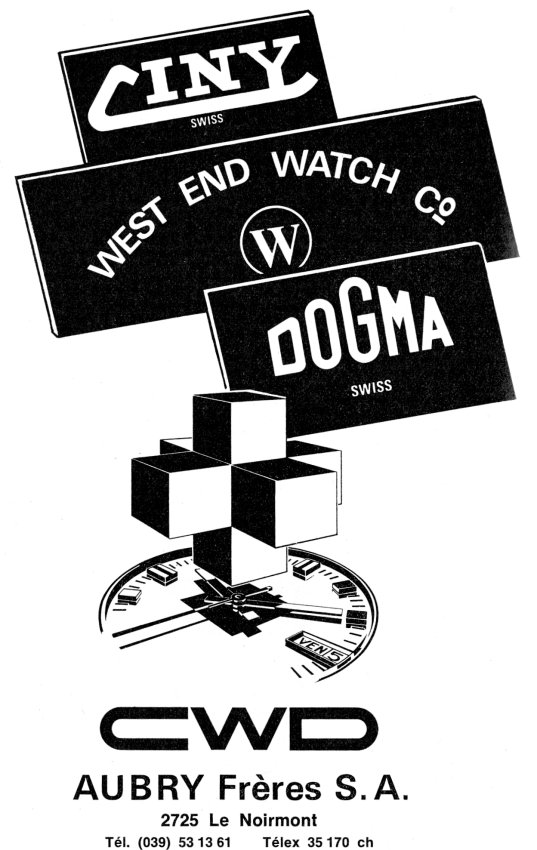
It was indeed this third path that was taken. In 1972, Marcel Aubry took over Arthur Dorsaz et Cie, the manufacturer of Dogma watches in La Chaux-de-Fonds [11], and the following year he took control of West End Watch [12]. The factory in Le Noirmont was expanded to increase production capacity to more than 400,000 pieces per year.

1976

In 1974, Marcel Aubry expanded the Société mécanique Espérus to manufacture mechanical and electronic devices [13], and in 1978, after the bankruptcy of the Synchron group, Aubry Frères took over the Ernest Borel, Doxa, and Auréole brands [14]!

This acquisition marks the end of the Ciny and Dogma brands.

Despite commendable attempts to revive the West End and Ernest Borel brands, Aubry Frères was in difficulty at the end of the 1980s, and its distributor in Asia, Hong Kong Truly, had to provide financial support to the company. It finally took control of the company in 1997.


See also: Ernest Borel, Dogma, West End


[1] This name is linked to the fact that this mountainous region was, at one time, exempt from taxes and duties.

[2] FOSC 1920

[3] FOSC 1928

[4] La Suisse Horlogère, weekly edition, 1977, 33, pp. 763-765

[5] FOSC 1893

[6] FOSC 1916

[7] La Suisse Horlogère, weekly edition, 1973, 6, p. 154

[8] FOSC 1946

[9] Swiss Watchmaking Journal, 1968, 1, p. 126

[10] Marcel Aubry, interviewed by the Journal Suisse d’Horlogerie in 1981

[11] FOSC 1972

[12] La Suisse Horlogère, weekly edition, 1973, 6, p. 154

[13] FOSC 1974

[14] The Synchron group's other brand, Cyma, was taken over by Claude Guilgot (Fabrique Delvina in Geneva).


The archives of the Fédération Horlogère, Davoine, and Impartial are available online at www.doc.rero.ch.

The archives of the Journal Suisse d’Horlogerie, Europa Star, Revue Internationale d’Horlogerie, and Suisse Horlogère are available at The Watch Library.

The FOSC (Swiss Official Gazette of Commerce) is available on E-periodica.

Notes :

About Time To Tell: Time To Tell has one of the largest private digitized databases on the history of Swiss watchmaking, with over 2.3 TB of data on more than 1,000 Swiss watch manufacturers. This database has been built up over a period of thirty years and continues to be updated with approximately 50 to 100 GB of data each year. The database consists of historical documents, mainly Swiss trade journals, dating from the late 19th century to the late 20th century. Most of these documents are not available on the Internet. The historical articles published on the time2tell.com website always cite the sources used.

Time To Tell is a privately owned company, independent of any watch manufacturer.

©Time To Tell, 2024-2025

Reproduction prohibited without permission.

Any use of this article by artificial intelligence is strictly prohibited and will be considered a violation of copyright.

Product Details

Product added to wishlist

Nous utilisons des cookies afin de fournir une expérience utilisateur conviviale. En naviguant sur ce site, vous acceptez la politique d'utilisation des cookies.