Stop and Sport: the two Stop watches from Helvétia manufacture

Stop and Sport: the two Stop watches from Helvétia manufacture

Helvétia

Stop watches are watches that measure intervals of time, but do not have all the functions of a chronograph. They appeared in the mid-1930s to offer a young, sporty public a more economical alternative to the chronograph, which was very expensive at the time.

Description

Joël Pynson

March 2025

1. Terminology

Generally speaking, a Stop watch always allows a counter hand to return to zero. Compared to a chronograph, however, there is a missing function: either the hand cannot be held at zero, which is what we call a "stop-en-vol" (stop-in-flight) watch, or the hand, once reset, started and stopped, cannot be held in position without pressure on the push-piece, in which case we call it a "chrono-stop" watch.

To recognize them easily, simply observe the seconds hand when the watch is in its normal position: if it runs continuously, it's a stop-in-flight watch; if it's fixed at zero, it's a chrono-stop.

2. A brief history

The first Stop watch was Mimo 's Mimolympic, launched in 1936. It's a rectangular stop-en-vol watch that can also be found under the Girard-Perregaux brand, which Mimo had acquired.

1936

1939

In 1937, Ébauches SA introduced two stop-en-vol calibres: the Venus 131 8.75/12-line movement and the Venus 103 10.5-line movement. They will be found under many brand names, including Fortis, Era, Eloga and many others.

Longines launched its Stop Second model in 1939. It is a stop-en-vol watch, equipped with calibre 12.68Z.

1939

1942

In 1940, Invicta launched its own stopwatch, the Secontrol. This is a small stop-watch with a column-wheelless caliber based on A. Schild 984 base with 10.5 lines.

Helvétia proposed its own solution in 1941. This was followed by Tissot' s Mediostat in 1942 and Montilier 's Telefoot in 1946.

3. The Helvetia manufacture

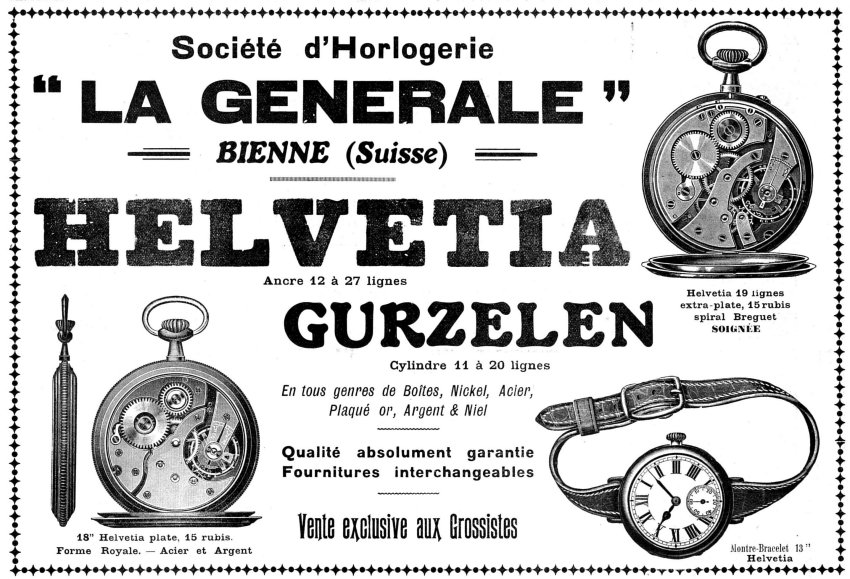
The Brandt brothers, who ran the famous Omega factory, wanted to expand their production range with a watch of good quality but below Omega's standards, at a price that would make it affordable to the middle classes [1]. In 1895, La Générale (General Watch) was created to manufacture Helvétia anchor watches and Gurzelen cylinder watches.

1909

La Générale broke away from Omega in 1911, becoming an independent manufacture.

From the 1930s onwards, under the impetus of its director, Charles Bonny, and its technical director, Lucien Chappuis, La Générale took on considerable importance.

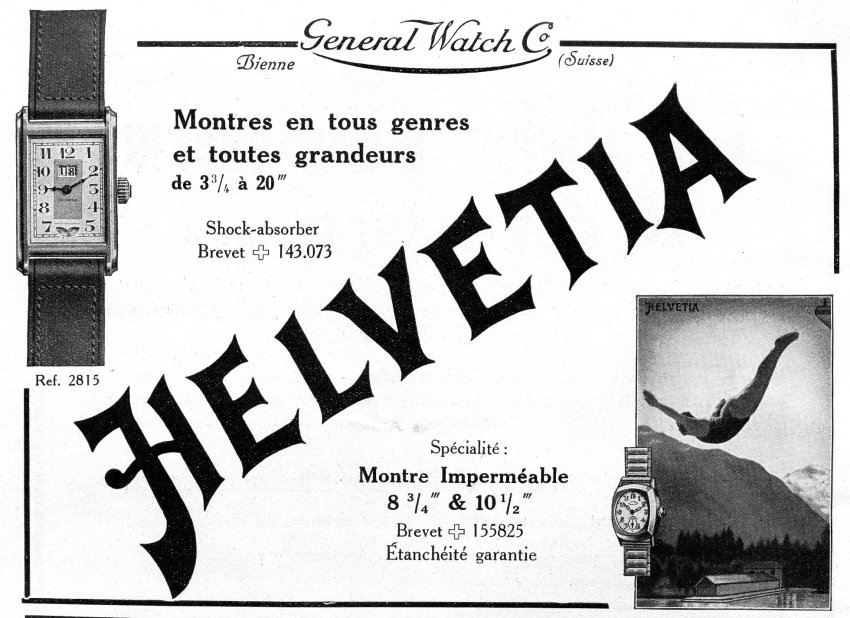
The Helvétia brand was henceforth the only one used, and as early as 1931, the first water-resistant wristwatches appeared, followed in 1932 by jumping hour watches, large date calendar watches, and the first chronometers submitted to the Bienne control office.

1933

1940

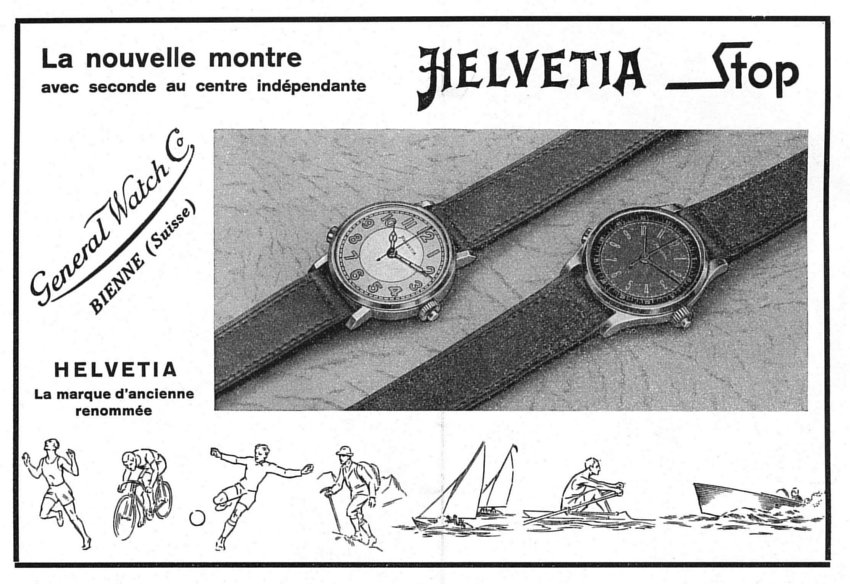
Around 1940, La Générale launched its first chronographs, based on Valjoux calibres. But because of the statut horloger, which had been in force in Switzerland since the early 1930s, La Générale, being a manufacture, could not use Ébauches SA calibers to make more economical Stop watches. It therefore developed its own movements, and in 1941 launched two remarkable Stop watches: the Helvétia Stop and the Helvétia Sport.

4. Helvétia Stop

1941

The Helvétia Sport and Helvétia Stop watches were presented at the Basel Fair in 1941 [2].

The Helvétia Stop was presented as "the ideal watch for all sporting, medical and scientific observations". It features a permanent-motion central seconds hand, and operates like a stop-en-vol watch:

- a pusher coaxial with the crown resets the central hand to zero. As soon as pressure on the pusher ceases, the hand immediately resumes its course.

- the central seconds hand can also be stopped at any time by a second pusher at 8 o'clock. But it resumes its course as soon as pressure on the pusher ceases.

Helvetia Calibre 822. Note the Helvetia shock absorber

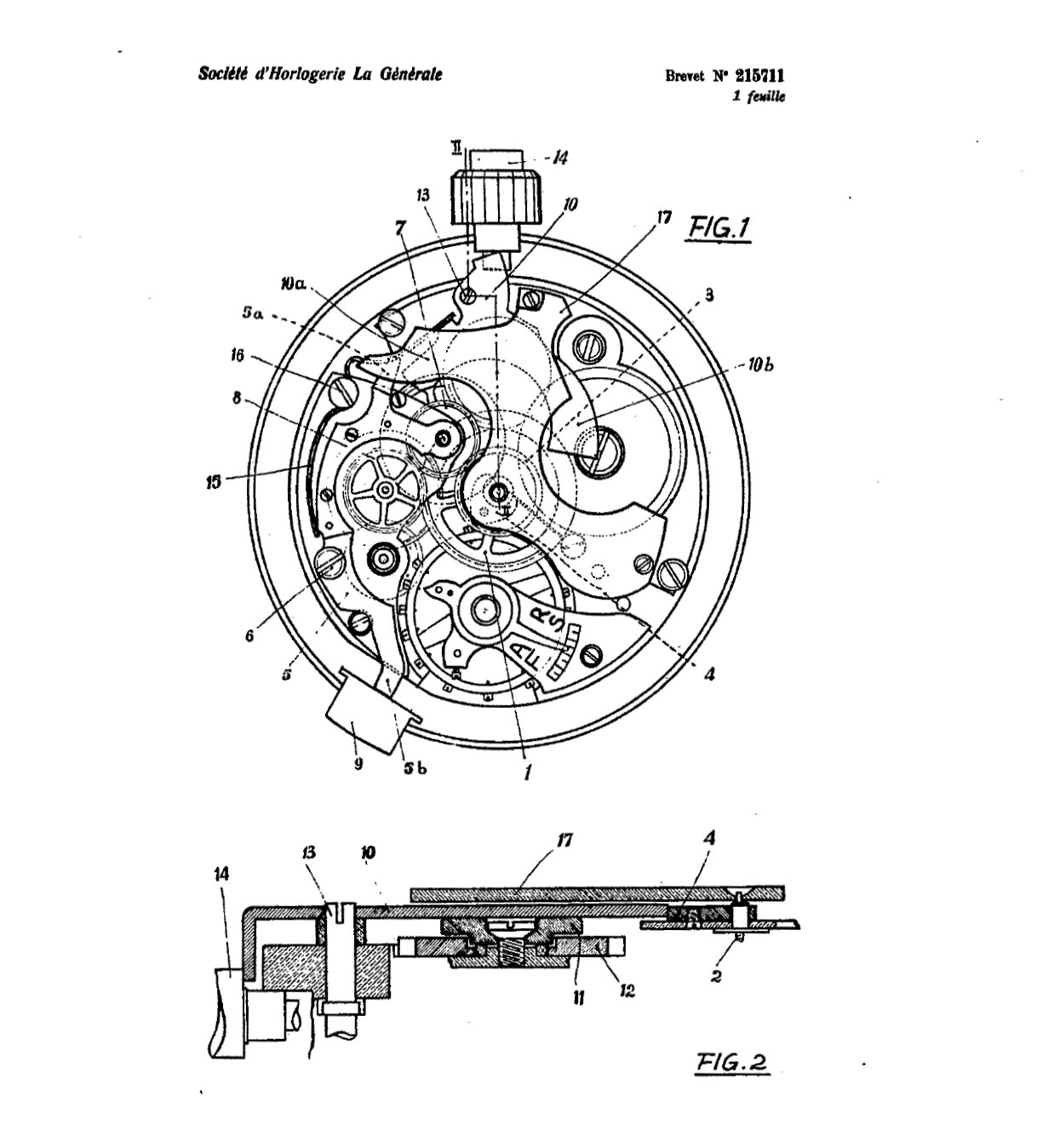
The Helvétia Stop was patented on October 23, 1940 [3].

There are several dial versions of this watch, and some have the co-axial pusher replaced by a pusher at 2 o'clock.

The movement used is the Helvétia 822 caliber, a modification of the in-house 82A caliber. The escapement features an original 3-prong shock absorber. This in-house system, patented in 1929 [4], was used by Helvétia until the late 1940s.

The Helvétia Sport was also marketed under the brand name Orator. This is a brand of Schild & Co. in La Chaux-de-Fonds, also known for its 8-day Hebdomas watches.

5. Helvétia Sport

Also presented at the Basel Fair in 1941, the Helvétia Sport "is the ideal counter for all sportsmen and women, allowing a clear, precise and rapid reading of a stage that can last up to 12 hours [5]".

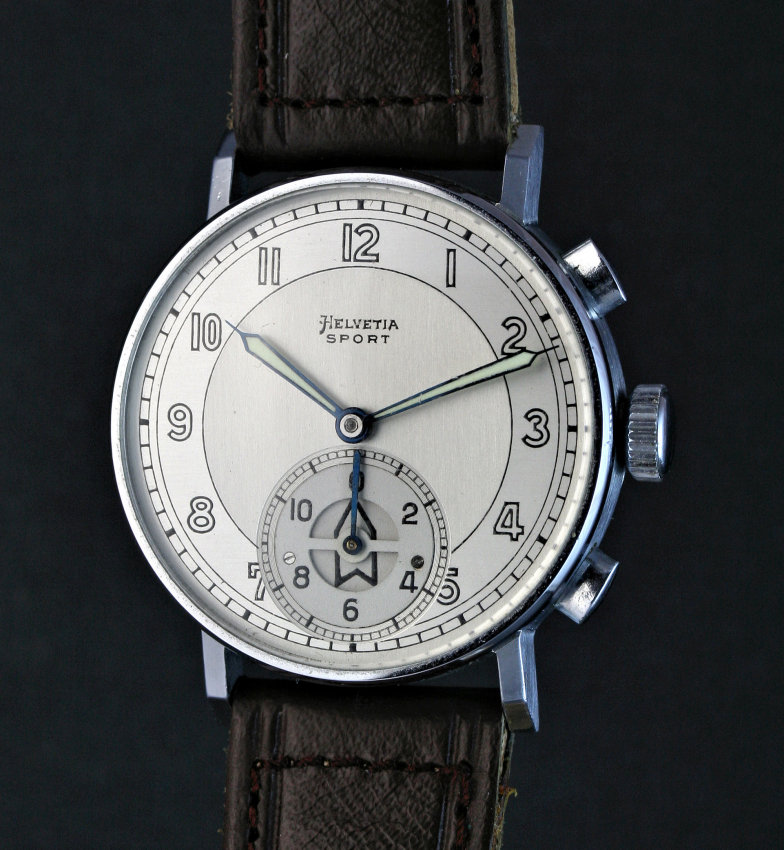
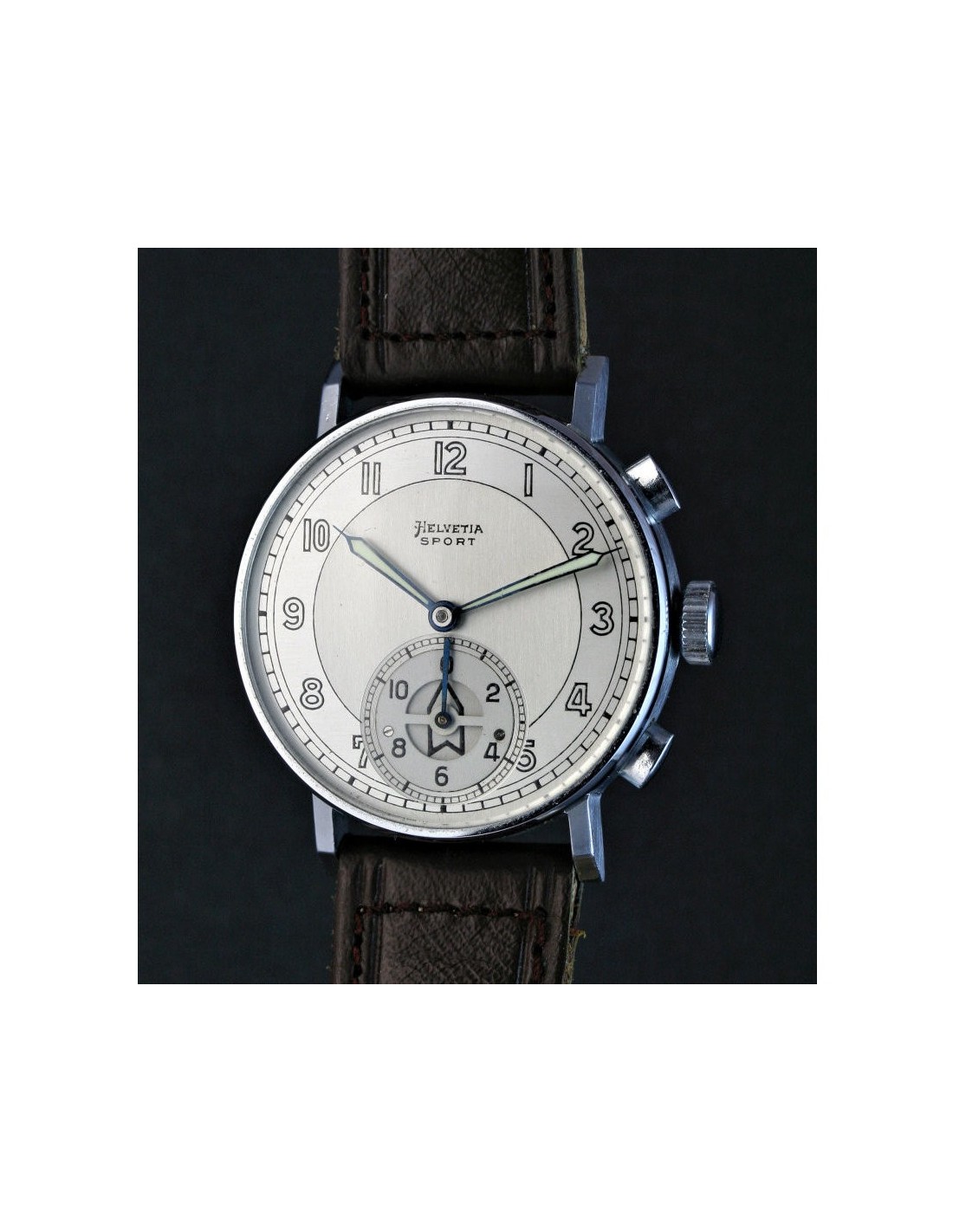
The Helvétia Sport features two pushers and a characteristic counter at 6 o'clock.

This is a special form of chrono-stop watch. The first pusher triggers the start not of a seconds counter hand, but simultaneously of a minute counter hand and a co-axial hour counter hand. This hand is replaced by an arrow-shaped disc.

It is not possible to stop the hands, for example to note a specific time. The second pusher simply resets them to zero.

The Helvétia Sport's operating principle was patented on October 1, 1940 [6]. It was co-signed by Lucien Chappuis, the company's technical director at the time.

The patent proposes a number of different designs, some of which are adapted to very attractive rectangular watches, but always with needle counters. But the text of the patent describes the version that was finally chosen for the counter: "The counter hands could be replaced by other indicating organs, for example by discs."

The basic caliber used was the same as for the Helvétia Stop, but here the mechanism is located under the dial.


Helvétia's two Stop watches had a relatively brief existence. After the Second World War, Helvétia concentrated on traditional watch ranges, and the company finally changed hands and strategy in 1961.

See also: Helvétia


[1] Revue Internationale d'Horlogerie, 1945, 11, pp. 9-15

[2] Revue Internationale d'Horlogerie, 1941, 6, p. 73

[3] Patent CH 215 711

[4] Patent CH 143 073

[5] Revue Internationale d'Horlogerie, 1941, 11, p. 25

[6] Patent CH 216 464

The archives of Fédération Horlogère, Davoine and l'Impartial are available online at www.doc.rero.ch

The archives of Journal Suisse d'Horlogerie, Europa Star, Revue Internationale d'Horlogerie and Suisse Horlogère are available at The Watch Library

The FOSC (Feuille Officielle Suisse du Commerce) is available on E-periodica

Notes :

About Time To Tell:

Time To Tell has one of the largest private digitized databases on the history of Swiss watchmaking, with over 2.3 TB of data on more than 1,000 Swiss watch manufacturers. This database has been built up over a period of some thirty years, and continues to be fed with around 50 to 100 GB of data every year. The database is made up of old documents, mainly Swiss trade journals, dating from the late 19th to the late 20th century. Most of these documents are not available on the Internet. Historical articles published on the time2tell.com website always cite the sources used.

Time To Tell is a private company, independent of any watch manufacturer.

©Time To Tell, 2025 

Reproduction forbidden without authorization.

Any use of this article by artificial intelligence is strictly forbidden and will be considered an infringement of copyright. 
Product Details

Model
Helvétia Sport
Helvétia Stop
Product added to wishlist

Nous utilisons des cookies afin de fournir une expérience utilisateur conviviale. En naviguant sur ce site, vous acceptez la politique d'utilisation des cookies.