Mido watches: Multifort, Ocean Star, and chronographs

Mido watches: Multifort, Ocean Star, and chronographs

Mido

Two major models made Mido's reputation: the Multifort and the Ocean Star. In between, Mido's superb chronographs had only a brief existence.
Description

Joël Pynson

February 2025

1. Mido Multifort

1936

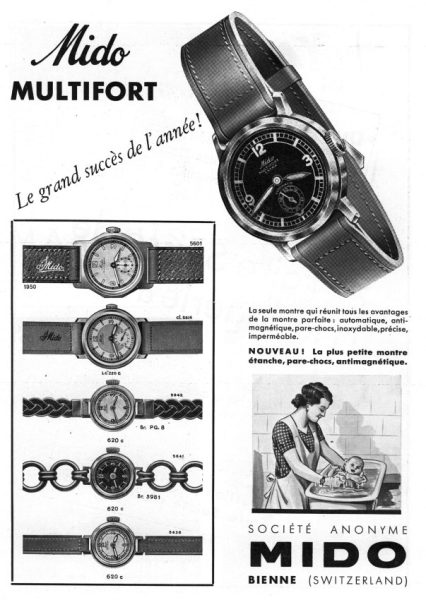
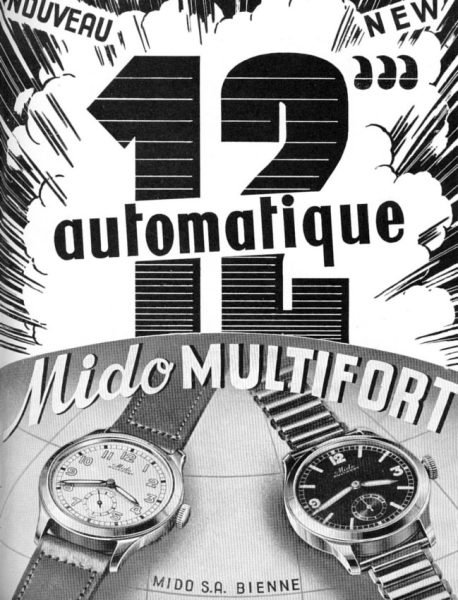
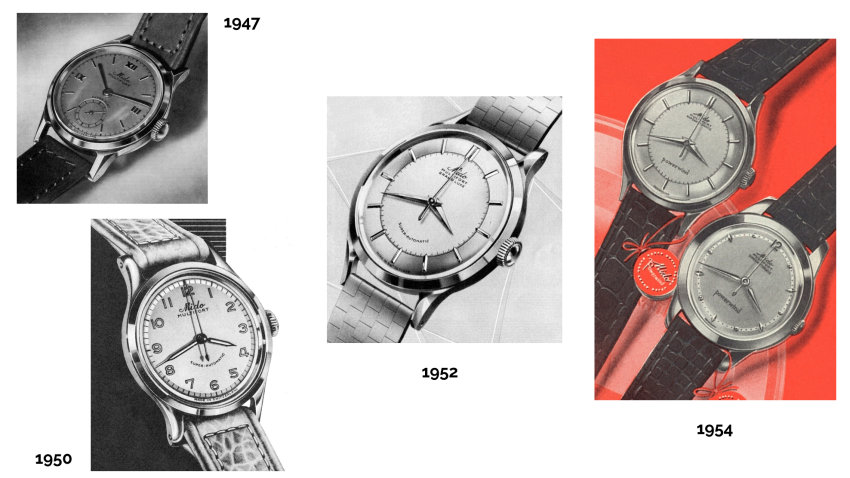
The Mido Multifort was historically the second water-resistant automatic watch to be launched, one year after the Rolex Oyster Perpetual in 1933. It even had an anti-shock system that the Rolex lacked.

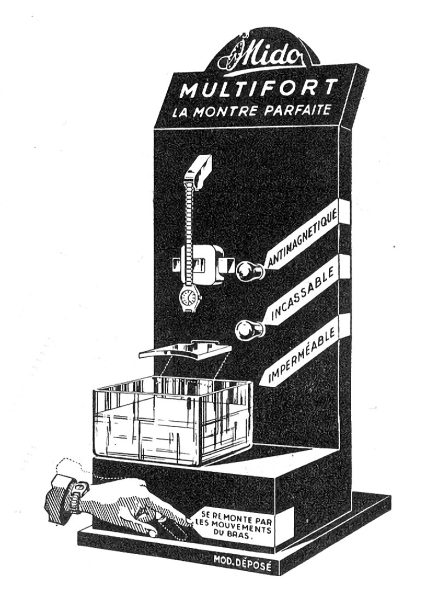
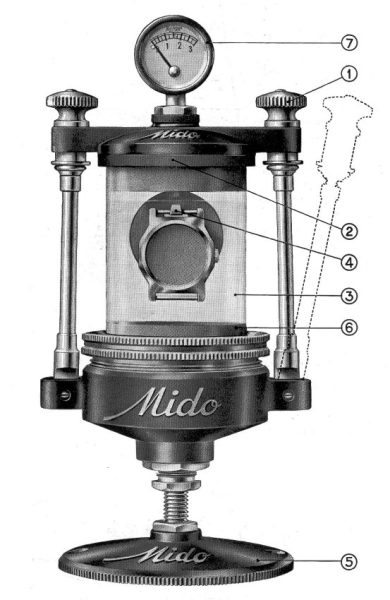
It featured all the technical refinements possible at the time: antimagnetic (beryllium bronze assortment, glucidur balance wheel and Nivarox hairspring), shockproof, watertight cases (manufactured by Taubert) and automatic movement. To demonstrate this, Mido had designed an original display unit that watchmakers could install in their showcases: the watch was subjected to the effect of a magnet, then dropped onto a metal tray before falling into the water [16]!

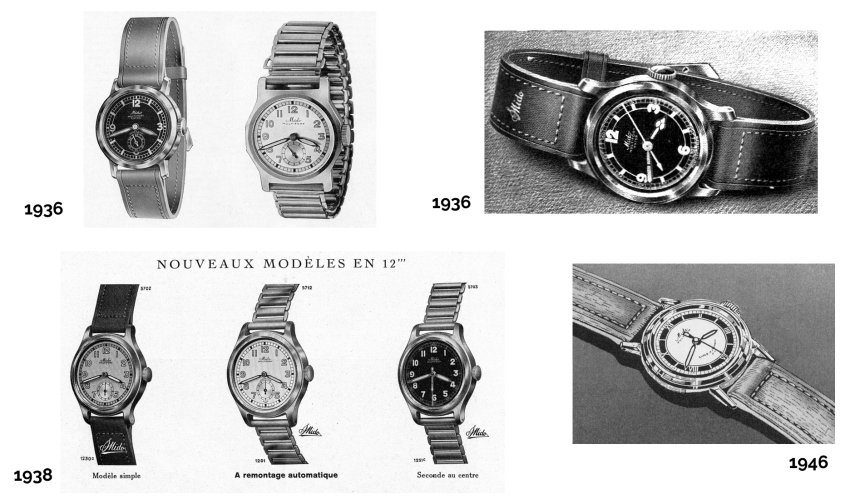
Two models were in fact available when it was launched in 1934: a “standard” model and a “luxury” model, with a dial marked “Extra”. Both models were available in automatic or hand-wound versions, and only the “luxe” was available in gold.

1938

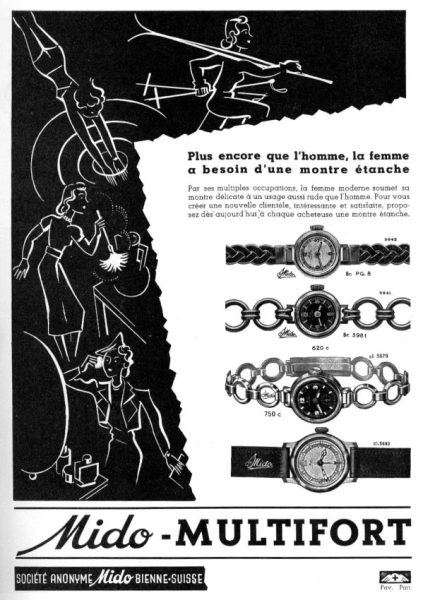
In 1936, smaller, non-automatic versions for ladies were offered, as well as a non-automatic version for men with a central second hand.

1938

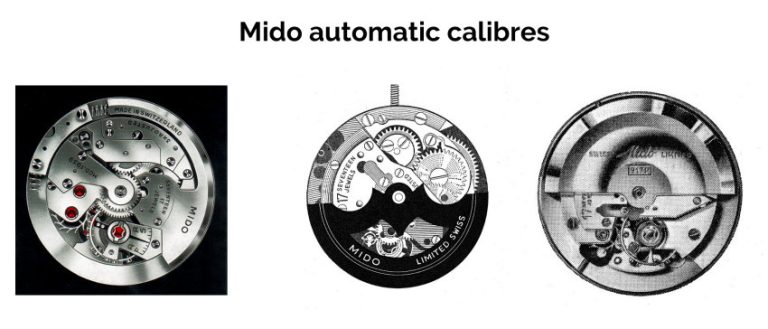
In 1938 the Multifort increased in size due to the use of new calibers with 12 lines instead of 11, and the following year Mido offered gold-plated Multiforts and square non-automatic models. It was also in 1939 that Mido named its automatic movement “Superautomatic”, derived from the A. Schild automatic calibers with stop oscillating weight, but with in-house improvements.

From 1939 onwards, Mido supplied watchmakers like Rolex with the Mido-Watertest B, a device for testing the water-resistance of watch cases up to a pressure of 3 atmospheres [17]. Special wrenches and jibs are also available for easy revision.

The Multifort then benefited from improvements in automatic calibers: a rotor to improve winding, and in 1954 the Powerwind system reducing the number of mobiles from 16 to 7, compared to calibers with oscillating masses with bumpers, to simplify the movement. Ladies were not forgotten, with the 1955 launch of an automatic model considered the smallest water-resistant automatic model of its time. Both ladies' and men's models were equipped with a date window at 3 o'clock in 1957. But these would be the last changes for Multifort, with the arrival of the Ocean Star model.

2. Mido Ocean Star

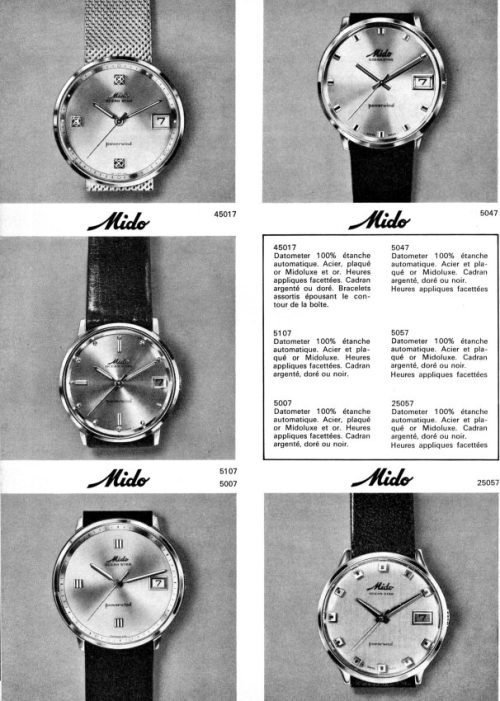
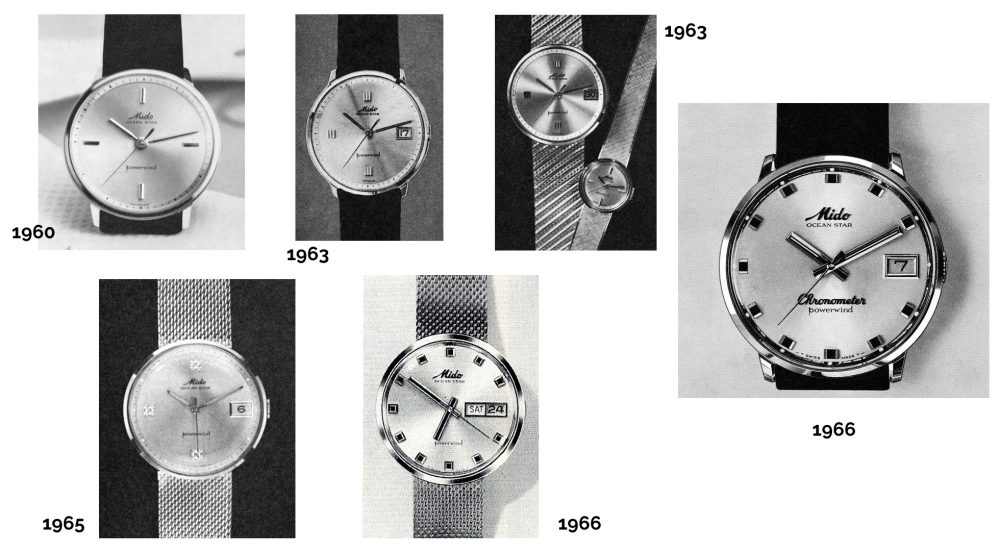
Always with the aim of improving the water-resistance of its watches, Mido launched the Ocean Star in 1959. The case is made in one piece, so there is no screw-down back, and opening is from the top. During servicing, a special key is used to remove the glass and bezel, while the crown remains in place. The same key is used to replace the glass. The watch is of course fitted with a Powerwind automatic movement, and was also available with date (Ocean Star Datometer).

The design of the Ocean Star was highly innovative: narrow lugs, a very thin bezel giving full prominence to the dial, an invisible crown embedded in the bezel, and only 4 minimalist hour markers. The date aperture was particularly large, making it unnecessary to use a magnifying glass on the crystal.

In 1963, Mido introduced a new no lug version, with the strap appearing to pass under the watch. There was also a ladies' model based on the same principle.

1966

In 1964 Mido introduced new versions with 11 indexes (the 12th was missing because of the date window), and in 1966 Day Date versions with day and date indication. It was also around 1966 that Mido launched chronometer versions of the Ocean Star, with the word “Chronometer” embossed on the dial.

In 1967, the “Commander” version was fitted with a special metal bracelet.

1968

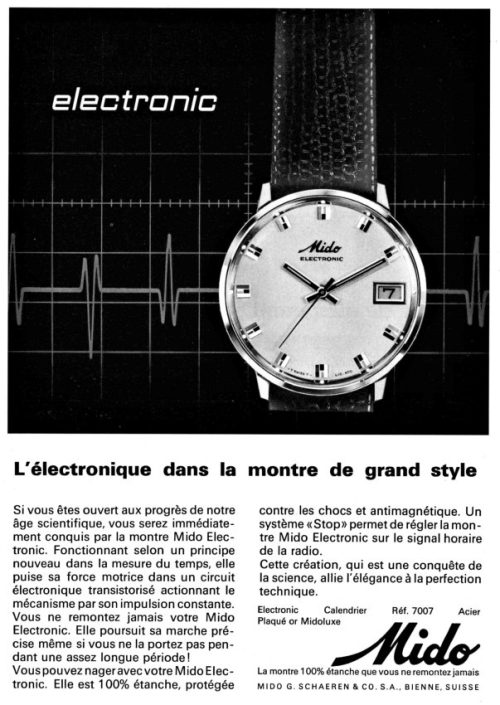
In 1968, an “Electronic” version was introduced, without the Ocean Star inscription on the dial. The watch was equipped with the ESA 9154 electronic balance-spring caliber, supplied by Ébauches SA. The following year, this model was fitted with luminescent indexes in a beautiful blue color.

From 1970 onwards, Mido offered luxurious versions of its Ocean Star model, adding semi-precious stones to the indexes. There were 5 different types: grossular (green), tiger's eye, chrysoprase (blue-green), lapis lazuli (blue) and carnelian (red) [18].

After the Executive model, the Ocean Star was fitted with “High-Beat” calibers (36,000 vph) in 1973.

In 1974, the Ocean Star was fitted with quartz movements with day and date, but the watch's design had been modified for the occasion and it had lost its discreet bezel. The following year, the design was again modified, with massive, two-tone dials that were a far cry from the original model. The automatic movements had a frequency of 28,800 vph.

A new range launched in 1979 featured very conventional designs with quartz or automatic calibers.

1982

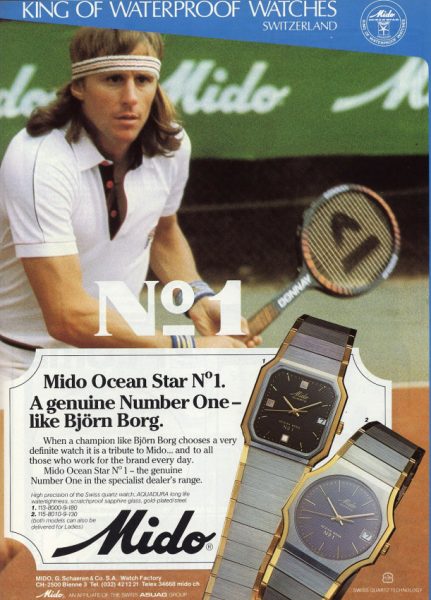
Finally, with the agreement of the world's No.1 tennis player at the time, Björn Borg, Mido launched the Ocean Star N°1 model, in steel with a plated case and sapphire crystal, with the bracelet clasp bearing the famous champion's signature.

This will be the last version before Mido joins SMH and the Swatch Group.

3. Mido chronographs

1937

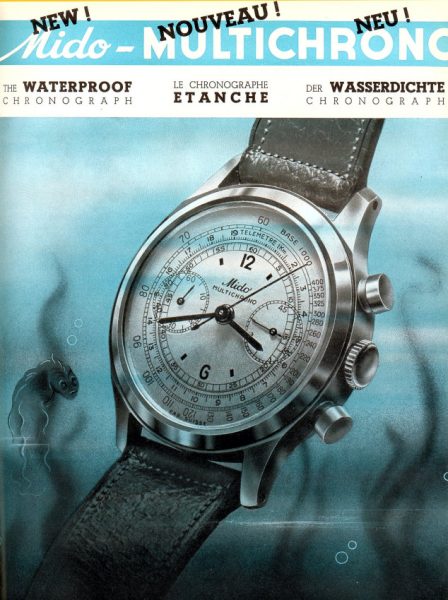
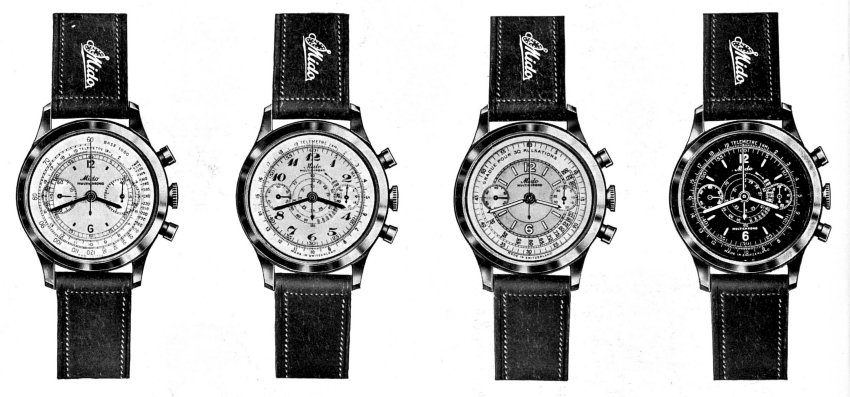
It was always the concern for water-resistance that led Mido to work on its first chronograph in 1937. The Multichrono was one of the first to be made of stainless steel and to have round pushers, making it easier to design watertight joints. Numerous dial variants were available, with different scales: tachometric, pulsometric and others.

The caliber used came from the Minerva manufacture. This is rather surprising, since Ébauches SA already offered Vénus and Landeron calibers, but Mido, although not officially a manufacture, has always remained fairly independent of Ébauches SA, using it as a supplier but modifying its movements. It's worth noting that the Multichrono was equipped with an anti-shock system right from the start.

1942

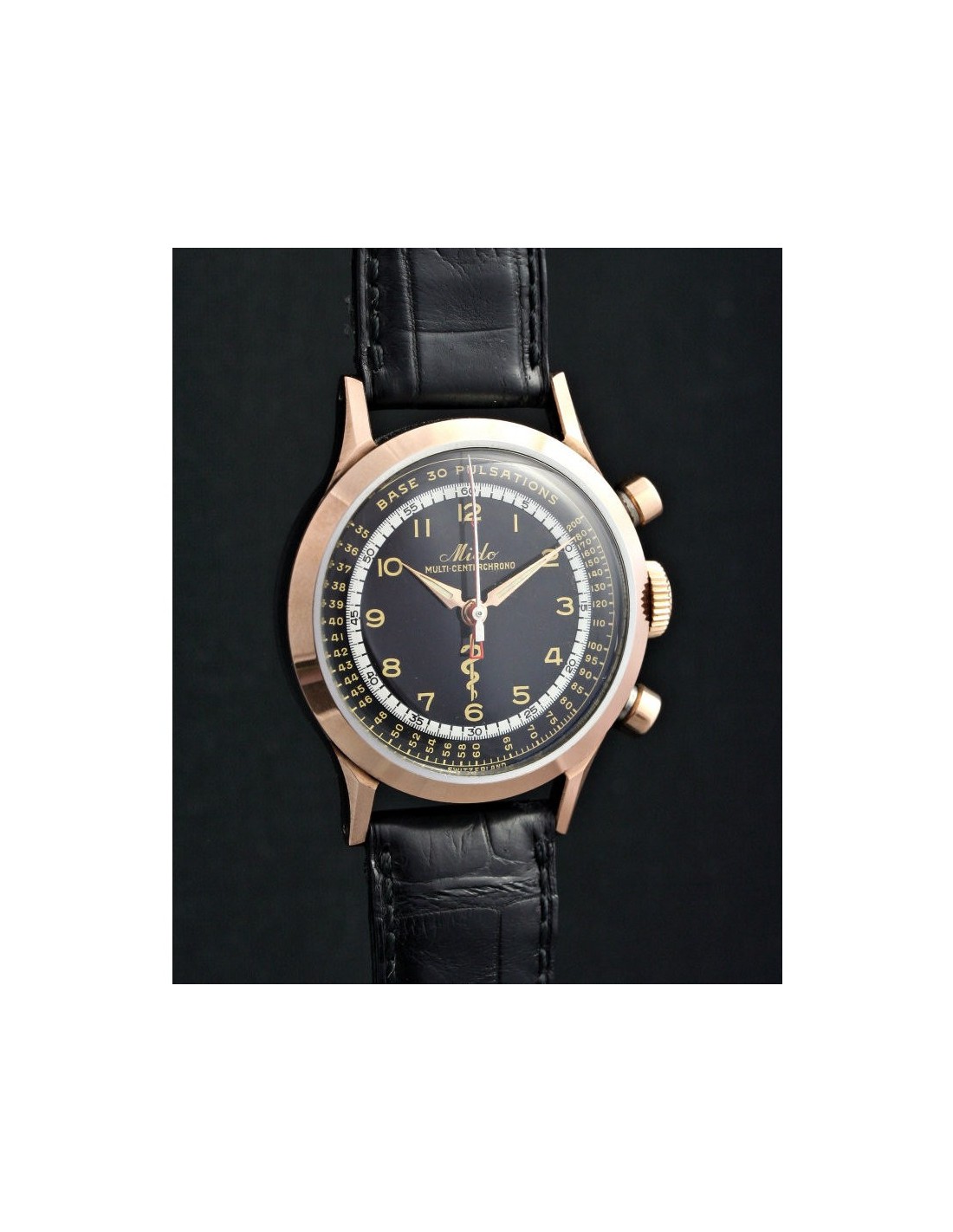
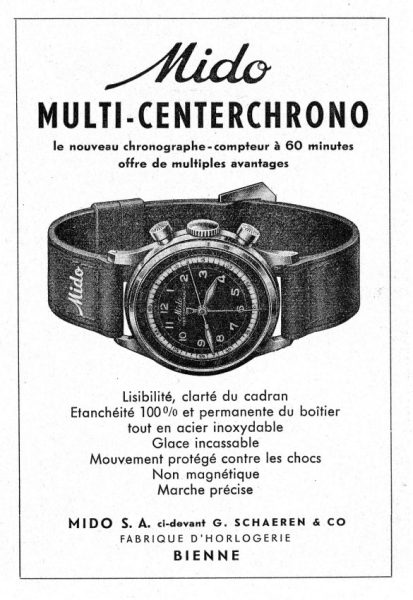
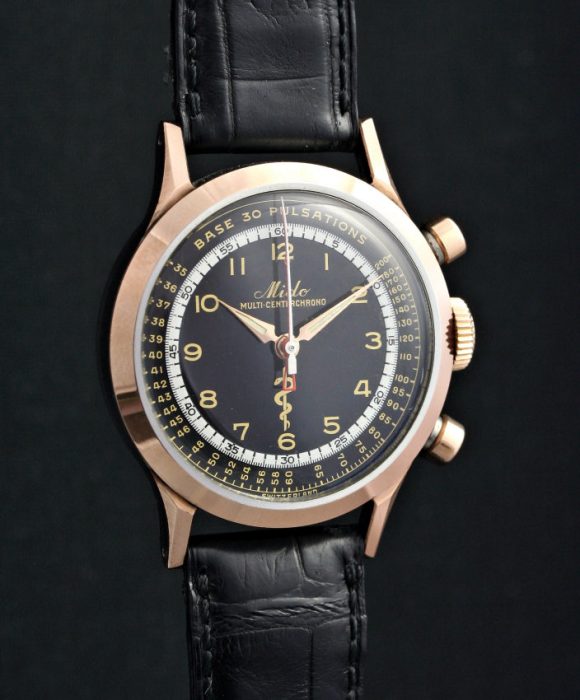
Mido's most famous chronograph, the Multicenterchrono, was launched in 1942. It owes its particularity to its central minute counter and the absence of small seconds: the dial is thus similar to that of an ordinary watch, apart from the metric scales on the periphery. The case, from the famous manufacturer Taubert, successor to Borgel in Geneva, was of course water-resistant.

Here again, the caliber did not come from Ébauches SA but from Valjoux [19]. It was modified to have the minute counter in the center, and was called Mido 1300.

Like the Multichrono, the Multicenterchrono existed with multiple dial variants, in different colors, and with different metric scales. The Multicenterchrono was produced for around ten years and never really had a successor: it wasn't until 1974 and the availability of the Valjoux 7750 automatic chronograph that new chronograph models appeared in the Mido ranges.


[16] Journal Suisse d'Horlogerie, 1936, 3, p. 33

[17] Journal Suisse d'Horlogerie (Genève), 1939, 7, hors texte

[18] Journal Suisse d’Horlogerie, 1970,

[19] Valjoux only joined the Ébauches SA trust in 1944.

All sources used are referenced. However, this does not preclude errors or omissions. Any comments are welcome, and readers can contact us at timetotell@orange.fr

Notes :

About Time To Tell: Time To Tell has one of the largest private digitized databases on the history of Swiss watchmaking, with over 2.3 TB of data on more than 1,000 Swiss watch manufacturers. This database has been built up over a period of around 30 years and continues to be updated with around 50 to 100 GB of data each year. The database consists of old documents, mainly Swiss trade journals, dating from the late 19th century to the late 20th century. Most of these documents are not available on the Internet. The historical articles published on the time2tell.com website always cite the sources used.

Time To Tell is a privately owned company, independent of any watch manufacturer.

©Time To Tell, 2025

Reproduction prohibited without permission.

Any use of this article by artificial intelligence is strictly prohibited and will be considered a violation of copyright. 

Product Details

Product added to wishlist

Nous utilisons des cookies afin de fournir une expérience utilisateur conviviale. En naviguant sur ce site, vous acceptez la politique d'utilisation des cookies.