The true story of MIMO watches

The true story of MIMO watches

Mimo

The Manufacture Internationale de Montres en Or (MIMO) is the originator of some remarkable models. But after MIMO acquired the famous Girard-Perregaux manufacture, the MIMO brand was gradually abandoned.
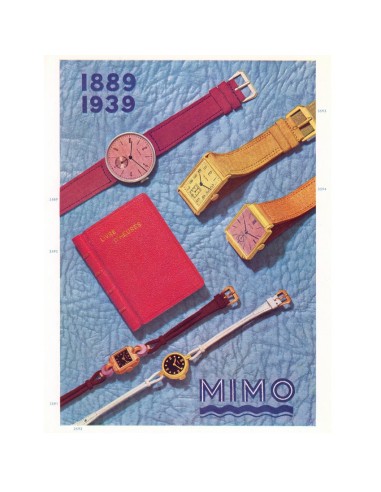
Description

Joël Pynson

March 2025

1. The Graef dynasty

From Germany, Wilhelm Otto Graef settled in La Chaux-de-Fonds in the early 1880s [1]. In 1889, he set up his own company, which he registered the following year [2].

Thanks to his international connections, the company flourished. In 1913, the trademark Manufacture Internationale de Montres en Or (MIMO) is registered.

In 1919, Otto Graef joined forces with his sons Willy, Paul and Jean, and the company became Graef et Cie, Fabrique Mimo. [3]

In 1923, Jean Graef left for the United States to set up a sales office that quickly became one of the most important in New York. It was probably thanks to the American market that MIMO overcame the crisis of the 1920s in Switzerland.

1927

In 1930, the famous Girard-Perregaux et Cie factory was in dire straits, and Otto Graef and his son Paul bought it [4].

2. MIMO and Girard-Perregaux

The Girard-Perregaux brand lay dormant for ten years. For MIMO, on the other hand, the 1930s and early 1940s were a period of impressive creativity. New models followed one another in rapid succession, with original technical solutions and high-quality manufacture calibers.

1939

But this golden age came to an end in 1940, when the Girard-Perregaux brand was relaunched. A few MIMO models were still offered, but the brand gradually disappeared: it was no longer promoted from 1944 onwards.

The death of Otto Graef in 1948 signaled the demise of the MIMO brand, which was definitively confirmed in 1962 when the Mimo factory was absorbed by Girard-Perregaux et Cie [5].

An article on the main MIMO watch models can be found here.


[1] Journal Suisse d'Horlogerie, 1940, 5-6, pp. 132-134

[2] FOSC 1890

[3] FOSC 1919

[4] FOSC 1930

[5] FOSC 1962

Notes :

About Time To Tell: Time To Tell has one of the largest private digitized databases on the history of Swiss watchmaking, with over 2.3 TB of data on more than 1,000 Swiss watch manufacturers. This database has been built up over a period of some thirty years, and continues to be fed with around 50 to 100 GB of data every year. The database is made up of old documents, mainly Swiss trade journals, dating from the late 19th to the late 20th century. Most of these documents are not available on the Internet. Historical articles published on the time2tell.com website always cite the sources used.

Time To Tell is a private company, independent of any watch manufacturer.

©Time To Tell, 2025 

Reproduction forbidden without authorization.

Any use of this article by artificial intelligence is strictly forbidden and will be considered an infringement of copyright.

Product Details

Product added to wishlist

Nous utilisons des cookies afin de fournir une expérience utilisateur conviviale. En naviguant sur ce site, vous acceptez la politique d'utilisation des cookies.